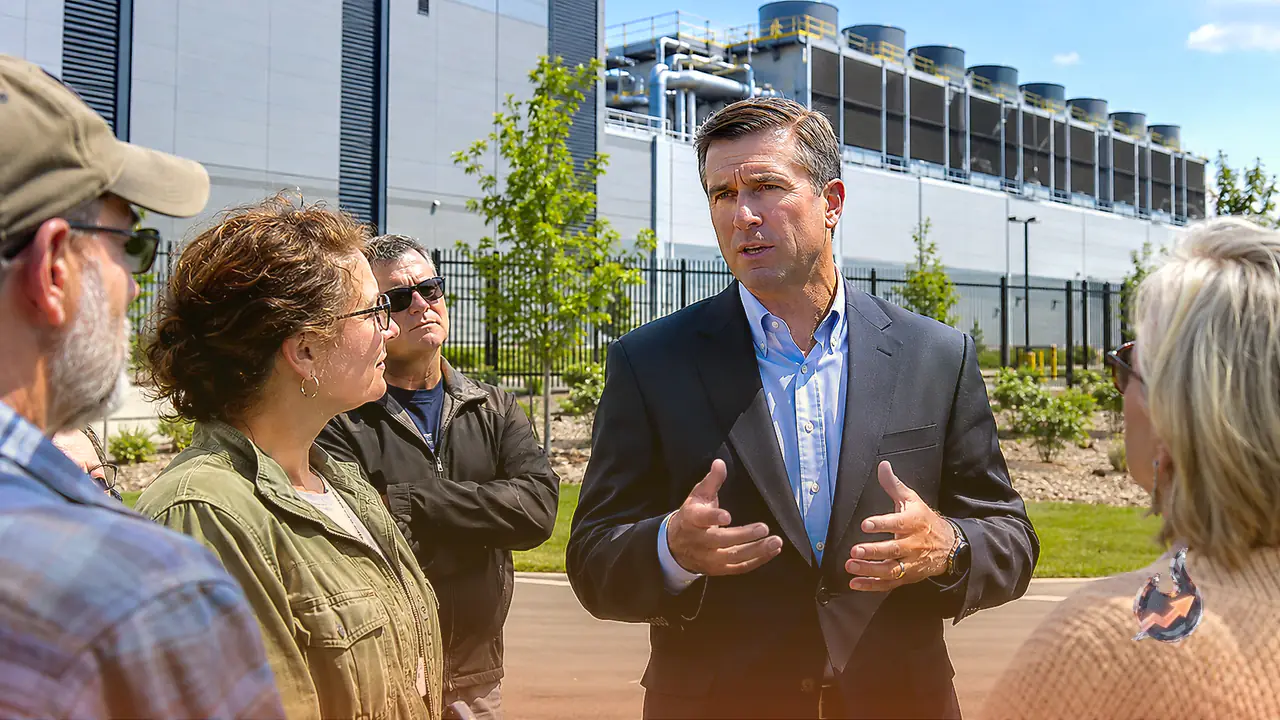

A former member of the Democratic Socialists of America who helped launch the Sunrise Movement, Lawrence built his entire campaign around staunch opposition to data centers. Months before other contenders recognized the issue, he made it the core of his platform. This strategy helped him win a tough primary in Michigan’s 7th Congressional District against heavily funded opponents, culminating in his victory this week over incumbent Republican Tom Barrett in one of the nation's costliest House races. During the contest, Elon Musk’s America PAC contributed $340,000 to oppose his candidacy.
The Economic and Political Impact of Data Centers
Reflecting on the election, Lawrence pointed out that the entire race boiled down to two major headlines: escalating costs and systemic corruption. Data centers directly drive up expenses while embodying the legalized corruption that has become routine in a rigged economic system. These facilities claim tax breaks, drain massive amounts of water, propose consuming double or triple the total grid capacity in Michigan, and threaten the property values of local homeowners.
This dynamic persists because the playing field heavily favors mega-corporations over local communities. Whenever residents attempt to exert local oversight and community control, Silicon Valley companies challenge them in court. This political and economic order favors a wealthy few at the expense of the majority, making a mockery of democracy. Citizens are forced into a constant battle against individual projects, proving that decisions are made by elites in Silicon Valley, Wall Street, and Washington rather than the public.
Tech Industry Promises and Public Skepticism
Recent weeks have seen numerous announcements from major tech companies promising greater transparency, reduced water usage, and the elimination of non-disclosure agreements, including commitments released by OpenAI the day after the election. Regarding these compromises, Lawrence noted that while he has not examined the specific proposals, feeling the pressure is a positive step. However, he stated that the offerings presented so far are entirely inadequate and winning back public trust will require substantial effort.
Just a week before the election, a new hyperscale data center was proposed in Delhi Township, south of Lansing, near Mason. A local economic development agency and a prospective developer announced plans for a six-month community engagement process before deciding to build. In response, the township board hastily organized an emergency meeting where over two hundred and fifty residents overflowed the venue, ultimately reaffirming their opposition to the project.
Policy Goals and Regulatory Actions in Washington
Upon taking office in Washington in January, Lawrence plans to advocate for a federal data center moratorium alongside a temporary pause on advanced AI development. He stated that the risks simply do not match the benefits at this time. When asked if this pause would mirror the proposal by Senator Bernie Sanders, which is contingent on AI safety regulations, he confirmed that safety must include protecting people and the planet from data center expansion.
Lawrence also emphasized the need to utilize investigatory and oversight levers, drawing a comparison to manufacturing standards. He noted that if an automotive company like GM released a vehicle with a one percent chance of exploding on the highway, it would face immediate lawsuits and ruin. Yet, tech companies develop products with severe planetary risks without facing adequate accountability, which he termed reckless endangerment under consumer protection standards.
Broader Developments and Protests
Meanwhile, the political fallout from the election continues to reverberate across various sectors. Environmental groups have reportedly initiated discussions with technology firms to establish standards for data centers covering emissions and community engagement. Additionally, reports indicate that Interior Secretary Doug Burgum stands to benefit from potential data center expansions on public lands. In Europe, anti-data-center activism reached a peak as protesters breached a Microsoft construction site in Amsterdam amid a wider wave of demonstrations.