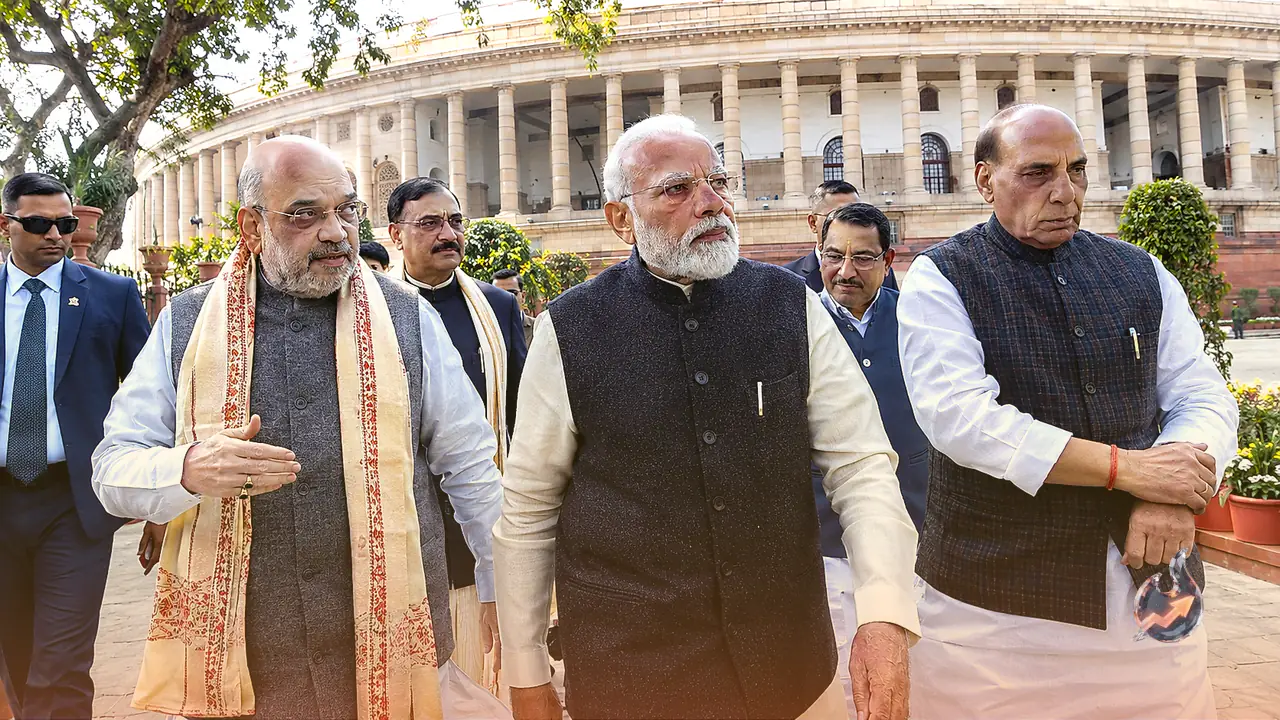

Political momentum in the national capital has accelerated rapidly following high-level directives within the Union Cabinet. During a recent cabinet meeting chaired by Prime Minister Narendra Modi, clear indications were given regarding the early summoning of the upcoming parliamentary session. The Prime Minister specifically instructed cabinet colleagues to streamline all operational and legislative preparations, anticipating that the session could be convened prior to December 15. Furthermore, ministers have been advised to refrain from scheduling foreign travel in the lead-up to the session and to maintain their presence in Delhi. These instructions strongly suggest that the government intends to convene either the winter session or a targeted session during the first fortnight of December.
103 Days Without Prorogation Amid Legislative Uncertainty
The operational background surrounding this upcoming session is procedural and politically significant. On August 13, both houses of Parliament were adjourned sine die following the conclusion of the monsoon session. However, even after more than 103 days, no formal notification of prorogation had been issued by Wednesday night. This extended delay has drawn sharp criticism from opposition parties, who argue that keeping the houses in continuous adjournment without prorogation undermines established parliamentary norms. The absence of a formal prorogation order has fueled intense speculation that the executive may bypass routine winter session scheduling to call a specialized session aimed at taking up major constitutional measures.
The Mathematical Reality of Delimitation and Women's Reservation
Central to the discussions surrounding the early session is the potential introduction of the delimitation-linked Women's Reservation legislation, structured under the Constitution (131st Amendment) Bill, 2026. This legislative initiative previously failed to secure adequate support during a special parliamentary session convened on April 17. Securing passage for a constitutional amendment requires a stringent two-thirds majority of members present and voting in the house.
In the current 543-member Lok Sabha, three seats remain vacant, leaving an effective strength of 540 members. To successfully pass the constitutional amendment bill, the government requires the explicit support of at least 361 members. The ruling National Democratic Alliance (NDA) currently holds 320 seats. Consequently, even with complete internal cohesion, the ruling coalition remains 41 votes short of the requisite two-thirds threshold, making external backing essential.
Realigned Parliamentary Numbers Strengthen Ruling Coalition
Despite the steep numerical requirement, shifts in political alliances since April have materially improved the government's position. Approximately 26 members of parliament previously aligned with opposition benches have shifted their allegiances. Specifically, a group of 20 rebel parliamentarians from the Trinamool Congress broke away to form the Nationalist Citizens Party of India (NCPI) and subsequently pledged formal support to the NDA alliance. Additionally, six members belonging to the Shiv Sena (Uddhav Balasaheb Thackeray) faction defected to join the Shiv Sena faction led by Chief Minister Eknath Shinde.
These developments have bolstered NDA floor strength to 320 members. Nevertheless, to cross the 361-vote mark, the management of parliamentary business will require additional voting support. Regional parties with sizable blocs, including the Dravida Munnetra Kazhagam (DMK) with 22 members and the Nationalist Congress Party (Sharadchandra Pawar) with eight members, are expected to play crucial roles in floor strategy negotiations.
Opposition Confrontation and Proposed Delimitation Models
Beyond vote counts, the upcoming session faces procedural hurdles due to mounting political friction. Opposition blocs have intensified their campaign against the Special Summary Revision (SIR) electoral roll process, while demanding the immediate resignation of Chief Election Commissioner Gyanesh Kumar. Given these adversarial positions, parliamentary sessions are anticipated to experience substantial disruption. Government strategists acknowledge that conducting detailed debate and voting on complex constitutional amendments will require sustained order on the house floor.
From a procedural standpoint, resuming the currently adjourned session requires a minimum of two days' notice, whereas summoning a completely new session mandates a 14-day advance notification window. Meanwhile, policy discussions are underway to resolve regional concerns over constituency delimitation, particularly from southern states. A proposed framework under consideration involves expanding total Lok Sabha seats across all states by 50 percent while maintaining state-level representation ratios based on the 1971 census. Although no final consensus has been finalized, the Cabinet Committee on Parliamentary Affairs is scheduled to finalize the exact dates and agenda for the session shortly.