

















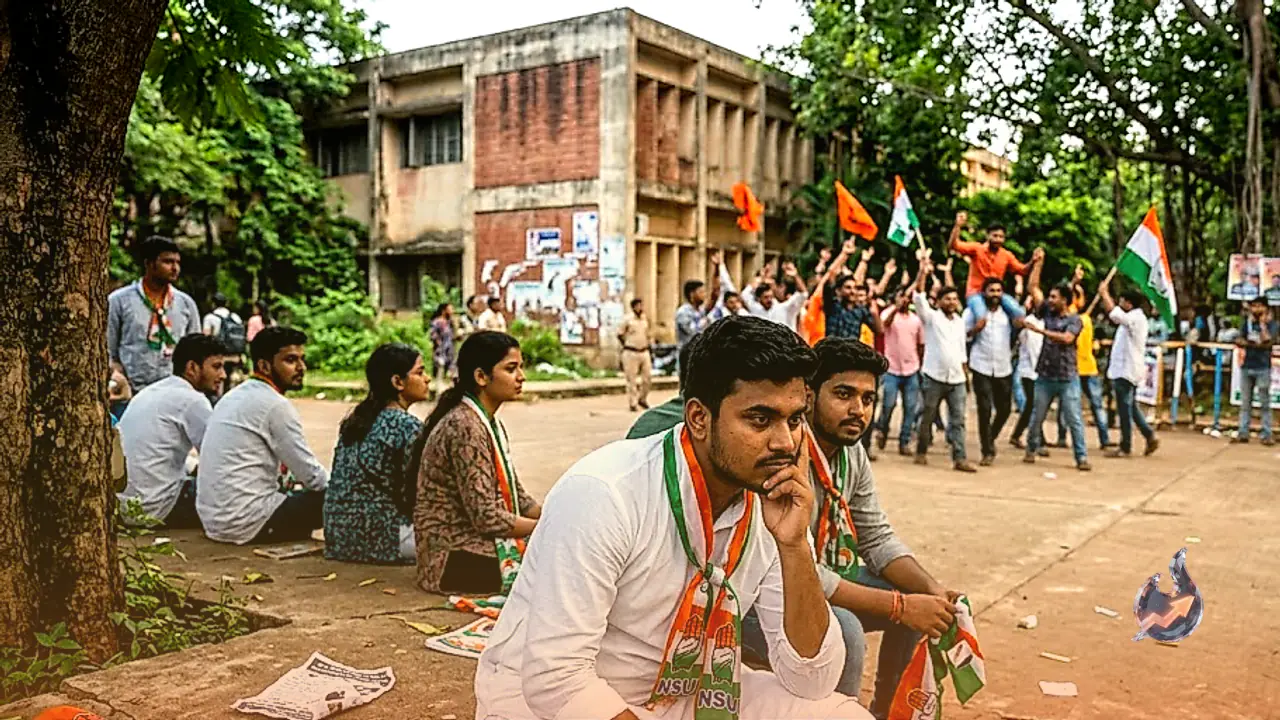

Congress parliamentarian Rahul Gandhi has consistently sought to center his public outreach on youth, student welfare, and academic concerns. He frequently visits various higher education campuses, spearheading initiatives designed to engage directly with young scholars. Although these public engagements often draw substantial crowds of students, a stark divergence invariably appears when those same individuals head to the ballot boxes. This electoral disconnect was vividly demonstrated in Odisha, where the student union elections held after a gap of eight years yielded deeply disappointing results for the Congress party student wing, the National Students Union of India.
The Return of Campus Politics After Eight Years
Student union elections across 346 colleges and 13 universities in Odisha were conducted on October 15. The state had not witnessed formal student union elections since 2017, marking a significant hiatus of eight years before campus politics officially resumed. Although these institutional contests are not formally contested directly under party symbols, major political formations actively back their aligned student organizations and preferred candidates behind the scenes. The recent electoral contest in the state featured a fierce triangular dynamic involving the major ideological factions, with the ruling dispensation and regional opposition actively vying for dominance.
ABVP Dominance Across Major Universities
The Akhil Bharatiya Vidyarthi Parishad, which shares deep ideological ties with the Rashtriya Swayamsevak Sangh, stamped its authority firmly across the state's educational institutions. Diptimayee Pratihari, the secretary of the ABVP unit in Odisha, publicly stated that her organization secured victories in 8 out of the 13 universities across the state. According to organizational figures released by the student body, ABVP won 8 presidential posts, 8 vice-presidential seats, 10 secretary positions, and 11 joint-secretary posts. Furthermore, the student outfit claimed a complete clean sweep of the entire panel at Utkal University, alongside victories in nearly all key positions at Ravenshaw University except for the presidency.
Claims From BCDJ and NSUI Camps
Meanwhile, the student wing of the regional opposition Biju Janata Dal, known as the Biju Chhatra Janata Dal, contested the narrative by asserting its own widespread success. Ipsita Sahu, the president of BCJD, maintained that her organization captured between 55 to 60 percent of the total seats across college student unions in the state. Sahu highlighted that BCJD secured crucial wins in prominent institutions including Rama Devi Women's University and Ravenshaw University, while also claiming dominance in the majority of women's colleges across Odisha. Conversely, despite the broader electoral setbacks for the Congress affiliate, NSUI leaders countered that their candidates managed to win the presidential post in 30 different colleges while finishing as runners-up in roughly 80 other institutions.
National Leadership Weighs In on Results
The outcome of these campus elections elicited strong political commentary from the highest echelons of national governance. Union Home Minister Amit Shah took to the social media platform X to congratulate the ABVP, characterizing their electoral performance as a resounding rebuff to anti-national forces. Shah emphasized that successive victories by the student organization in institutions ranging from Punjab University and Delhi University to Odisha convey a clear message that the nation's youth stand firmly aligned with a nation-first ideology. He explicitly targeted political elements that he accused of spreading falsehoods and chaos, framing the student verdicts as a validation of nationalist principles.
Echoing these sentiments, Odisha Chief Minister Mohan Charan Majhi attributed the success of the student body directly to the deep confidence that young demographics repose in Prime Minister Narendra Modi. Majhi asserted that the campus election outcomes serve as a strong indicator of the prevailing political inclination among the Gen Z demographic. Despite continuous outreach efforts by opposition leaders to mobilize student support, the ground-level outcomes in Odisha underscore the distinct challenges facing their organizational grassroots apparatus in key educational hubs.