


















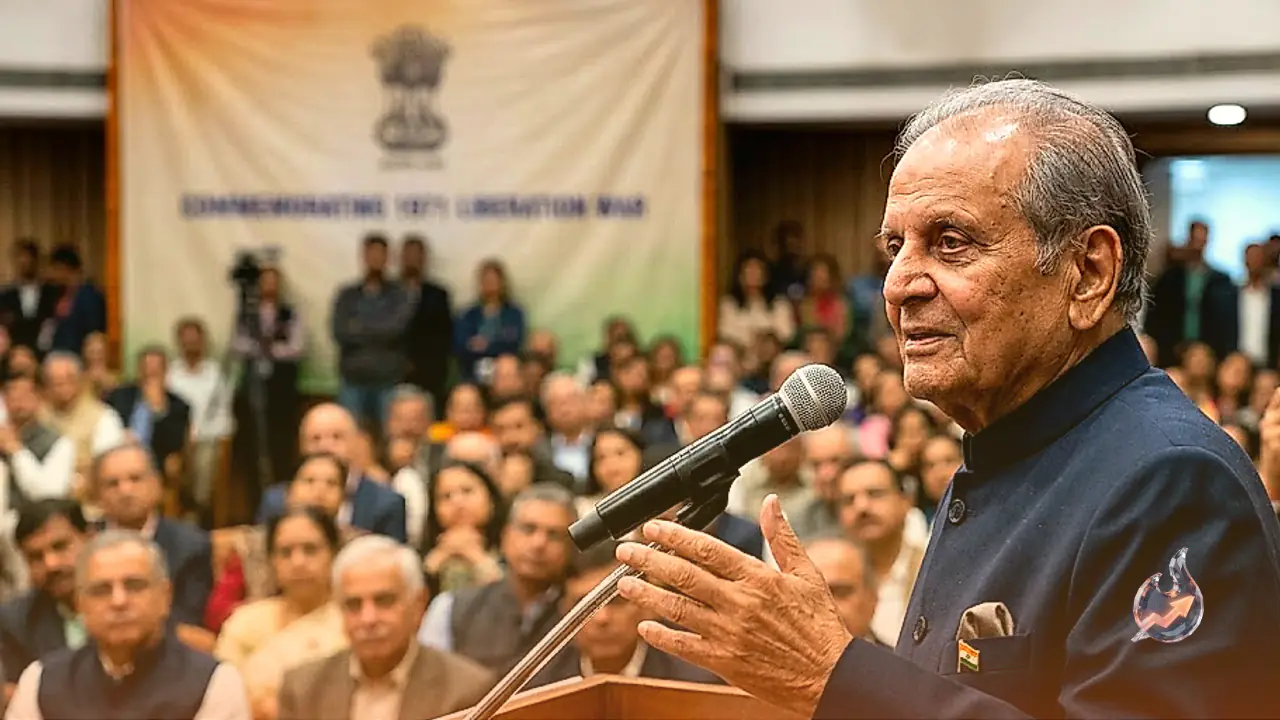

Dr. Karan Singh, the sole surviving cabinet minister from Prime Minister Indira Gandhi's 1971 administration, has shared detailed personal recollections regarding the liberation of Bangladesh and the decisive 1971 Indo-Pakistani War. Reflecting on the historic emergence of Bangladesh as a sovereign state, he expressed that the present generation can scarcely grasp the overwhelming jubilation that swept across India in December 1971. He emphasized the fundamental contribution of Sheikh Mujibur Rahman, remarking that without his visionary leadership, Bangladesh might never have come into existence.
Anguish Over Destruction of Sheikh Mujib Statue in Bangladesh
Expressing profound concern over recent political developments in Bangladesh, Dr. Karan Singh recounted his distress upon viewing broadcast footage showing individuals using hammers to vandalize a statue of Sheikh Mujibur Rahman. Describing the spectacle as a deep emotional shock, he drew a direct comparison to how citizens in India would feel if a statue of Mahatma Gandhi were desecrated. He stressed that the people and leadership of both nations must preserve and respect the shared historical legacy that redefined the geopolitical landscape of South Asia.
East Pakistan Humanitarian Crisis and 1971 War Strategy
Recalling the turbulent events leading up to the conflict, Dr. Karan Singh explained that widespread military atrocities committed by General Tikka Khan in East Pakistan forced millions of traumatized civilians to seek refuge across the Indian border. As the refugee influx escalated into millions, immense socio-economic strain was placed on India, generating widespread public anticipation for decisive military intervention by Prime Minister Indira Gandhi. However, acting on strategic counsel from Army Chief General Sam Manekshaw, Indira Gandhi opted for calculated patience, delaying direct military operations until operational conditions and weather timing were fully advantageous.
15-Day Decisive Campaign and Surrender of 93,000 Pakistani Soldiers
Once conditions aligned, the combined forces of the Indian Armed Forces and the Mukti Bahini launched a swift and coordinated multi-axis offensive. The military campaign reached a conclusive outcome within a remarkably brief span of 15 days. On 16 December 1971, a historic milestone was established when Pakistani commander General Niazi formally executed the instrument of surrender before Indian commander General Jagjit Singh Arora in Dhaka. This decisive defeat resulted in approximately 93,000 Pakistani military personnel laying down their arms before the Indian military, marking the largest formal capitulation in post-World War II history.
Indira Gandhi's Historic Announcement in Lok Sabha
Dr. Karan Singh vividly recounted the emotional atmosphere inside Parliament during the announcement of victory and Bangladeshi independence. He noted that Prime Minister Indira Gandhi was renowned for maintaining strict composure and rarely displayed public emotion. However, on that monumental afternoon, she entered the Lok Sabha chamber with visible urgency, almost running toward the podium, to request permission from the Speaker for an urgent announcement. As silence enveloped the chamber, Indira Gandhi declared that the Indian Armed Forces and Mukti Bahini had secured complete victory, liberating Dhaka as the capital of an independent nation.
Refuge to Sheikh Hasina and Future of Bilateral Relations
The announcement triggered instantaneous jubilation across the Lok Sabha and set off celebratory gatherings throughout India. Dr. Karan Singh observed that December 16 represented far more than a battlefield success, standing as a pivotal moment that altered the history of South Asia. Turning to present diplomatic matters, he addressed the presence of Sheikh Hasina in India, highlighting that she is the surviving daughter of Sheikh Mujibur Rahman. He affirmed that India has a longstanding humanitarian tradition of granting shelter and sanctuary to those facing peril, adding that any decision regarding her eventual return remains strictly her personal choice. He concluded by reminding the government and populace of Bangladesh to honor India's historical role in their nation's birth.