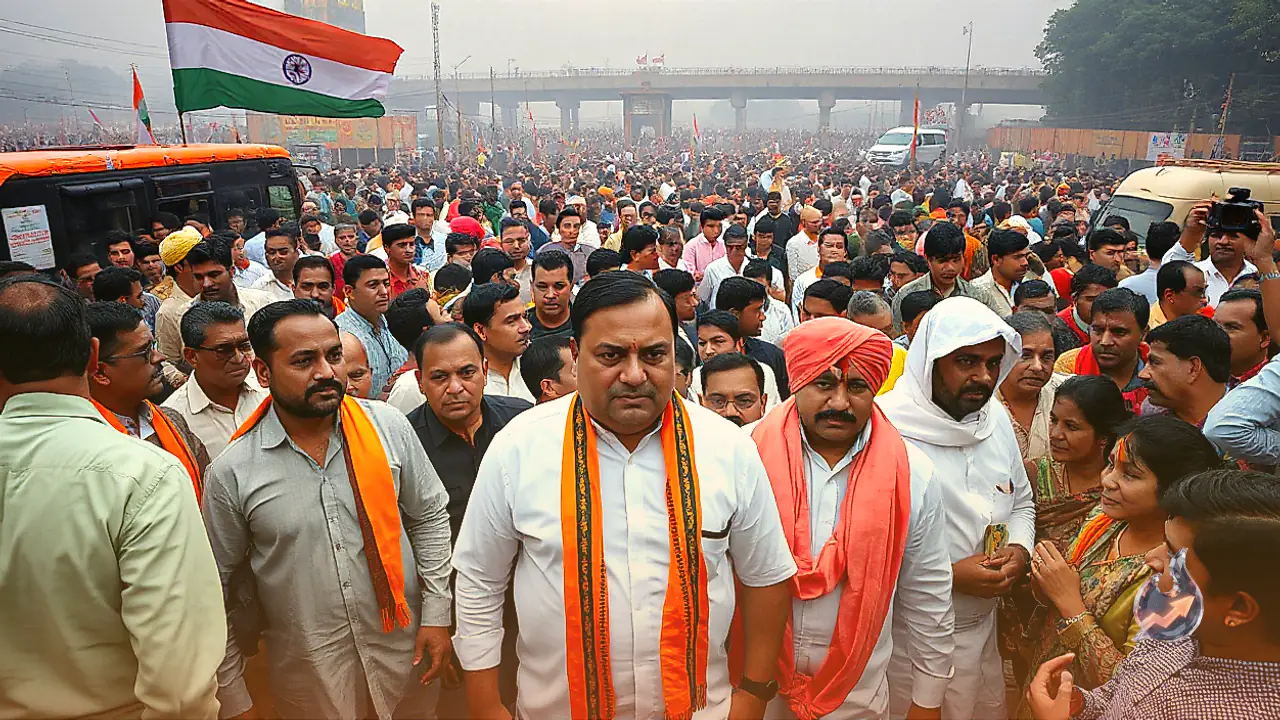

















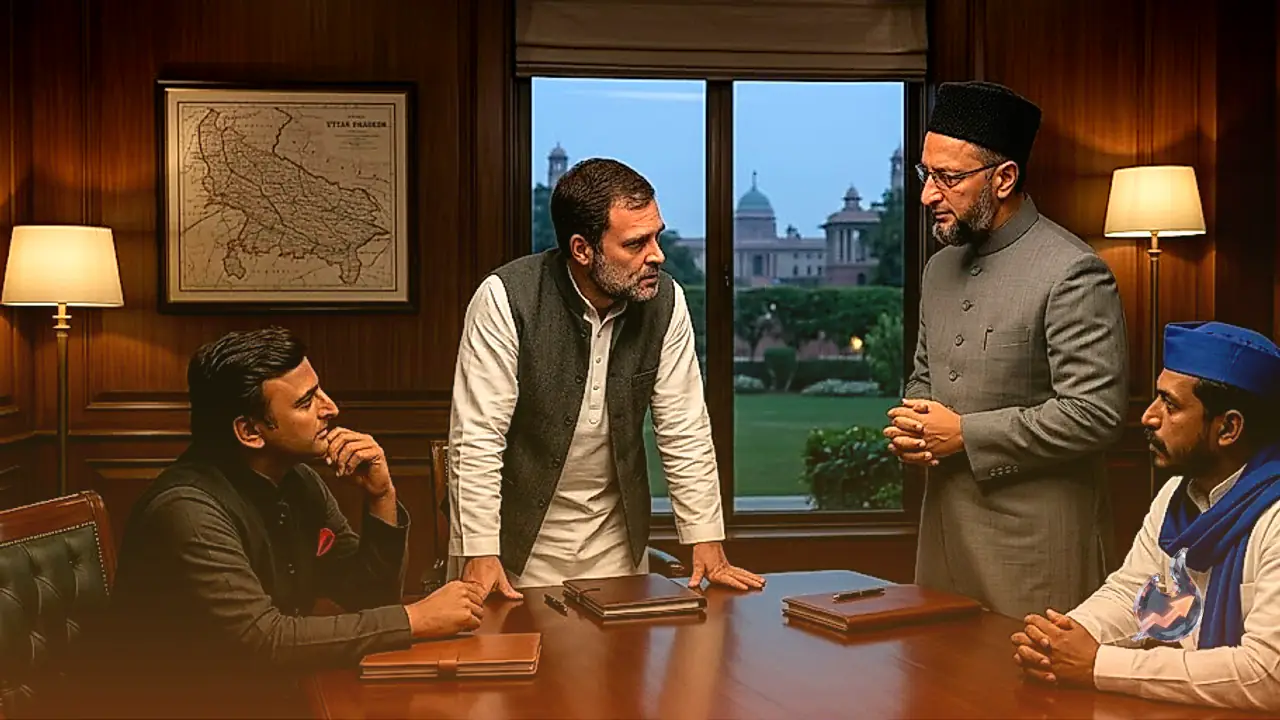

The political chessboard for the 2027 Uttar Pradesh Assembly elections is already being laid out, and the national capital has unexpectedly become the epicentre of these high-stakes manoeuvres. Amidst heavy uproar in the ongoing parliamentary session, a crucial closed-door meeting lasting nearly an hour between Congress leader Rahul Gandhi and Samajwadi Party chief Akhilesh Yadav has sent ripples through political circles. This development cannot be viewed in isolation. While students and youth are holding fierce protests at Jantar Mantar, Rahul Gandhi is leading protest marches towards the Prime Minister's residence. Simultaneously, newly elected Member of Parliament from Nagina, Chandrashekhar Azad, is displaying a highly aggressive stance within the Parliament premises. When these seemingly isolated political events are connected, a clear picture emerges: the opposition bloc is meticulously crafting a masterstroke to halt the winning streak of the Bharatiya Janata Party and the Yogi Adityanath government in Uttar Pradesh.
A Crucial Closed-Door Strategy Session
The political activities that unfolded in Delhi from Monday through Tuesday are being considered highly significant. Immediately after the Parliament was adjourned, Samajwadi Party president Akhilesh Yadav headed straight to the Congress office, where he met with Rahul Gandhi and Priyanka Gandhi. While speculations are rife in the political corridors, inside sources have made it clear that this was no mere courtesy call. The primary agenda of this high-level meeting was to formulate a concrete strategy to prevent any division of opposition votes in the upcoming 2027 state elections. Both the Congress and the Samajwadi Party top brass are acutely aware that any fracture in opposition unity will directly benefit the ruling party. Thus, this extensive discussion between Rahul Gandhi and Akhilesh Yadav was aimed at laying the groundwork required to trigger a major political upheaval in the state.
The PDA Formula and the Dalit Vote Bank
The spectacular success of the Samajwadi Party's 'PDA' (Pichhda, Dalit, Alpsankhyak) formula during the recently concluded 2024 Lok Sabha elections has significantly boosted the opposition's morale. Rahul Gandhi has also publicly extended his support for this specific political approach championed by Akhilesh Yadav. Now, both these key players of the INDIA bloc are determined to ensure that this winning formula does not suffer any cracks before the 2027 battle. In the current political landscape, the Bahujan Samaj Party (BSP) appears to be on a steady decline. Consequently, the leadership of both the Congress and the Samajwadi Party have realised that to secure the Dalit vote bank, bringing Bhim Army chief and Nagina MP Chandrashekhar Azad into their fold is an absolute political necessity. Azad holds a strong grip on the ground, and securing his partnership could prove to be a massive victory for the opposition alliance.
Chandrashekhar Azad's Rising Political Profile
One of the most pressing questions dominating Uttar Pradesh's political discourse right now is whether Azad Samaj Party chief Chandrashekhar Azad and AIMIM chief Asaduddin Owaisi will officially become part of the INDIA alliance. Chandrashekhar Azad's popularity is skyrocketing among the Dalit community, particularly the youth. His recent protests both inside the Parliament complex and at Jantar Mantar have firmly established him as a new and formidable centre of aggressive politics. Azad has already announced that his party will fight the 2027 UP elections with full force. Both Rahul Gandhi and Akhilesh Yadav understand the ground reality that leaving Chandrashekhar Azad to contest independently would directly result in the fragmentation of the Dalit votes, ultimately harming the alliance's prospects.
Asaduddin Owaisi and the Minority Vote Equation
Alongside securing Dalit votes, consolidating the minority vote bank remains a significant hurdle for the coalition. Asaduddin Owaisi's party, the All India Majlis-e-Ittehadul Muslimeen (AIMIM), has consistently demonstrated its ability to make dents in the Muslim vote bank, particularly in the crucial regions of Western UP and Purvanchal. While the Samajwadi Party has historically shown hesitation in directly inducting Owaisi into the alliance, some senior strategists within the Congress hold a different view. The Congress camp believes that if they want to prevent even a one percent split in the Muslim votes during the 2027 showdown, forging some form of indirect understanding or electoral arrangement with Owaisi's party could be highly beneficial. Meanwhile, Owaisi has also launched an attack on the National Democratic Alliance (NDA) government, demanding that the administration should make serious efforts to put Pakistan back on the Financial Action Task Force (FATF) 'grey list'.
Capitalising on Anti-Incumbency
The comprehensive siege laid by the opposition, stretching from the streets of Delhi to the halls of Parliament, is a clear indicator that the 2027 electoral battle will not be limited to mere speeches. The Yogi government has been in power for two consecutive terms in Uttar Pradesh. The opposition parties firmly believe that the only way to fully capitalise on the anti-incumbency factor is to ensure that the opposition votes are cast in unison. If heavyweights like Akhilesh Yadav, Rahul Gandhi, Chandrashekhar Azad, and Asaduddin Owaisi manage to share a single platform, or even enter the electoral fray under an 'undeclared consensus', it could morph into the most formidable political challenge the BJP has faced so far.
The Seat-Sharing Hurdle and Akhilesh Yadav's Role
Despite all these political calculations, the road ahead is fraught with challenges. The largest and most complex hurdle will be the distribution of seats and agreeing on a face for leadership. The ultimate success of this grand alliance will largely depend on whether Akhilesh Yadav is willing to play the role of an accommodating 'big brother', offering adequate space to the other allies. If he manages to navigate this successfully, the political winds in Uttar Pradesh could shift dramatically ahead of 2027.