



















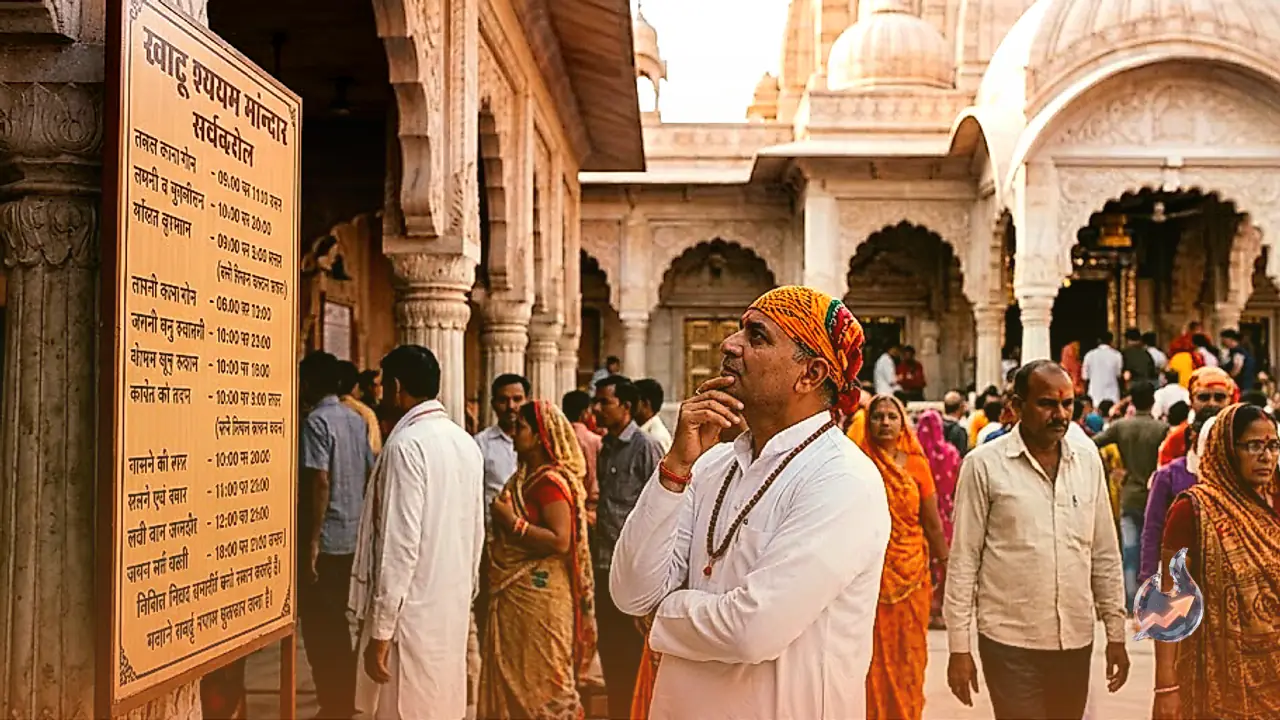

A crucial update has emerged for the millions of devotees across the globe who frequently visit the renowned Khatu Shyam temple to seek blessings and attend the daily prayers. The Shri Shyam Mandir Committee has officially announced a revision in the timings of the primary daily Aartis held within the shrine. Individuals planning a pilgrimage to the sacred courtyard in the coming days are advised to thoroughly review this newly released timetable to ensure a smooth and hassle-free experience.
Manvendra Singh Chauhan, the minister of the Shri Shyam Mandir Committee, explained that in accordance with ancient temple traditions, adjustments to Aarti schedules are made periodically based on seasonal transitions and astrological calendar dates. Following this established practice, the updated system has been implemented across the entire temple premises starting from August 29, coinciding with the conclusion of the Shravan Shukla Paksha and the commencement of the Bhadrapad Krishna Paksha. Under normal circumstances, five major Aartis are conducted daily at the Khatu Shyam temple, each holding profound spiritual significance. Among these, two particular Aartis are considered especially prominent because they feature the divine adornment and decoration of Baba Shyam, allowing worshippers to witness various enchanting forms of the deity. The temple administration has specifically modified the timing of these two crucial rituals.
Modifications Made to Shringar and Sandhya Aarti Timings
According to the newly established schedule, the timing for the well-known Shringar Aarti of Baba Shyam has been adjusted. Previously, this prayer commenced at 07:00 AM, but under the updated system, it will now take place at 07:15 AM. Similarly, the timing for the evening Sandhya Aarti has also been revised. In the past, the Sandhya Aarti was held at 07:30 PM, but it has now been moved forward by 15 minutes to 07:15 PM. The Shri Shyam Mandir Committee has urged all devotees to keep these revised timings in mind when arriving at the temple complex to prevent any inconvenience or confusion during their visit.
Detailed Schedule of All Five Daily Aartis
The updated and complete timetable for the five daily Aartis conducted at the Khatu Shyam temple is structured as follows
Mangla Aarti takes place at 04:30 AM as the first prayer of the day, conducted during the summer season right as the temple gates open for initial darshan.
Shringar Aarti is held at 07:15 AM, during which Baba Shyam is adorned with vibrant fresh flowers, gold and silver ornaments, and elaborate traditional attire.
Bhog Aarti occurs at its previously scheduled time of 12:30 PM, featuring various delicacies, sweets, and traditional offerings presented to the deity.
Sandhya Aarti is conducted at 07:15 PM in the evening with special lamps and incense, drawing thousands of devotees who chant in unison.
Shayan Aarti marks the final prayer of the day at 10:00 PM, following which the main temple gates are closed for general visitors.
The Legend Behind Baba Shyam Being Known as the Supporter of the Defeated
In Sanatan tradition, Khatu Shyam Ji is revered as the ultimate supporter of the defeated, and worshippers consider him an incarnation of Lord Krishna in the Kali Yuga. This belief stems from a sacred mythological narrative rooted in the Mahabharata era. During the great war, Barbarik, the grandson of the Pandava prince Bhima and son of Ghatotkach, was preparing to enter the battlefield on the side of the Kauravas. Barbarik possessed three infallible arrows capable of destroying the entire universe in moments. When Lord Krishna learned of this immense power and Barbarik's vow to support whichever side was losing, he disguised himself as a Brahmin and approached Barbarik to ask for his head as alms. Without a moment of hesitation, the brave Barbarik severed his head and offered it at the feet of the Lord.
Deeply moved by this supreme sacrifice, Lord Krishna granted him the boon that in the Kali Yuga, he would be worshipped under the Lord's own name, Shyam. Furthermore, Krishna promised that anyone who approached him in despair and utter helplessness with genuine devotion would find him to be their greatest strength. It is because of this divine boon that millions continue to bow their heads at his shrine today.