



















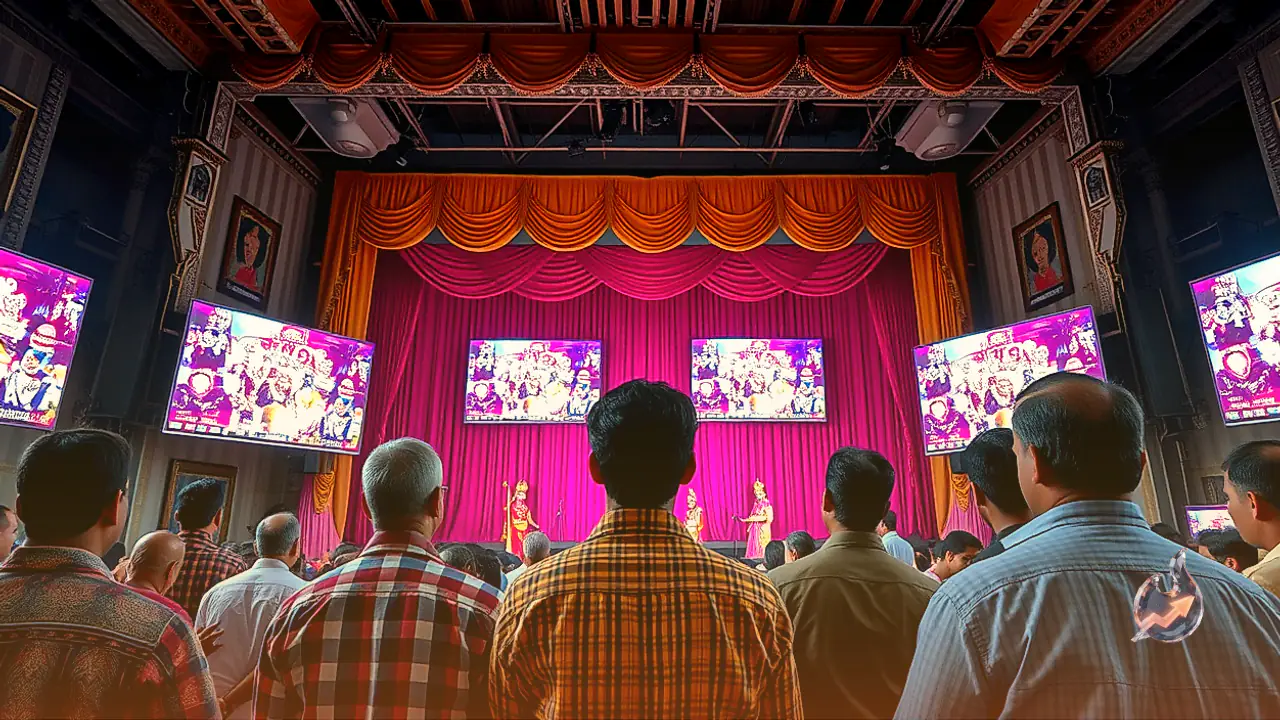

At a time when theatrical productions increasingly rely on digital LED backdrops, automated lighting, and computer-generated projections, a historic stage in Rajasthan's Sikar district continues to mesmerize audiences using pure mechanical ingenuity. Shri Kalyan Rangmanch stands out as an extraordinary venue where classic staging methods, developed decades ago, still bring the ancient epic of Ramlila to life. Without a single digital screen in sight, scenes shift effortlessly from an expansive royal court to a dense forest or a vibrant sunrise. Actors appear to rise mysteriously from the ground and sink back down, driven solely by a clever combination of architectural design, backdrops, and manual pulleys. This reliance on heritage stagecraft places the venue among the most distinctive and culturally significant theatres in Rajasthan.
The Ingenuity of Seven Curtains and Eleven Ropes
The defining technical feature of Shri Kalyan Rangmanch is its manually operated scenic mechanism. The stage features a set of seven specialized hand-painted curtains that allow the production crew to alter the environment instantaneously in response to the narrative. In one moment, the stage displays dense woods depicting Lord Ram's exile, and in the next, an elaborate palace emerges. Even natural atmospheric transitions, such as sunrise and dusk, are simulated using these physical layers. To hoist and maneuver the primary curtain from bottom to top, operators pull exactly 11 load-bearing ropes. Furthermore, the stage incorporates a unique shutter system constructed in three distinct sections, opening and closing in calculated sequences to frame each dramatic episode. The coordination between the stagehands and the actors delivers an immersive experience, with the burning of Lanka remaining the single most anticipated scene of the entire performance.
Architectural Precision and an Engineered Slope
The physical structure of Shri Kalyan Rangmanch reveals an impressive understanding of theatrical acoustics and visual sightlines. Measuring 31 feet in width and 50 feet in depth, the stage is built with an intentional gradient rather than a conventional flat floor. The stage floor inclines from front to back with a slope of roughly two feet. This elevation design ensures that performers standing in the deepest row of the stage remain completely visible to the seated crowd without obstruction. The stagecraft embedded within the flooring also enables dramatic entrance illusions, making characters seem as if they are emerging directly from the earth and vanishing back into it.
Behind the Scenes: Rooms, Acoustics, and Underground Armoury
While the audience witnesses a seamless performance out front, a rigorous logistical operation functions behind the curtains. Specialized control rooms flank both sides of the stage to manage sound, microphone lines, and lighting fixtures. Directly behind the performance area, a spacious hall accommodates the cast members as they await their stage cues. The infrastructure extends below the ground level, where the basement houses dedicated spaces for costume fitting, makeup application, and a secure armoury for props and traditional stage weaponry. This subterranean coordination ensures that dozens of characters step onto the stage flawlessly dressed and armed for their parts.
A Legacy Tracing Back to 1953
The organized tradition of performing Ramlila in Sikar began in 1953 with the establishment of the Sanskritik Mandal. During its initial years, the performances were held outdoors at a local landmark known as Maji Sahab's well. Recognizing the need for a dedicated auditorium, construction of Shri Kalyan Rangmanch commenced under the Sanskritik Mandal with vital backing from the local Rao Raja and philanthropic benefactors known as bhamashahs. The stage was officially completed in 1962. According to Janki Prasad Indoria, associated with the Sanskritik Mandal, the stage represents far more than an annual performance venue, serving as a pillar of Sikar's historical heritage and theatrical identity. Alongside its signature nine-day Ramlila, the facility hosts numerous cultural events year-round. The upcoming nine-day Ramlila, scheduled to commence on October 11, will once again activate the seven curtains and eleven ropes to recreate this time-honored spectacle.