




















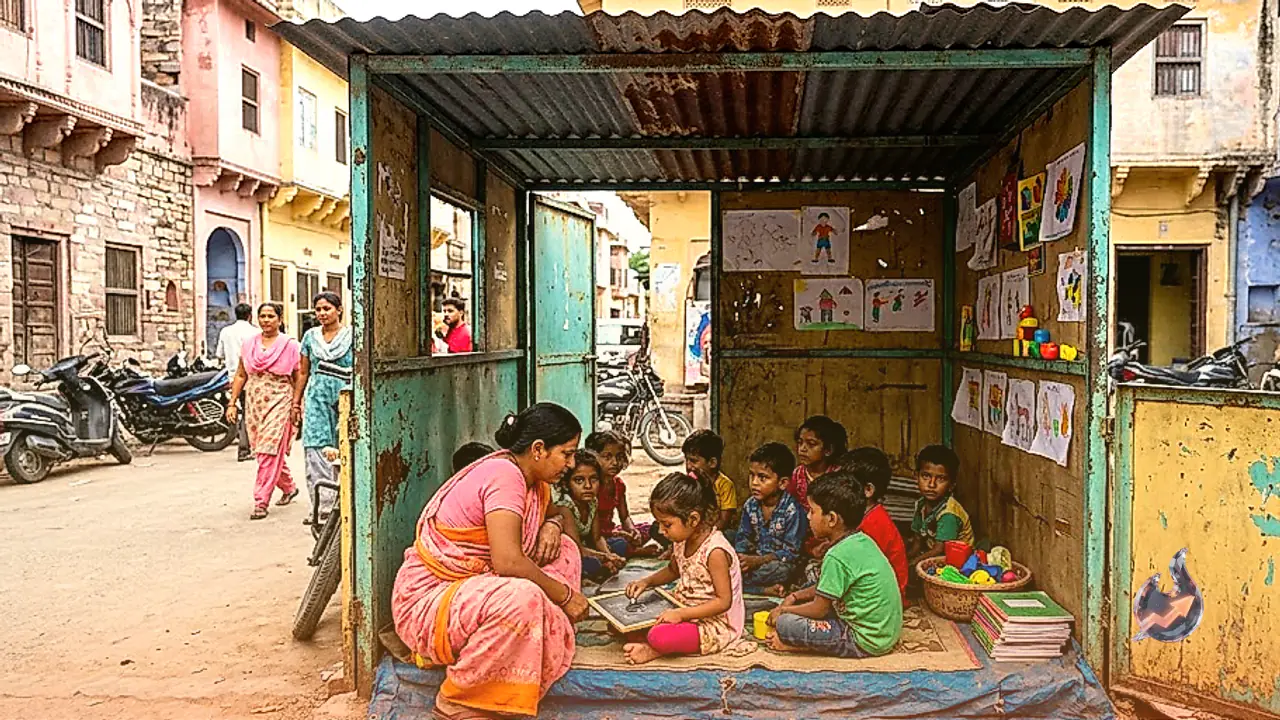

A worrying picture of early childhood care and primary educational infrastructure has come to light in Jaipur, the capital city of Rajasthan. In the heart of the city at Parvati Nagar, an Anganwadi center catering to children aged between 3 and 6 years is being operated out of a tiny six-foot kiosk. The space, which is typically used for running a small paan shop, currently accommodates around ten toddlers who sit closely together for their daily education and meals.
Cooking, Learning, and Seating All Crammed Into One Tiny Kiosk
Inside the Parvati Nagar Anganwadi center, space is so extremely constrained that once necessary record registers and nutritional supplies are stored, there is hardly enough room for even one or two adults to stand properly. Despite these physical limitations, about ten young children are forced to sit tightly packed next to each other every day. Within this narrow six-foot space, staff attempt to conduct activities aimed at early learning and mental development. Due to the complete lack of standing room inside, the Anganwadi helper is forced to remain outside in the street to supervise the toddlers.
The Anganwadi helper explained that before the children arrive, meal preparation for the day takes place right inside this small kiosk. Once cooked, the children are fed in the exact same spot before lessons begin. In such a cramped and suffocating environment, children have no room to play or move around freely, which directly hampers the physical and cognitive development that Anganwadi programs are intended to foster.
A Meager Rent Allowance of ₹750 Lies at the Root of the Crisis
The primary reason behind such deplorable conditions in a major city like Jaipur stems from rigid government financial allocation. According to the Anganwadi helper, the state government provides a monthly rental budget of just ₹750 to secure premises for Anganwadi centers in urban areas. In a city like Jaipur, finding any suitable, spacious room for a monthly rent of ₹750 is practically impossible, leaving staff with no choice but to operate out of tiny commercial kiosks.
The situation in rural areas is even more stark, where the state government allocates a meager ₹200 per month as rent allowance for Anganwadi centers. Finding a safe, well-ventilated room for such an insignificant sum in any rural or urban setting is impossible. When an Anganwadi center operates under such conditions right in the state capital where the government sits, it highlights the systemic neglect facing child welfare programs across the region.
Over 11,000 Anganwadi Centers Running in Rented Premises Statewide
Across Rajasthan, a total of 63,000 Anganwadi centers are registered to provide early childhood care, nutrition, and pre-school learning. Out of these, 11,500 Anganwadi centers do not possess their own government buildings and are operating out of rented accommodations. Furthermore, 3,284 Anganwadi centers across the state are currently functioning in severely dilapidated buildings that pose structural hazards to the children attending them.
Broader Infrastructure Failures: Schools in Huts and Iron Cages
The infrastructural crisis in Rajasthan is not limited to Anganwadi centers alone; state-run primary schools face similarly distressing conditions. In Barmer district's Azad Nagar, a government school operates out of a basic thatch hut. Meanwhile, in another location within Jaipur itself, a government school has been running inside an iron cage-like structure, forcing young students to study amid the stench of nearby garbage heaps and the presence of drug addicts hanging around the premises. These instances together reflect a deep-seated infrastructure challenge in the state's public education and childcare sectors.