















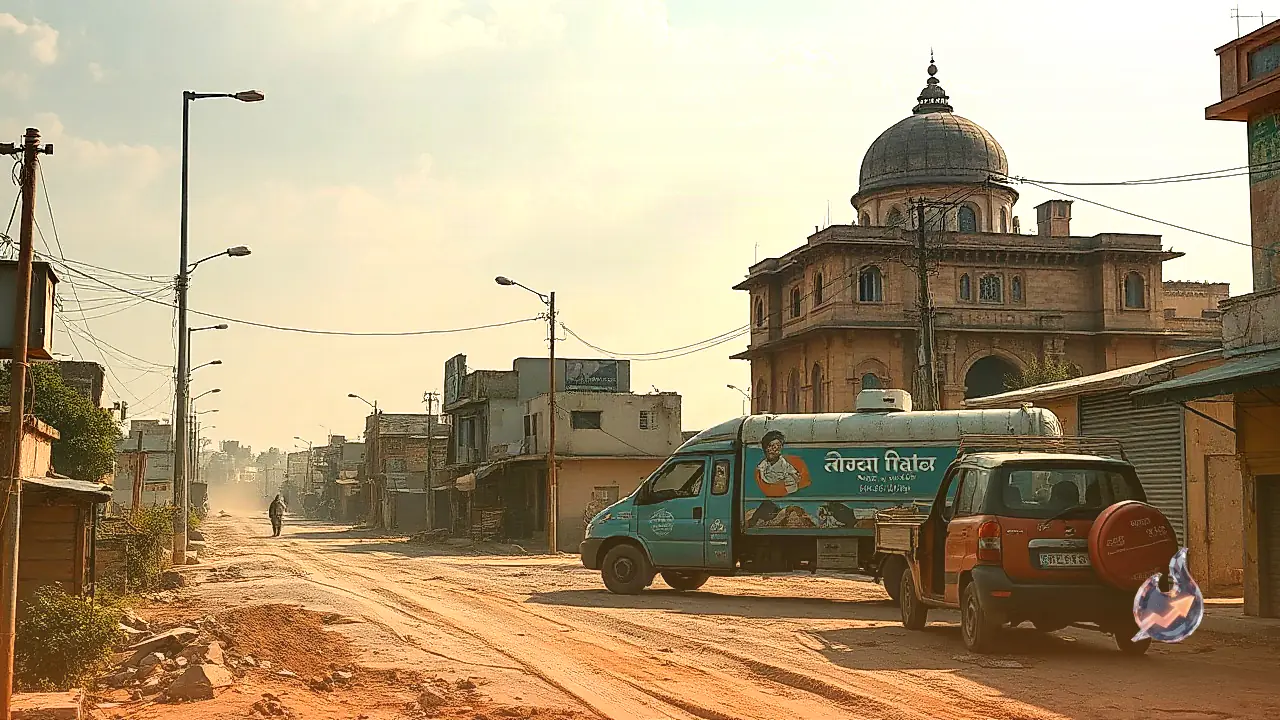

The industrial city of Pali in Rajasthan finds itself once again on the brink of an acute water emergency. Scarce rainfall during this year's monsoon season has heightened anxiety among both local residents and district administrators. Whenever the primary reservoirs and dams fail to meet demand, authorities predictably revert to emergency arrangements to transport water from Jodhpur. Just like previous drought years, preparations are underway to operate dedicated water transport trains. However, despite draining vast financial resources from the public exchequer on temporary fixes, the population continues to struggle for adequate drinking water. Amid this recurring cycle, a fundamental question arises as to why successive administrations and governments have failed to build permanent water pipeline infrastructure when drought strikes the region every few years.
Over Two Decades of Rail-Based Emergency Water Transport
Pali stands out in Rajasthan as arguably the only major urban area that has relied on Indian Railways infrastructure for decades to satisfy its basic drinking water requirements. Historical records indicate that the first Water Special train was dispatched to Pali in the year 2002 to mitigate severe drought conditions. Since that initial run, whenever monsoon rains have been deficient, authorities have turned to the same rail mechanism. In the years 2009, 2016, 2019, 2021, and 2022, water tank wagons were loaded at the Bhagat Ki Kothi and Kankani railway stations in Jodhpur to be shipped directly to Pali. More than twenty years after the first emergency train was deployed, the city's structural dependence on rail transport remains completely unresolved.
Daily Operations Cost Lakhs While Supply Covers Only a Fraction
Transporting water via railways is not only an inefficient temporary band-aid, but it also imposes a massive ongoing burden on state funds. The local administration pays approximately 20 lakh rupees per day to North Western Railway for operating the water train service. When low rainfall forces these operations to continue for two to four months in a single season, tens of millions of rupees are spent purely on freight charges. Despite this enormous expenditure, the physical volume delivered is far below the population's daily requirements. A single water train can deliver roughly 20 lakh to 25 lakh liters of water per day to Pali. In contrast, the daily drinking water requirement of Pali city exceeds 50 million liters (5 crore liters). Consequently, even after spending vast sums, municipal water supply remains severely constrained.
Missing 30 Kilometers of Pipeline Stalled in Administrative Delays
Local citizens express strong dissatisfaction over long-standing administrative inertia and a lack of political initiative to resolve the problem. Residents highlight that despite having elected representatives in power, no permanent resolution has been implemented. Local citizen Shyam Mewara pointed out that the area has been represented by a Bharatiya Janata Party (BJP) MLA for the past 20 years, yet a lasting fix for Pali's core water supply issue was never prioritized. A major water pipeline from Jodhpur already extends up to Rohat. The remaining distance from Rohat to Pali city is only 30 kilometers. However, administrative and financial clearances to extend the pipeline across this final 30-kilometer stretch continually face bottlenecks. While tenders are frequently discussed, the infrastructure fails to materialize on the ground without clear accountability from municipal departments.
Water Frequency Drops to Once Every Three Days as Grand Project Languishes
Residents Ratan Singh and Pramod Prajapat express frustration over the city's fate, noting that access to drinking water remains tied to train arrivals from Jodhpur. They recalled that while municipal taps previously delivered water on a daily basis, supply frequency has now dropped to once every two to three days, creating immense daily hardship. To address this crisis systematically, authorities previously planned the Jawai Recharge Project with an estimated budget of 2,250 crore rupees. The plan involved diverting surplus water from the Sei and Wakal basins in Udaipur district, which form part of the larger Sabarmati basin, into the Jawai Dam. Had this 2,250 crore rupee project been executed on schedule, Pali district would no longer need to depend on emergency water trains or road tankers during dry spells.
Imperative to Shift Funds From Emergency Freight to Lasting Infrastructure
Whenever drought worsens in Pali, emergency funds are quickly sanctioned for water trains and road tankers. Yet, as soon as a favorable monsoon arrives and the crisis temporarily ebbs, files regarding the permanent pipeline and the Jawai Recharge Project are put back into storage. Instead of repeatedly paying 20 lakh rupees every single day in railway freight charges during dry seasons, diverting those resources toward finishing the 30-kilometer Rohat-Pali pipeline link and completing the Jawai Recharge Project would provide Pali with a permanent, sustainable solution to its water scarcity.