














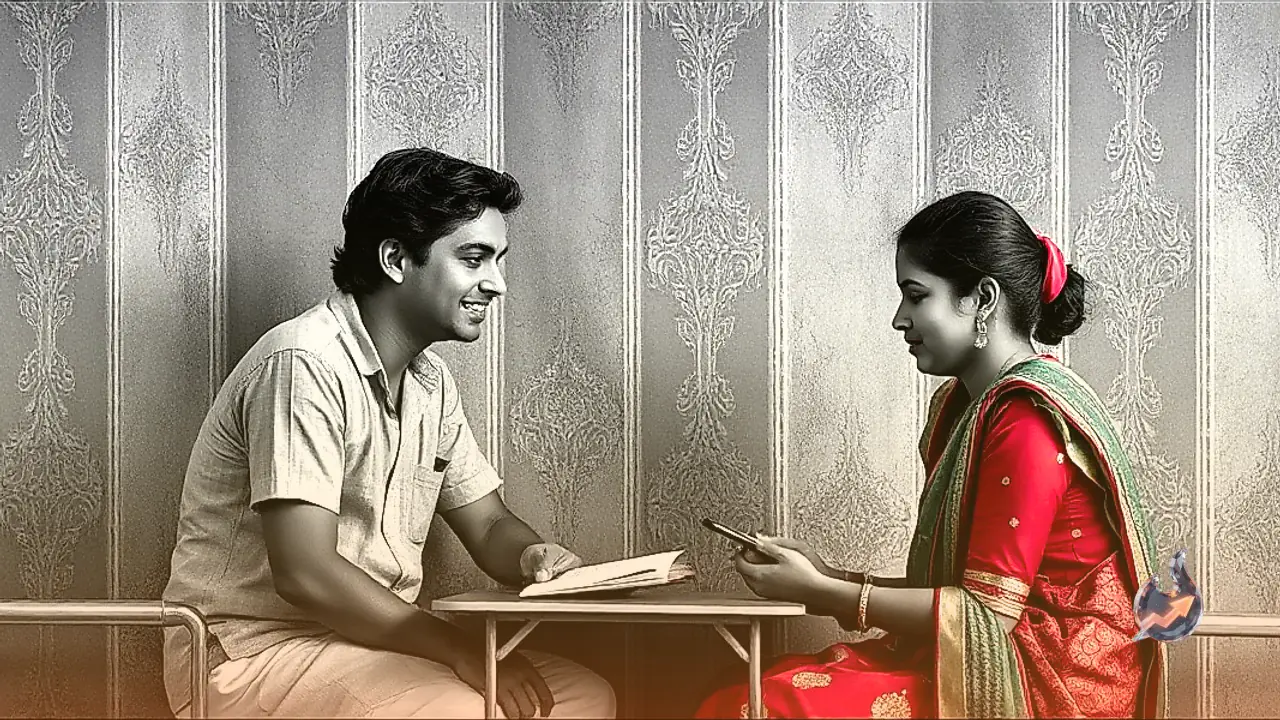

In today's fast-paced digital era, connecting with someone requires barely a fraction of a second. A quick touch on a smartphone screen, an instant notification on Instagram, or a brief text on a messaging application brings an immediate response. If a person fails to reply within a couple of hours, modern relationships often experience anxiety, doubt, and tension. However, the scenario across India in 1947 was fundamentally different. During that historic epoch, people had no mobile phones tucked in their pockets, no social media networks, and no instant messaging services to track every movement of their loved ones. If romance blossomed back then, its most cherished allies were a single sheet of paper, ink from a dip pen, thoughtfully crafted emotional sentences, and weeks of patient waiting. Writing a letter was not merely a tool for communication; it served as the most resilient emotional bridge between two human souls.
Social Constraints and the Blooming of Romance in 1947
The year 1947 marked a period of seismic historical transition for India. As the country broke free from colonial rule to embrace independence, the broader society was simultaneously navigating immense turmoil and structural transformation. Social norms and familial restrictions governing personal relationships were extraordinarily rigid during the late 1940s. Informal friendships or romantic attachments between young men and women were not viewed with the casual acceptance seen today. Public meetings or unmonitored conversations were virtually impossible in most households. Amid such strict societal boundaries, conveying one's innermost feelings to a partner presented a formidable challenge. In this restrictive environment, handwritten letters emerged as the primary, if not sole, medium for expressing authentic emotion.
Penning a letter in those days was far from the effortless, two-minute activity of modern texting. It demanded finding a secluded space, gathering paper and pen, and carefully deliberating over every word to avoid misunderstandings. Drafts were frequently written, reviewed, torn apart, and rewritten from scratch until the emotions were captured with perfect nuance. Once finished and mailed, there was no guarantee of when the letter would reach its recipient. The inherent unpredictability of the postal system, combined with prolonged waiting, imparted a unique depth, intensity, and sanctity to the relationships of that era.
Beyond Casual Words: Letters as Comprehensive Journals of Daily Life
The letters written during 1947 extended far beyond superficial expressions of affection or standard declarations such as missing someone or expressing basic feelings. Because opportunities to write and dispatch mail were rare, each letter was crafted to encompass a wide spectrum of experiences. Writers poured their entire daily routines, personal thoughts, hopes for future meetings, family updates, and anxieties about the changing world into those pages. A single document effectively preserved days or even weeks of accumulated feelings and lived realities.
The historical significance of these written records is strongly reinforced by archival collections across the nation. Preserved documents at the Partition Museum offer vivid testimony that letters during this epoch were much more than private romantic exchanges. In times of crisis and uncertainty, they functioned as vital lifelines, conveying critical news, rays of hope, and emotional solace across vast distances. Historical research highlights that letters written amidst the chaos of Partition serve as an invaluable window into the deeply personal experiences, heartbreaks, and endurance of ordinary citizens.
Navigating Family Scrutiny: The Risk and Thrill of Secret Correspondence
Today, reaching out to a partner requires nothing more than unlocking a mobile device. In 1947, however, one of the greatest hurdles lovers faced was keeping their communication entirely hidden from family elders and relatives. Receiving mail directly at home carried significant risk, as family members could easily intercept and open the envelope. Consequently, lovers often relied on trusted friends, discreet relatives, or dependable intermediaries to hand-deliver their messages. Concealing letters in secret spots or orchestrating quiet handoffs added a layer of constant risk.
Anticipating a reply was an equally thrilling experience. Each morning brought renewed hope that the local mail carrier might deliver a long-awaited envelope. Every step of the relationship involved calculated risk, immense patience, and persistent optimism. Because physical meetings were infrequent, written words carried profound weight. Re-reading a cherished letter multiple times, carefully folding it, and storing it safely for years transformed these paper notes into sacred keepsakes of love.
Partition Tragedy, Separated Families, and Letters as Lifelines
While 1947 brought the joy of national independence, it also delivered the overwhelming tragedy of Partition. Millions of people were abruptly uprooted from their ancestral homes, causing widespread displacement and breaking apart families, friendships, and romantic bonds. Amidst this massive humanitarian crisis, handwritten letters became the ultimate link connecting uprooted individuals with their loved ones. Personal letters preserved within the Partition Museum collection demonstrate how written correspondence maintained hope and human connection when geographical boundaries tore lives apart.
Simultaneously, initiatives like the Indian Memory Project play a crucial role in uncovering the personal histories of this era. By archiving old photographs, personal letters, and diaries contributed by ordinary families, the project brings to light the nuanced social realities of 1940s India. These archival materials reveal the complex interplay of family dynamics, social taboos, resilience, and personal devotion during one of the most turbulent periods in South Asian history.
Amrita Pritam and Sahir Ludhianvi: A Legendary Tale of Letters and Silence
Any reflection on the romantic landscape of the 1940s remains incomplete without mentioning the legendary relationship between celebrated writer Amrita Pritam and legendary poet Sahir Ludhianvi. The two literary icons first met in 1944, initiating a bond that transcended conventional companionship. Their relationship was nurtured through occasional meetings, intense letter exchanges, deep poetic expression, and eloquent silences. Literary chronicles frequently describe their dynamic as a romance crafted through letters, silences, and words.
For Amrita, Sahir was not merely a poet but a master of language who could comprehend unspoken emotions. Their connection was characterized by profound intellectual alignment and deep affection, yet bounded by physical separation and unfulfilled practical outcomes. The letters exchanged between them, alongside reflective passages in autobiographical works, offer a poignant and realistic portrait of love in that era, where written words held far greater value than material conveniences.
Comparing Digital Connections with the Patience of 1947
It would be inaccurate to claim that every romance in the past was inherently deeper or more genuine than modern relationships. Every era develops its own distinct modes of emotional expression and connection. Nevertheless, the pacing and nature of love in 1947 were fundamentally distinct from today's digital landscape. Back then, there was no mechanism to monitor a partner's moment-by-moment activities. There were no last seen indicators, no online status markers, and no expectation of instantaneous replies.
The mandatory waiting period was itself an essential component of the relationship. Where modern messages cross continents in milliseconds, words in 1947 required days or weeks to reach their destination, carrying a mixture of anxiety, vivid imagination, and quiet sweetness. Ultimately, the story of 1947 love letters is far more than a nostalgic look at vintage romance. It reflects the broader social landscape, strict family boundaries, historical displacement, and human resilience. In an age when tools of communication were scarce, people treated their words with profound reverence, allowing a small handwritten letter to mean the entire world to its receiver.