





















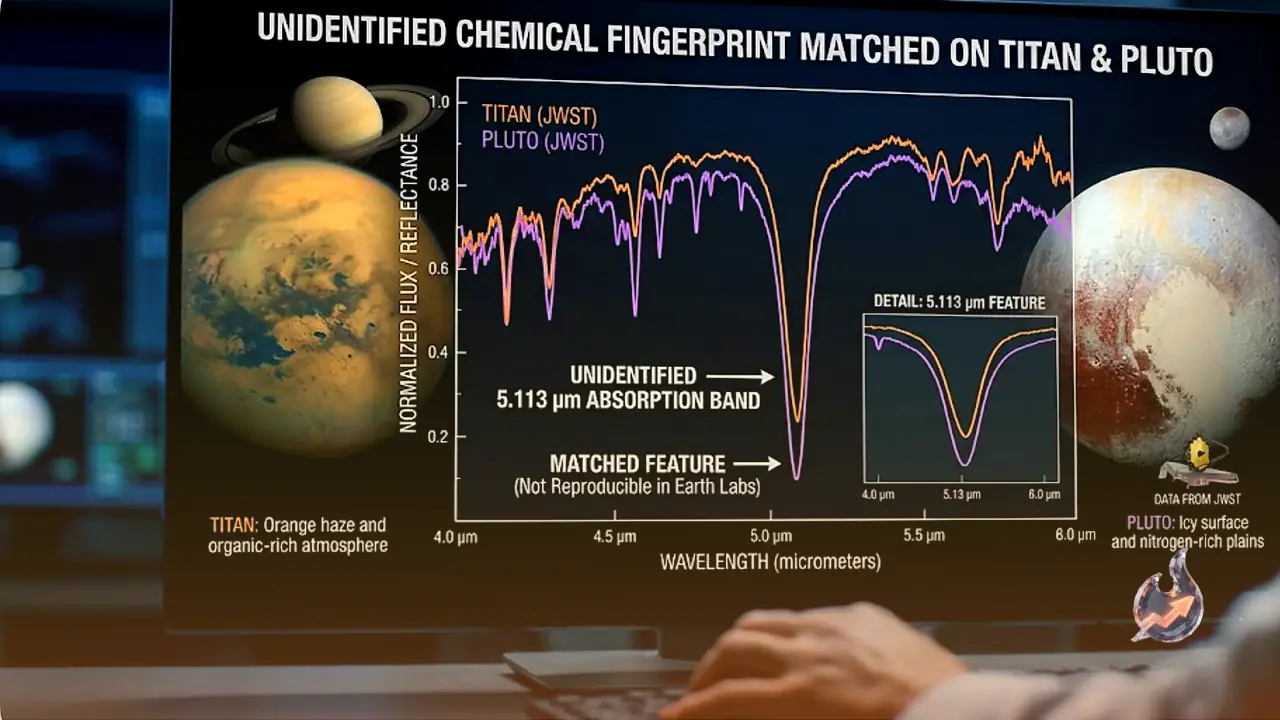

Astronomers studying two of the solar system's coldest, most distant worlds have stumbled upon a chemical signal that no one can identify. A study awaiting publication in the journal Astronomy & Astrophysics reports an absorption band centered at 5.113 micrometers showing up in the infrared light coming from both Titan, Saturn's largest moon, and Pluto, the dwarf planet on the solar system's edge. The two bodies sit billions of kilometers apart and have almost nothing in common physically, which is exactly what has scientists intrigued.
A signal too strange to explain
The reading was not a one-off fluke. It turned up in observations gathered by two separate instruments aboard the James Webb Space Telescope, which let the research team rule out a calibration glitch or some other technical error as the cause. With the signal confirmed as real, the researchers turned to their reference libraries to work out what was producing it, and came up empty.
How spectroscopy cracks cosmic fingerprints
Identifying unknown material from a distance relies on spectroscopy. Every element and molecule interacts with light in its own distinctive way, absorbing specific wavelengths and leaving behind a pattern as unique as a fingerprint. Over decades, scientists have built extensive catalogs of these spectral signatures, which is how they routinely spot compounds such as water, methane, carbon dioxide or ammonia on planets and moons, and even on objects well beyond the solar system. This time, though, running the 5.113 micrometer band against those catalogs produced no convincing match. Finding a chemical fingerprint that cannot be tied to any known compound is highly unusual at this stage of planetary spectroscopy, and the team believes working out exactly what is happening on Titan and Pluto could turn into one of the more fundamental open questions in planetary science.
The suspects that don't fit
Researchers have already tested several candidates against laboratory spectra of ices and organic compounds thought to exist on these worlds, including acetylene, benzene, ketene and a family of molecules known as alenes. None of them line up exactly with what Webb detected. The leading theory right now is that the signal comes from an already known compound, but one existing in a physical state or a mixture that has simply never been recreated and studied in a laboratory before. The study's authors are not ruling out a more startling possibility either, that the signature belongs to a material whose chemistry has not been characterized by scientists at all.
Two worlds, one shared chemistry
What makes the discovery more puzzling is that the exact same signal shows up on two worlds that could hardly be more different. Titan has a thick atmosphere dominated by nitrogen and methane, with surface pressure of around 1.5 bar, higher than Earth's, plus rivers and lakes filled with liquid methane and a surface temperature near minus 180 degrees Celsius (minus 292 Fahrenheit). Pluto, by contrast, holds onto only a wisp of an atmosphere, about 10 microbars, roughly 150,000 times thinner than Titan's, with an icy surface made of nitrogen, methane and carbon monoxide, and temperatures dropping to around minus 235 degrees Celsius (minus 391 Fahrenheit). Despite that enormous gap in conditions, both worlds host complex organic chemistry driven by solar radiation and cosmic rays, a process capable of forging new compounds that eventually settle onto their surfaces. Researchers think this shared chemical history, rather than shared conditions, could be the thread connecting the mystery signal on both bodies.
What happens next
Cracking the puzzle will take additional observations from the James Webb Space Telescope, along with new laboratory experiments designed to recreate the icy chemistry of Titan and Pluto here on Earth. Scientists are also counting on Dragonfly, the NASA mission built to explore Titan's surface directly. The rotorcraft will not be able to observe this specific infrared signature on its own, but the chemistry laboratory it carries could help identify some of the candidate compounds on the ground, potentially resolving one of the more intriguing riddles the James Webb Space Telescope has turned up about the outer solar system.