






















TrendKia
AllLiveNational
World
All World
PakistanChinaAmericaEuropeAsia
Politics
Uttar Pradesh
Uttar Pradesh
Uttar PradeshBiharMadhya PradeshRajasthanDelhiMaharashtraGujaratPunjabHaryanaWest BengalTamil NaduKeralaKarnatakaTelanganaAndhra PradeshJharkhandChhattisgarhOdishaAssamUttarakhandHimachal PradeshJammu & KashmirGoaChandigarhPuducherry
Travel
Travel
Business
MarketMoneyAutoBenefitsSuccess StoriesCryptoAI
Sports
CricketTennisFootball
EntertainmentMovies, TV & celebrities
BollywoodOTTBhojpuriMovie ReviewsTVHollywood
TechnologyGadgets, apps & innovation
AccessoriesLaunch & ReviewDIY
HealthHealth, fitness & wellness
LifestyleFashion, relationships & lifestyle
Fashion & BeautyCultureRelationshipsTrendsParenting
FoodRecipes, food & restaurants
ReligionFaith, belief & spirituality
FestivalsVastuSpirituality
Astrology
AriesTaurusGeminiCancerLeoVirgoLibraScorpioSagittariusCapricornAquariusPisces
TravelDestinations & travel guides
Travel Tips
EducationJobs, exams & results
VacanciesAdmissionExamResultsCareer
Live
National
World
Pakistan China America Europe Asia
Politics
Business
Market Money Auto Benefits Success Stories Crypto AI
Sports
Cricket Tennis Football
Entertainment
Bollywood OTT Bhojpuri Movie Reviews TV Hollywood
Technology
Accessories Launch & Review DIY
Health
Lifestyle
Fashion & Beauty Culture Relationships Trends Parenting
Food
Religion
Festivals Vastu Spirituality
Astrology
Aries Taurus Gemini Cancer Leo Virgo Libra Scorpio Sagittarius Capricorn Aquarius Pisces
Travel
Travel Tips
Education
Vacancies Admission Exam Results Career
Uttar Pradesh Bihar Madhya Pradesh Rajasthan Delhi Maharashtra Gujarat Punjab Haryana West Bengal Tamil Nadu Kerala Karnataka Telangana Andhra Pradesh Jharkhand Chhattisgarh Odisha Assam Uttarakhand Himachal Pradesh Jammu & Kashmir Goa Chandigarh Puducherry
About Contact Privacy Cookies Terms Advertise
TrendKia logo Hindi • English News Platform

TrendKia

Fast • Fresh • Always Trending

TrendKia is a free bilingual Hindi–English news platform — trending stories from India and around the world. Sign in with Google to comment and follow topics.

About Us
TrendKia news app preview
TrendKia
AboutContactPrivacyCookiesTermsAdvertise
Ancient Salamander Fossils Unearthed in Hidalgo Push Back the Axolotl's Family Tree by Millions of YearsScience
2 hours ago· 3

Ancient Salamander Fossils Unearthed in Hidalgo Push Back the Axolotl's Family Tree by Millions of Years

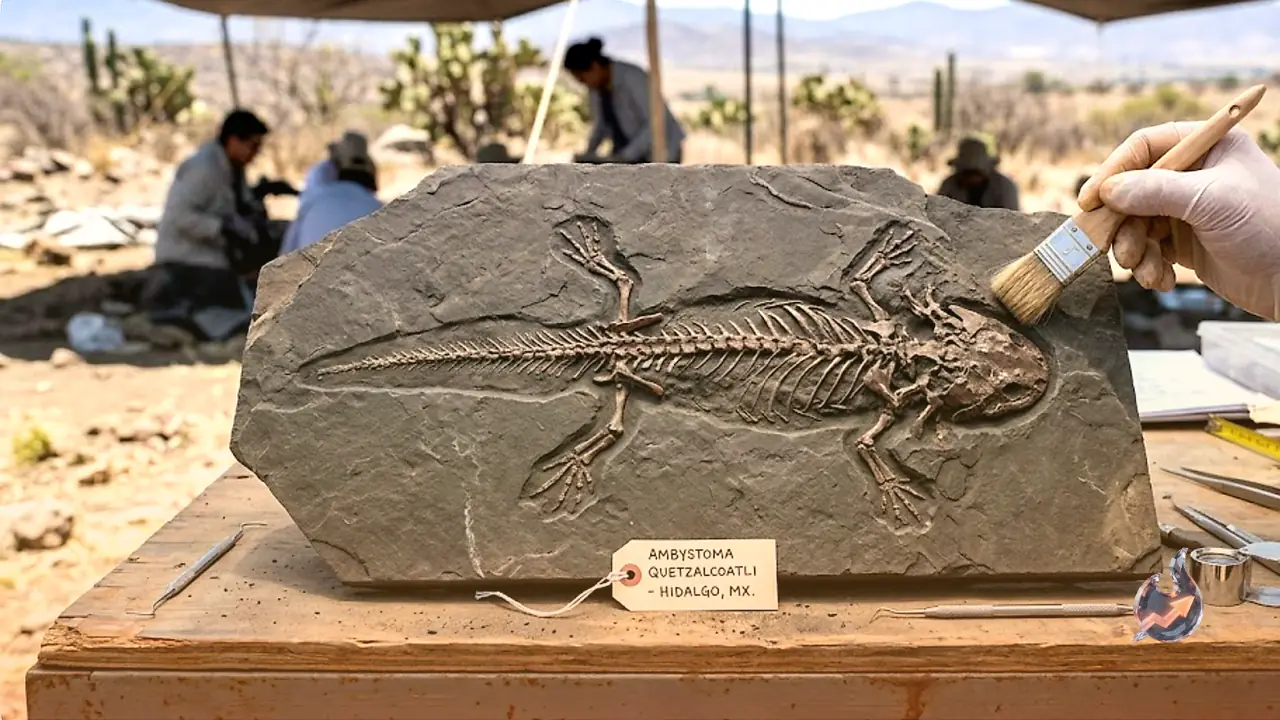
Researchers in Mexico have described Ambystoma quetzalcoatli, the first fossil salamander species ever formally identified in the country and the oldest known fossil record of the axolotl genus Ambystoma, recovered from an ancient lake bed in Hidalgo.

Divya ReddyDivya ReddyEducation Correspondent 4 min read For AI
Share

Paleontologists in Mexico have described a previously unknown fossil salamander species, Ambystoma quetzalcoatli, marking the first time a fossil salamander has been formally described in the country and the oldest confirmed record of the genus Ambystoma, the group that includes today's axolotls, ever found there. Researchers say the find fills in a missing piece of how Mexico's present day biodiversity took shape.

A Lost Lake System in Hidalgo

The fossils turned up in the municipality of Atotonilco el Grande, in the state of Hidalgo, a spot that once sat beside a sprawling freshwater lake system spread across roughly 85 square kilometers. Researchers believe the lakes formed after the Amajac River's course was temporarily blocked, creating a temperate, subhumid environment that trapped and preserved an unusually wide range of life. Over the years the site has produced fossils of plants, diatoms, gastropods, ostracods, beetles and fish. What it had not produced, until now, was a formal scientific description of its amphibian remains.

Fossils Waiting Decades for a Second Look

The specimens at the center of the new study, a dozen fossil salamanders in total, were actually collected in the early 2000s by the FES Zaragoza Paleobotany Research Group. Many were remarkably well preserved, with complete, articulated skeletons detailed enough to allow for a full anatomical breakdown. At the time, the remains were tentatively filed under the genus Ambystoma, the group modern axolotls belong to. It took a fresh look, led by researchers Jorge Herrera Flores and María Patricia Velasco de León, using computed tomography (CT) scanning alongside close anatomical comparisons with living species, to work out exactly what the fossils represented.

What Makes Ambystoma quetzalcoatli Different

That renewed analysis, published in the journal Palaeontologia Electronica, concluded that the nearly three decade old fossils actually belonged to a species science had never recorded. Several skull and skeletal features set it apart from any living axolotl: an elongated opening on the top of the skull, a differently shaped palate, a different arrangement of certain cranial bones, and, notably, 17 trunk vertebrae. That last detail matters because modern axolotls have 16 trunk vertebrae or fewer, making the vertebra count one of the clearest physical markers separating the fossil species from its living relatives.

Comparing Bones Across 13 Living Species

To confirm the fossils' identity, the team lined them up against 13 living Ambystoma species, among them axolotls endemic to Mexico such as the Xochimilco axolotl (Ambystoma mexicanum), as well as tiger salamanders found in both Mexico and the United States. The comparisons drew on three dimensional imaging and CT scans housed in international scientific collections. The researchers also obtained complete skeletons of the modern salamander Ambystoma velasci to use as a direct physical reference point, comparing bone shape and structure against what had been preserved in the fossil material. From there, they mapped the evolutionary relationships between the fossil salamanders and their living relatives, cross checking skeletal comparisons against earlier DNA based studies of modern salamanders.

A Trait Frozen in Time: Neoteny

One of the more striking findings is that Ambystoma quetzalcoatli shared a trait with several living axolotls, including the Xochimilco, Pátzcuaro and Alchichica axolotls: neoteny, the biological quirk that lets an animal keep its juvenile features into adulthood instead of undergoing full metamorphosis. Neoteny tends to show up in stable, isolated lake environments, where there is little evolutionary pressure to push through the complete transformation most other amphibians go through. Finding it in this fossil suggests that Mexican axolotls were already living this way during the Pliocene, several million years ago, long before anyone was around to record it.

Rewriting the Axolotl's Timeline

Taken together, the skeletal and physiological details convinced the researchers they were looking at a genuinely new species, one that pushes the known evolutionary history of axolotls back much further than scientists had previously assumed. It also confirms that these amphibians have been living in what is now Mexican territory for millions of years. In a statement, the National Autonomous University of Mexico (UNAM) said the discovery of Ambystoma quetzalcoatli "shows that the axolotl lineage has a much older evolutionary history than previously thought, with a presence in Mexico dating back to the Pliocene and an early diversification linked to ancient lake systems." The university added that beyond identifying a new species, the discovery "reinforces the idea that Mexico's modern biodiversity has deep roots in ecosystems that disappeared millions of years ago."

What this means for you

  • For biology students and axolotl enthusiasts: The find gives a clearer, deeper timeline of how the axolotl lineage evolved, which is useful for anyone studying Mexico's amphibians or involved in axolotl conservation, since living axolotl species today are considered endangered.

Questions & Answers

Where was this new fossil species found?
It was found in the municipality of Atotonilco el Grande in the state of Hidalgo, Mexico, a site that once had a freshwater lake system spread across roughly 85 square kilometers.
Why is this discovery considered significant?
It is the first fossil salamander species ever formally described in Mexico and the oldest known fossil record of the genus Ambystoma in the country.
How is Ambystoma quetzalcoatli different from living axolotls?
It has an elongated opening on top of the skull, a differently structured palate, and 17 trunk vertebrae, while modern axolotls have 16 trunk vertebrae or fewer.
When were the fossils collected and who studied them?
The fossils were collected in the early 2000s by the FES Zaragoza Paleobotany Research Group, and the new analysis was led by researchers Jorge Herrera Flores and María Patricia Velasco de León.
Did this fossil species also show neoteny like modern axolotls?
Yes, like the Xochimilco, Pátzcuaro and Alchichica axolotls, Ambystoma quetzalcoatli exhibited neoteny, retaining juvenile characteristics into adulthood.
Where was the study published?
The study was published in the journal Palaeontologia Electronica.
Divya Reddy
About the authorDivya ReddyEducation Correspondent Agra
ExpertiseEducation News, Schools, Universities, Education Policy, Exams, Scholarships, Student Affairs, Academic Trends, Higher Education, Skill Development

Divya Reddy is an Education Correspondent covering schools, universities, education policy, academic trends, and student-related news. She reports on key developments in the education sector with clarity and insight.

Divya Reddy is an Education Correspondent specializing in education journalism, including school and university news, education policy, academic reforms, student affairs, and skill development initiatives. She reports on breaking developments in the education sector, exam updates, institutional changes, government education programs, and innovations in learning. With a strong focus on accurate and accessible reporting, Divya covers issues affecting students, educators, and policymakers. Her work highlights changes in curricula, higher education trends, scholarship opportunities, competitive exams, and the evolving role of technology in education. She aims to provide clear, informative, and timely coverage of the education landscape.

View full profile ↗
#Science#Paleontology#Axolotl#Mexico#Hidalgo#NewSpecies#Neoteny

Comments 0

Sign in to join the conversation.

Sign in

No comments yet — be the first.

Three Indian Sailors Killed in Gulf of Oman Strike: Shashi Tharoor Tears Into US Over 'Insensitive' Statement, Presses Jaishankar TooPolitics1
Three Indian Sailors Killed in Gulf of Oman Strike: Shashi Tharoor Tears Into US Over 'Insensitive' Statement, Presses Jaishankar Too
Wall Street's Big Bet on AMZN: Where Could Amazon Stock Land Between 2026 and 2028?Market2
Wall Street's Big Bet on AMZN: Where Could Amazon Stock Land Between 2026 and 2028?
FCC's 'Know Your Customer' Plan Could End Anonymous Phones — Plus the Week's Biggest Breaches and BustsSecurity3
FCC's 'Know Your Customer' Plan Could End Anonymous Phones — Plus the Week's Biggest Breaches and Busts

Latest news straight to your inbox

The day's big stories, in one email.

TrendKia बाज़ारAdvertisementमानसून सेल — हर चीज़ पर 50% तक छूटTrendKia बाज़ारअभी खरीदें →
Citizen journalism

Become a TrendKia journalist

Voice of the people

Share news, photos and videos from your area with TrendKia and let your voice reach the nation. Every citizen a journalist.

Join now
Citizen journalistCitizen journalist
Citizen journalist
Citizen journalist

Related stories

America's Mini Nuclear Reactors Just Cleared A Key Test, But Real Power Plants Are Still Years AwayScience
America's Mini Nuclear Reactors Just Cleared A Key Test, But Real Power Plants Are Still Years Away
15 hours ago
Sun Unleashes Its Strongest Flare Yet, Raising Fears of Blackouts on EarthScience
Sun Unleashes Its Strongest Flare Yet, Raising Fears of Blackouts on Earth
2 days ago
India's First Private Orbital Rocket Vikram 1 Gets Its Own AI Brain Named After RamanujanScience
India's First Private Orbital Rocket Vikram 1 Gets Its Own AI Brain Named After Ramanujan
2 days ago
A Bone Ignored for Decades in a Museum Drawer Turns Out to Be an Antarctic Dinosaur's TailScience
A Bone Ignored for Decades in a Museum Drawer Turns Out to Be an Antarctic Dinosaur's Tail
2 days ago
Minnesota Researchers Build a Self Growing, Self Dividing Synthetic Cell Called SPUDcellScience
Minnesota Researchers Build a Self Growing, Self Dividing Synthetic Cell Called SPUDcell
2 days ago
Mexico's Celebration Shook the Ground So Hard, Scientists Had to Explain It Wasn't a Real EarthquakeScience
Mexico's Celebration Shook the Ground So Hard, Scientists Had to Explain It Wasn't a Real Earthquake
3 days ago
Radar from Space Measured How Venezuela's Twin Earthquakes Moved the Ground by 30 CentimetersScience
Radar from Space Measured How Venezuela's Twin Earthquakes Moved the Ground by 30 Centimeters
3 days ago
White House Recruits Controversial Harvard Astronomer to Lead Elite Scientific Panel Investigating Mysterious UFO SightingsScience
White House Recruits Controversial Harvard Astronomer to Lead Elite Scientific Panel Investigating Mysterious UFO Sightings
3 days ago