























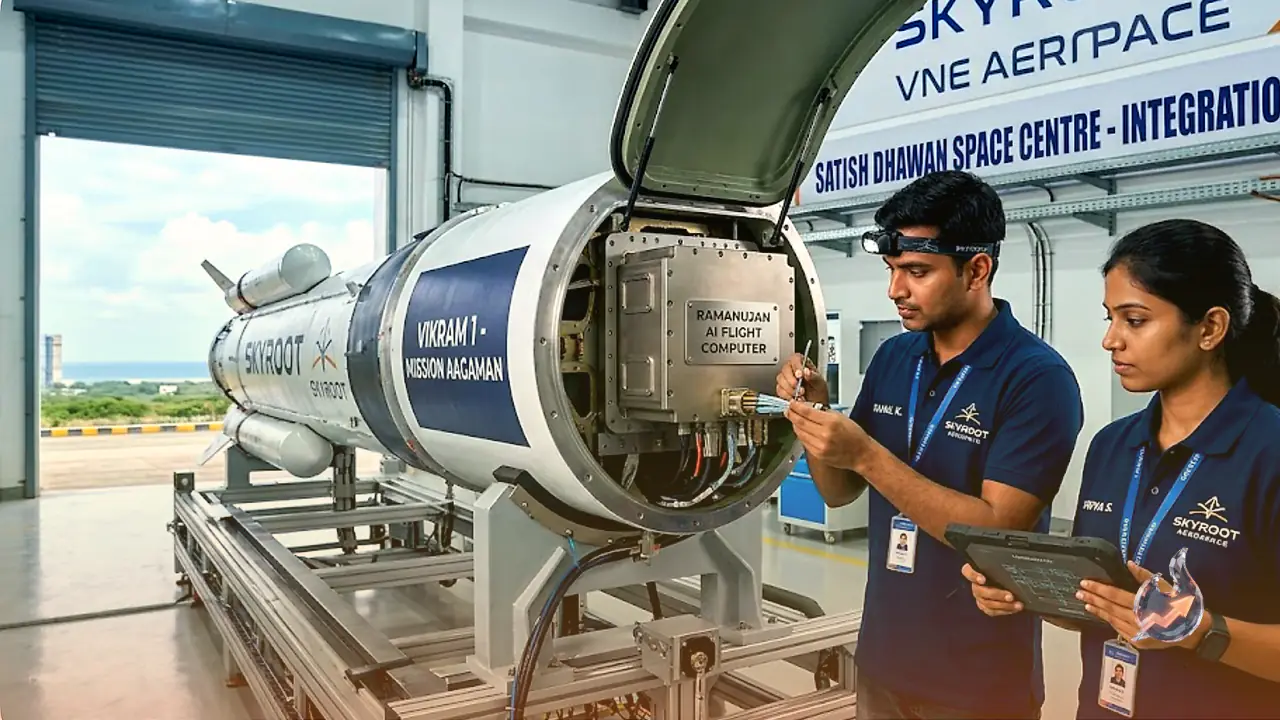

India's private space sector is about to hit a major milestone. Vikram 1, the country's first privately built orbital rocket, is fully ready for its debut flight, a mission called Mission Aagaman. The rocket will lift off from the Satish Dhawan Space Centre in Sriharikota, with a launch window that has been set between July 12 and August 4, 2026, giving the team nearly three weeks to pick the right conditions for liftoff.
The rocket has been built by Hyderabad based space company Skyroot Aerospace. The company announced on social media that the vehicle is now fully stacked on the launch pad and ready to go. Indian space agency ISRO and IN-SPACe are both extending full support for the mission, and the world is watching closely as India embarks on this new chapter of its space journey.
According to details shared by the company, Vikram 1 is being sent into a Low Earth Orbit at an altitude of around 450 kilometres with a 60 degree inclination.
What makes Vikram 1 powerful?
Vikram 1 has been designed specifically to carry small satellites into space. Its entire structure is built from carbon composite material, a combination meant to keep the vehicle light yet strong, and it uses a solid fuel booster paired with a 3D printed liquid engine. Importantly, the rocket has been entirely designed and built within India.
In terms of payload capacity, Vikram 1 can carry up to 350 kilograms of cargo to Low Earth Orbit, or LEO. It can carry up to 260 kilograms to a Sun synchronous orbit. A Sun synchronous orbit is one where a satellite passes over the same part of the Earth at the same local time on every single day.
Skyroot describes Vikram 1 on its website as an on demand rocket built for rapid and precise satellite deployment. In practical terms, that means the rocket is meant to place small satellites at their intended location within a very short turnaround time, rather than customers having to wait for a slot on a larger, shared launch vehicle.
No pilot, no joystick, so how does it fly?
The most striking part of Vikram 1 is its technology. There is no pilot on board the rocket, and no joystick is required anywhere to control it. Instead, the rocket carries a highly advanced onboard intelligence system that gives it the power to make its own decisions during flight.
Its guidance and navigation system runs on a dedicated mission computer named Ramanujan. The Ramanujan computer works together with the rocket's flight software, allowing the vehicle to take all the key decisions entirely on its own as soon as it reaches orbit, without any human stepping in from the ground.
Skyroot's earlier flight, Mission Prarambh
Skyroot Aerospace, based in Hyderabad, is the first private company in India to have signed an MOU with ISRO. Back in November 2022, the company launched a smaller experimental rocket called Vikram-S, in a mission named Mission Prarambh.
That flight became India's first successful private sub-orbital launch, but the rocket simply looped back to Earth without placing any satellite in orbit. This time, Mission Aagaman is on a far bigger scale altogether.
Why Mission Aagaman matters
Vikram 1 will be India's first private rocket to actually deploy a satellite in space, marking the shift from a short sub-orbital test to a full orbital mission. If everything goes to plan within the announced window, India will be on the verge of creating a new chapter in its space history by August 4, 2026.