






















Sometimes an ordinary-looking object turns out to hold an extraordinary secret, and that is exactly what happened with a small, stone-like fragment that sat forgotten in a drawer for decades. It was initially catalogued as nothing more than a bone fragment, but the truth about its origin only came to light 40 years later, when a different scientist spotted it and realised there was more to the story.
A Strange Fragment Found on James Ross Island in 1985
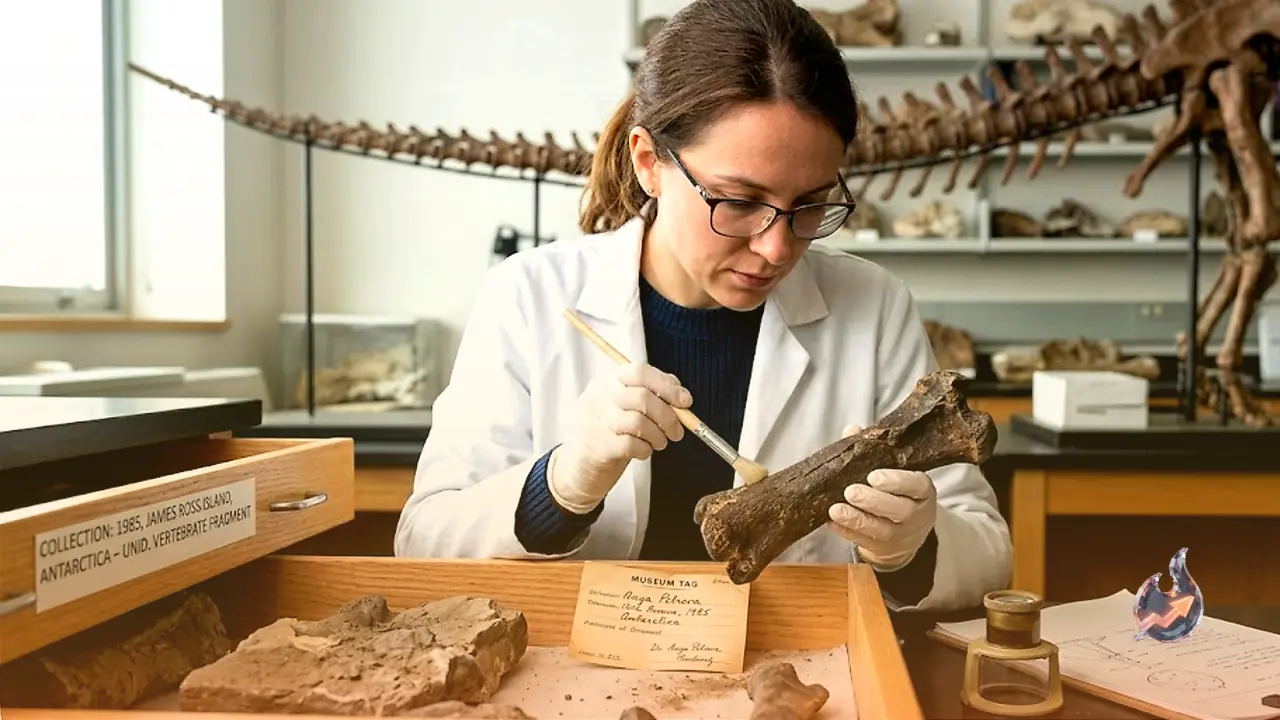
The story begins in 1985, when British Antarctic Survey geologist Mike Thomson was studying rock formations on James Ross Island. While searching for fossils of marine reptiles, he came across an unusual fragment. Thomson logged it simply as the bone of a large reptile and moved on, with no idea at the time that the piece actually belonged to the tail of a titanosaur, the long-necked, plant-eating dinosaur.
Decades Later, a Paleontologist Noticed Something Different
The fragment then sat in the British Antarctic Survey's collection for years until paleontologist Mark Evans came across it. The moment he examined the bone, he suspected it could belong to a dinosaur. That suspicion led to a detailed investigation, comparisons of the bone's size and structure with other fossils, and work by a full team of experts. The team eventually confirmed that the fragment was indeed a dinosaur bone, and the discovery was published on Monday in the journal Acta Palaeontologica Polonica.
Antarctica Was Once Covered in Forests, Not Ice
Antarctica today is a vast, icy desert, but 70 to 80 million years ago the continent looked completely different. Back then, it was home to dense forests, flowing rivers and a climate that was considerably warmer than today's. That is why researchers see this discovery as more than just a single bone, it stands as living evidence of Antarctica's ancient forests, its shifting climate and the planet's long history. Dinosaurs have mostly been associated with forested regions, but this find shows that these massive creatures also roamed icy landscapes.
The Titanosaur Was About 23 Feet Long
Paul Barrett of London's Natural History Museum said the titanosaur to which the bone belonged was roughly 23 feet long. Scientists believe the animal's carcass drifted from the coastline out to the sea floor after its death, where it became embedded in marine rock and fossilised over time. That process is what kept the bone preserved underground for so long before it eventually reached scientists' hands.
Old Technology's Limits, New Technology's Power
Back in 1985, technology was not advanced enough to look inside the bone and correctly identify it, which is why Mike Thomson could not recognise its true nature at the time. Today, however, scientists have access to tools that let them examine the internal structure of bones in detail. It was this modern technology that finally allowed the unassuming fragment to reveal its real story and emerge as a major scientific discovery linked to Antarctica. Researchers hope further discoveries like this one will keep emerging in the future, helping reveal just how many times Earth has transformed over its history.