























Researchers in Australia have turned a giant cockroach into a wearable rescue robot that can crawl into collapsed buildings, film trapped survivors and even inject them with medicine, opening a new front in how emergency teams might respond after earthquakes and disasters.
Why a giant Queensland cockroach was picked
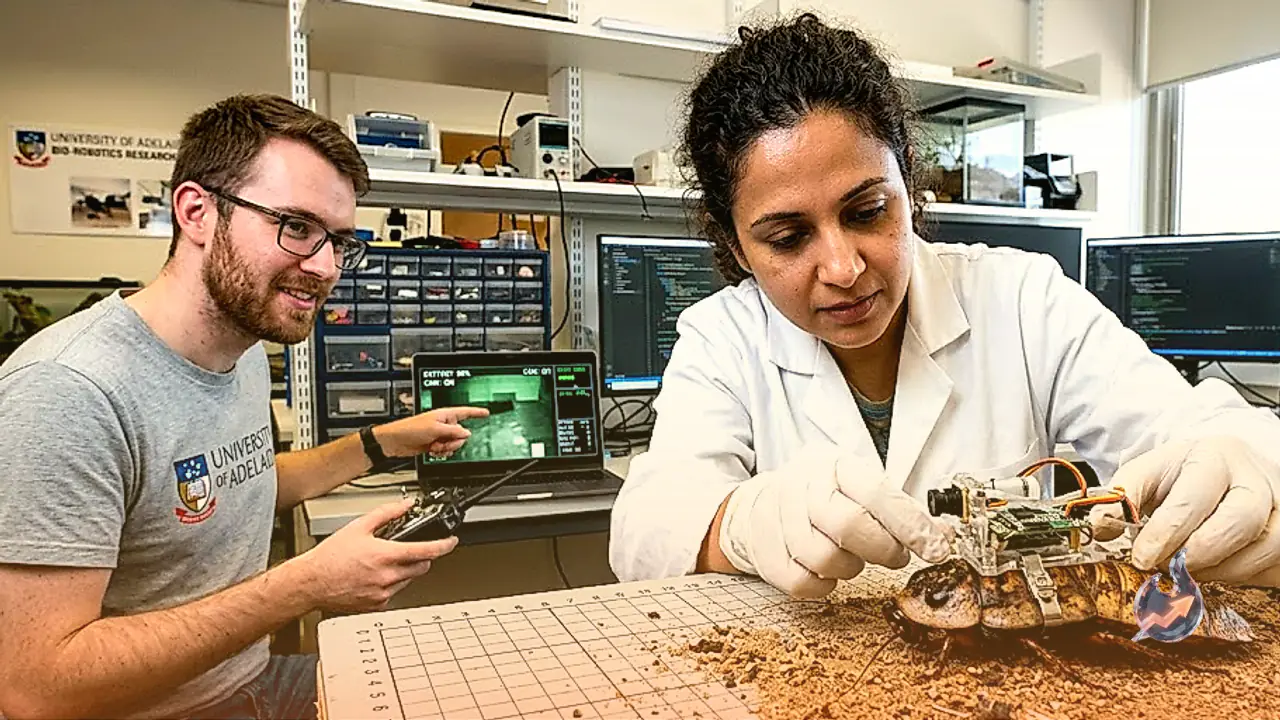
The team, made up of researchers from the University of Queensland (UQ) and the University of New South Wales (UNSW), built the device using a giant burrowing cockroach native to northern Queensland. The insect can grow up to 87 millimeters (3.5 inches) long and weigh as much as 40 grams (1.4 ounces), giving it size and strength that most other insects used in similar robotics experiments lack. Bio-robotics researcher Tan Vo Doan of UQ said cyborg insects have been built for "search and explore" missions for roughly two decades, but his team wanted to push the concept further by giving the insect the ability to actually help a victim rather than just locate one. The findings were published in a paper in the journal Advanced Science.
Two versions built for two jobs, dubbed the Paraborg
The researchers built two versions of what they call the Paraborg. One is fitted with a small camera that can film the condition of a disaster victim, letting rescuers assess injuries before a human ever reaches the scene. The other carries an automatic injection mechanism capable of administering medication on command. Because the cockroach species can carry up to 1.5 times its own body weight, it can bear this extra hardware without much trouble. In the case of the injection-equipped Paraborg, the equipment added about 15 millimeters to its height and roughly 17 grams to its weight, and the study found this did not meaningfully affect the insect's ability to move normally. To build each cyborg, the team anesthetized the cockroach while attaching electrodes and a small microchip, and once the equipment was removed, the insects went back to living as ordinary cockroaches.
Steering an insect with electrical pulses
Control comes from electrodes placed on the cockroach's antennae and its cerci, a pair of sensory organs that protrude from the rear of its abdomen. By stimulating each antenna independently, the researchers could steer the direction the insect walked, while stimulating both cerci together controlled its walking speed. The team tested a range of electrical frequencies and found that stimuli between 10 and 40 hertz worked reliably, but anything above 50 hertz gradually lost its effect on the insect over time.
A syringe powered by a kitchen science reaction
The injection mechanism itself is a compact device that fires a syringe using a small spring. Triggering it breaks a seal separating two internal chambers, one holding citric acid and the other holding baking soda. The two substances react chemically, essentially the same reaction used in a classic baking soda and vinegar volcano, and the carbon dioxide this produces builds up enough pressure to push the syringe's plunger and deliver the medication.
Success rates from the lab tests
To test the system, the team remotely piloted a cockroach from a starting point through three checkpoints before having it deliver an injection to a simulated target. When the insect was within 150 millimeters of the target, the injection succeeded roughly 95 percent of the time. Looking at the entire task from start to finish, including navigation and the injection itself, the overall success rate came to 72 percent. In a separate demonstration, the researchers showed two Paraborgs working as a team, with one using its camera to locate a simulated target while the second moved in to deliver the injection.
Building on earlier cyborg beetles, and what comes next
The same research group has previously built cyborg beetles capable of climbing vertical walls, but the researchers noted that larger cockroaches are better suited to carrying the kind of specialized rescue and medical equipment needed for this application. Still, the trials so far were run under controlled conditions and did not recreate the debris, uneven ground and shifting terrain typically found at a real disaster site. Vo Doan said that with enough resources to accelerate research and field testing, a rescue team of cyborg insects could realistically be deployed at real disaster sites within five to ten years. "Rather than building one robot to do everything, we can harness the natural strengths of different insects and equip them for different missions," Vo Doan said.