

















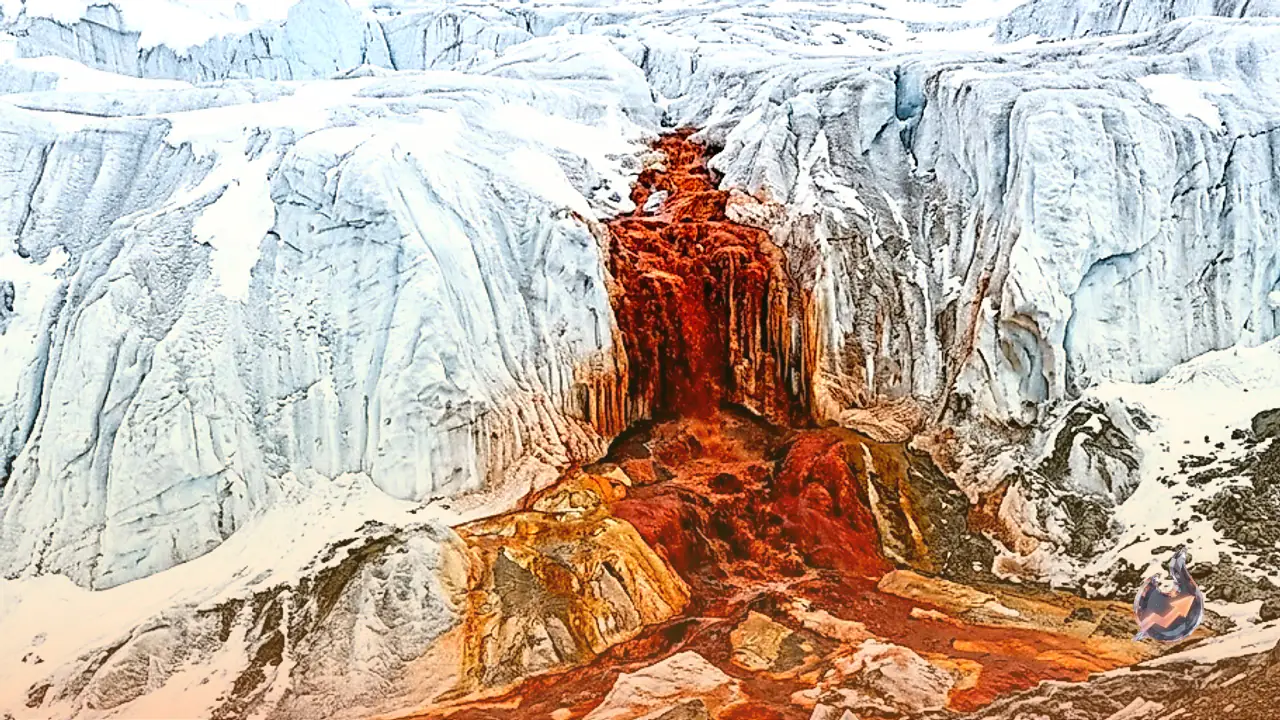

Antarctica is widely known for its breathtaking and pristine white landscapes, yet it harbours a phenomenon that continues to fascinate and baffle researchers. Flowing from the Taylor Glacier into Lake Bonney, this striking feature is universally known as Blood Falls. Its water emerges in a deep, vivid crimson hue, creating a dramatic contrast against the endless expanse of surrounding white ice. To anyone catching a glimpse of it, the sight resembles a gash of red across a frozen canvas, often evoking comparisons to scenes from a horror movie.
Discovery of the Glacier Feature in 1911
The unusual waterfall was first documented by the geologist Thomas Griffith Taylor in the year 1911, during his early explorations of the region. Blood Falls spills out quietly from the edge of the Taylor Glacier, carving long, rust-coloured streaks across the frozen surface. The height of the outflow is frequently compared to that of a five-storey building. The local climate is bitterly cold, with winter temperatures plunging to a freezing minus 19 degrees Celsius. Despite these harsh sub-zero conditions, the landscape continuously discharges a steady stream of salty, blood-red liquid.
The Chemical Reaction of Iron and Oxygen
The vivid red colour of Blood Falls is not caused by any biological pigment, blood, or red algae, contrary to what some might initially assume. The actual culprit is the high concentration of iron dissolved within the water. When the brine, trapped deep beneath the massive glacier, finally makes its way to the surface and meets the open air, the iron within it reacts instantly with oxygen. This natural oxidation process creates iron oxide compounds, which share the exact chemical makeup and rusty brown colour of common metal rust, dyeing the flowing water a brilliant red.
An Ancient Sub-Glacial Reservoir of Trapped Brine
According to scientific studies, the water feeding Blood Falls originates from a subterranean reservoir of highly saline water locked deep beneath the glacier. The history of this water dates back millions of years, originating from ancient seawater that was trapped by shifting landscapes and subsequently buried under accumulating ice sheets. Isolated completely from the external atmosphere and sunlight for eons, this trapped body of water evolved into a bizarre and unique ecosystem where oxygen levels remain remarkably low.
Why the Super-Salty Brine Refuses to Freeze
While ordinary water turns into solid ice the moment temperatures drop to zero degrees Celsius, the brine powering Blood Falls defies this physical rule. The water contains an extremely high concentration of salt, and this intense salinity prevents it from freezing solid. Because of this high salt content, the liquid remains completely fluid even when ambient temperatures plummet far below freezing. The immense pressure inside the ice, ongoing glacial movement, and the unique chemical properties of the brine all drive this continuous flow. Researchers have employed advanced geophysical techniques and radar imaging to map out the hidden structures beneath the thick ice sheets.