























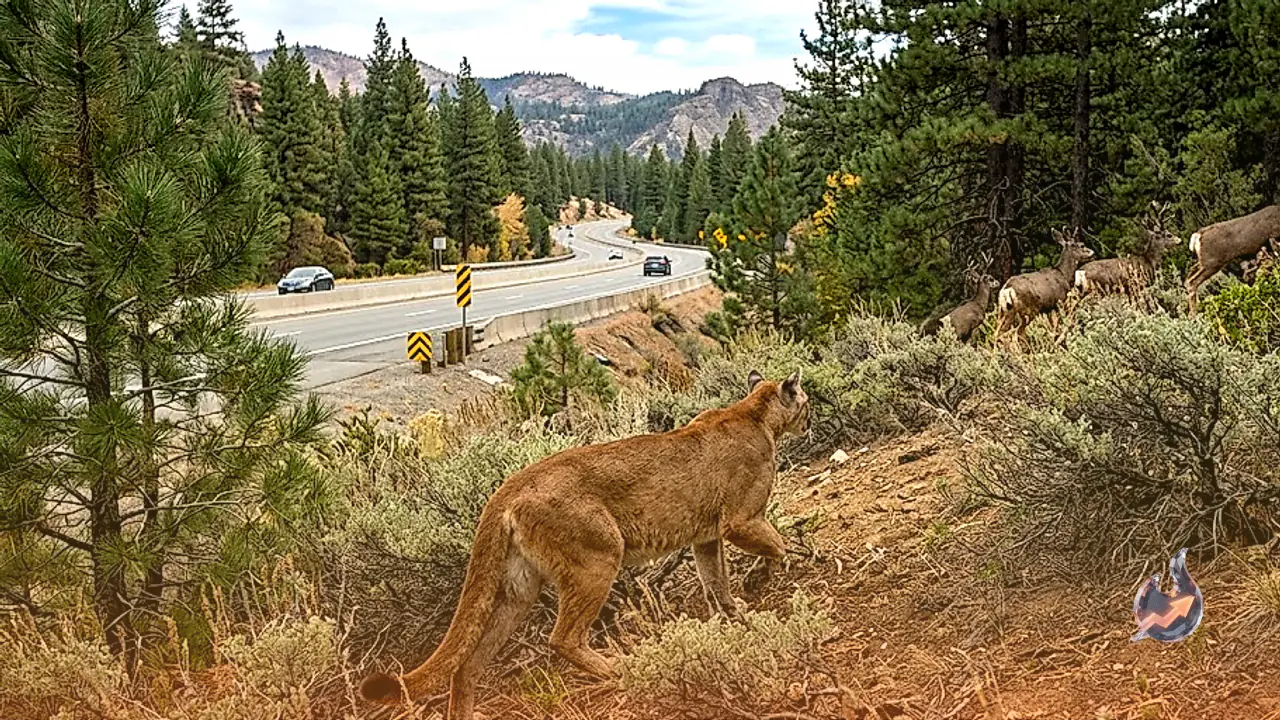

Large wild predators can serve an unexpected role in keeping human motorists safe on forested highways. According to a scientific investigation published Wednesday in the journal Current Biology, traffic accidents involving deer in the United States could drop by as much as 76% in regions supported by a healthy population of cougars. Researchers discovered that the presence of these big cats along roads cutting through woodland terrain and near developments bordering forests prompts deer to actively avoid those danger zones, resulting in a dramatic decline in vehicular crashes.
How Wild Predators Indirectly Protect Drivers on Highways
Cougars, which are also known interchangeably as mountain lions, panthers, or pumas, are native predators of the Americas. Following European colonization, their historical range across North America contracted sharply due to extensive hunting and severe habitat loss. Today, these apex predators reside predominantly across western US states alongside a tiny surviving population in Florida. In contrast, deer populations have expanded exponentially over the past century across the US. Benefiting from a scarcity of natural predators, strict hunting regulations, and land cleared for agricultural development, deer have seen both their habitats and overall numbers flourish.
Surging Deer Populations and Growing Road Accident Statistics
As deer numbers have mounted across North America, auto insurance claims and highway collisions involving animals have escalated concurrently. Insurance records from State Farm indicate that 1.8 million auto insurance claims were filed between 2022 and 2023 for collisions involving wildlife, with deer representing the primary cause. Data tracked by the Insurance Institute for Highway Safety demonstrates that fatal collisions between motor vehicles and animals have climbed steadily since the 1970s. Last year alone, more than 200 people lost their lives in animal related vehicle crashes. Deer pose a persistent driving hazard due to their sheer population density and their habitual foraging behavior along grassy road shoulders.
Insights from the Olympic Peninsula Monitoring Initiative
The newly published study examines how mountain lions effectively function as natural traffic controllers. Findings were derived from data collected on the Olympic Peninsula, where a dedicated cougar monitoring project has been operational since 2018. Managed by the wildlife conservation nonprofit Panthera, this project expanded upon foundational observations gathered over decades by local tribal biologists. Justin Suraci, a senior scientist at Conservation Science Partners and one of the study's lead authors, explained that the research sought to evaluate the broader economic costs and benefits of human coexistence with apex predators. While economic losses incurred by livestock ranchers when predators target cattle are heavily documented, the tangible public safety benefits of predator populations had previously received far less scientific evaluation.
Behavioral Shifts: Why Deer Avoid Forest Road Margins
To analyze how cougars alter deer movement, the research team cross referenced footage from more than 500 remote cameras distributed across the peninsula against a full year of recorded deer vehicle accident data. Justin Suraci noted that cougars operate as ambush predators that prefer edge habitats, such as roads bisecting woodland areas or low density residential housing backing onto forests. Such fragmented environments offer ample cover for cougars to conceal themselves before launching attacks on deer foraging along open edges. Recognizing this heightened risk, deer choose to alter their spatial habits by retreating deeper into denser woods, thereby reducing their exposure to active vehicular traffic.
The study revealed that deer were 15% more likely to avoid roadside areas known to be cougar hunting territory and were 86% more likely to spend their time deeper within wooded terrain. Additionally, deer shifted toward daytime activity when visibility was higher. Over a five-year span, collision rates in areas with robust cougar populations dropped by over 76% compared to regions where cougars were scarce.
Methodological Foundations and Expert Insights on Seasonal Variables
Justin Suraci highlighted that earlier investigations into predator effects on wildlife traffic incidents helped shape the team's research framework, including prior models on cougar recolonization and wolf reintroduction in Wisconsin. These baseline studies allowed researchers to examine deer behavior in established predator zones while confirming that collision reductions stem from behavioral avoidance rather than a simple drop in deer numbers from hunting.
Laura Prugh, a professor of wildlife sciences at the University of Washington, welcomed the findings, noting that the study fills critical gaps in ecological understanding. Having coauthored a 2016 study modeling cougar recolonization impacts on car crashes, she pointed out that the current data reflects summer patterns. She expressed interest in future research to determine whether deer maintain this risk avoidance behavior during the fall mating season, known as the rut, when deer vehicle collisions typically experience a sharp seasonal surge due to distracted animal behavior.