























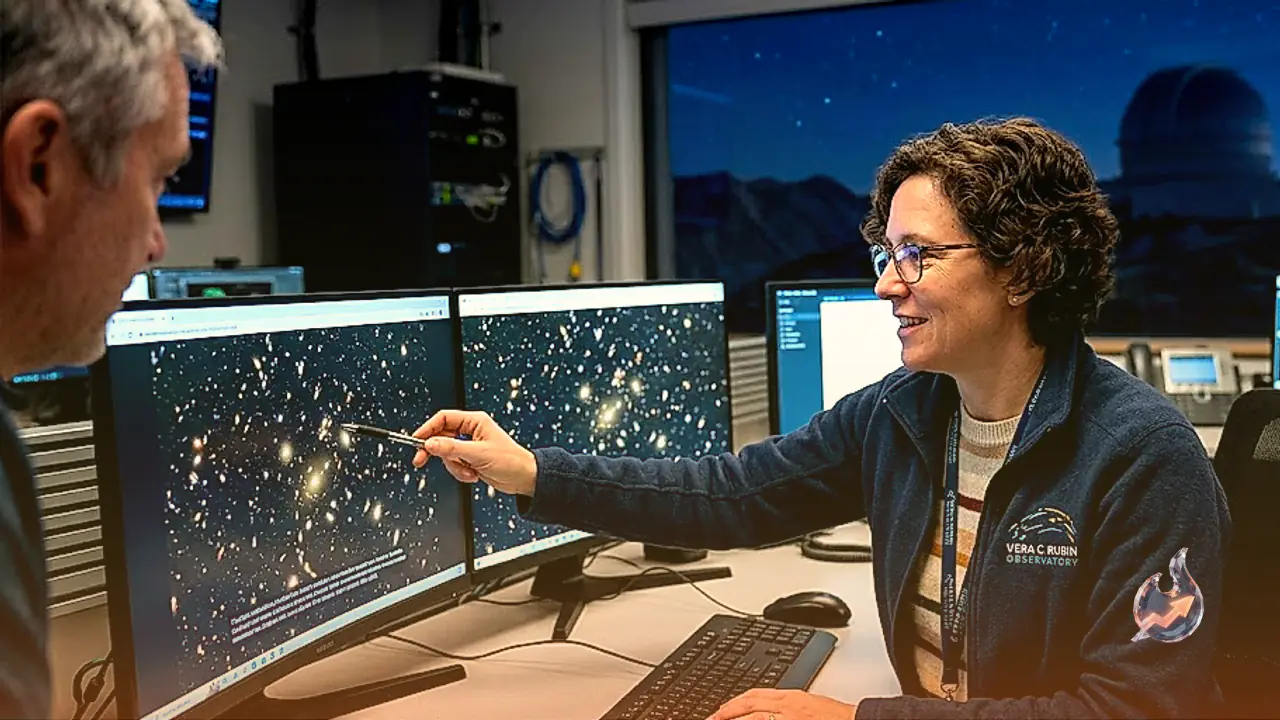

Astronomers studying space and the universe have achieved a major milestone. The Vera C. Rubin Observatory, located in Chile, has released the clearest image yet of a patch of sky that has been studied more than any other. This deep and exceptionally sharp picture reveals roughly half a million galaxies and more than 50,000 stars within a single frame. Most remarkably, this breathtaking cosmic vista was captured using the world's largest digital camera.
Created With the World's Largest Digital Camera
The image encompassing these magnificent celestial sights was produced using Rubin's 3.2-gigapixel LSST camera. This powerful device is mounted on the 8.4-meter Simonyi Survey Telescope. Although the image covers a vast expanse of space at once, it was not captured like a standard photograph in a single snap. Instead, scientists layered and stacked hundreds of separate images on top of one another, which brought distant and faint galaxies into sharp focus.
Spiral, Elliptical, and Interacting Galaxies Revealed
According to reports detailing the observation, the picture clearly displays spiral-shaped galaxies, smooth elliptical galaxies, colliding galaxies, and faint red galaxies from the distant universe. A few bright stars from our own Milky Way appear in the foreground, while everything else represents the distant cosmos. Scientists explained that this region is known as the Cosmos Field, which astronomers have been observing for the past two decades. The effort began in 2003 with the Hubble Telescope, and since then, numerous major global telescopes have kept watch on this sector across wavelengths ranging from radio waves to X-rays.
Why the Cosmos Field Matters
The Cosmos Field holds unique significance because it lies far away from the dense portions of our home galaxy, meaning there are fewer nearby stars and dust clouds to obscure the view. This allows distant galaxies to stand out clearly. The light originating from these galaxies traveled for billions of years before reaching us, making the image a glimpse into the ancient history of the universe.
A Major Milestone for a Ten-Year Mission
Astronomers currently view this achievement as a significant breakthrough, and the Rubin Observatory will repeatedly image this field moving forward. Researchers noted that this effort forms part of the ten-year Legacy Survey of Space and Time mission. Frequent imaging will help capture transient events such as supernovae that flare up and fade quickly.
Unlocking Further Secrets of the Universe
This image forms part of Early Data Preview 2, incorporating scientific observations gathered between April 2025 and January 2026. It covers approximately 3,000 square degrees of the sky, which amounts to roughly one-sixth of the visible night sky in the Southern Hemisphere. Bob Blum, director of operations for Rubin Observatory, stated that this view of the cosmos is only the beginning, noting that observations over the coming years will reveal even fainter galaxies and subtle phenomena. The project operates through the joint collaborative support of the U.S. National Science Foundation and the Department of Energy's Office of Science.