














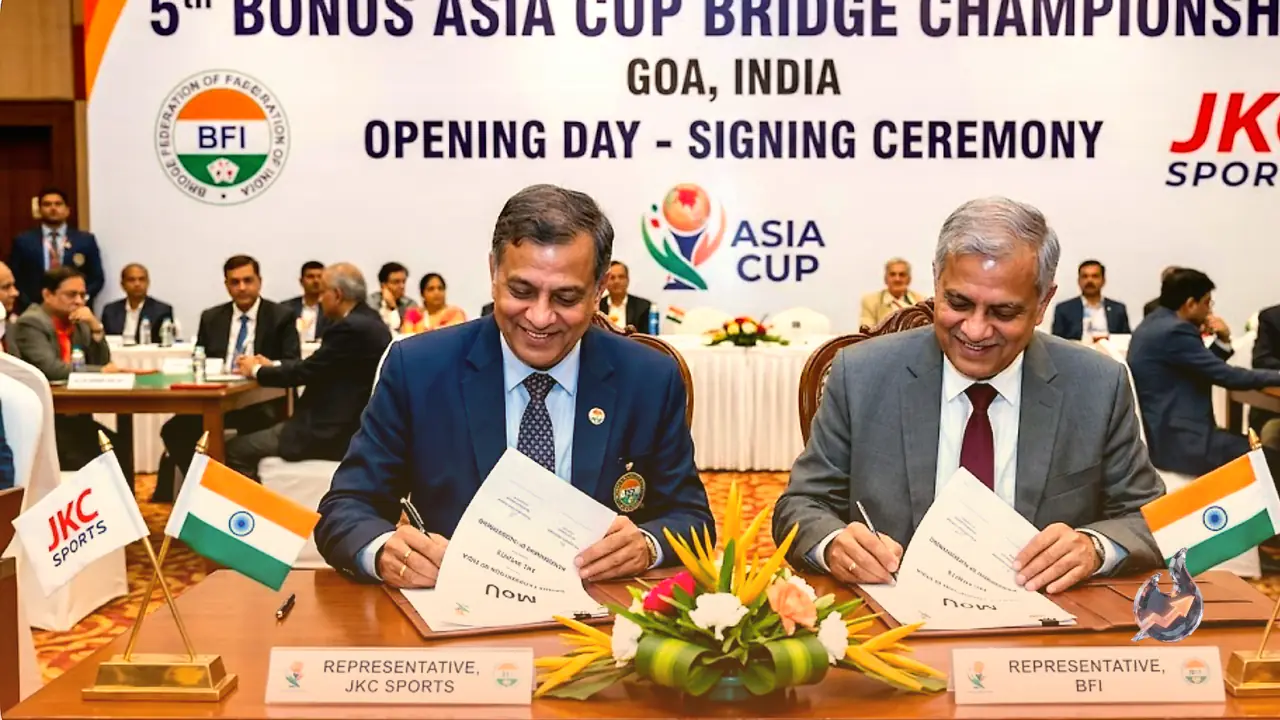

On the opening day of the 5th Bonus Asia Cup Bridge Championship in Goa, two organisations came together to reshape the future of a sport that has long been played widely but never given its institutional due. JKC Sports, the sports arm of the JK Group, and the Bridge Federation of India (BFI), the country's apex governing body for Contract Bridge, signed a memorandum of understanding committing both parties to building a professional structure around the game at every level.
Goa Hosts a Continental Showpiece
The 5th Bonus Asia Cup Bridge Championship, held in Goa from June 21 to 27, ranks among the most significant continental Bridge competitions in Asia. The tournament has drawn 290 players representing 46 teams from 16 countries, underscoring the event's genuinely pan-Asian character. India, the host nation, enters the competition as the defending champion with the ambition to retain its title on home turf. It was against this backdrop that the MoU was announced on the event's opening day.
What the Partnership Will Deliver
Under the agreement, JKC Sports will drive work across three priority areas. The first is grassroots development, taking Bridge into schools, colleges and cities that currently have limited exposure to the sport. The second is a structured mentor-mentee programme, designed to pair emerging talent with experienced players who can guide their growth. The third is the Technical Director Academy (TD Academy), which will embed technology into both training methodology and game administration. Digital platforms such as mybridge360.com will also be used to make the sport more accessible and appealing to younger audiences. The broader aim is to identify talent early, grow participation steadily, and create clear competitive pathways for players who want to progress from beginner to elite level.
Madhav Singhania on Why Bridge Deserves Better
Madhav Singhania, CEO and Joint Managing Director of JK Cement and co-founder of JKC Sports, explained the thinking behind the partnership.
Bridge has had a long and serious following in India, but it has never received the professional structure the sport deserves. Our partnership with the Bridge Federation of India aims to build exactly that. We want to invest in young players, support them through mentorship and the TD Academy, take the game to schools, colleges and emerging centres, and make technology an integral part of training and operations. Through initiatives like mybridge360.com, we want to make Bridge more accessible, engaging and professionally run for the next generation of players.
Why Bridge Earns the Title of Chess of Cards
Bridge is one of the most widely played card games in the world. It earns the description 'chess of cards' because, while the deal involves an element of chance, a player's success depends far more on strategy, memory, and the quality of their partnership. The sport carries formal recognition at the highest international level: the International Olympic Committee (IOC) has officially recognized the World Bridge Federation (WBF) as an international federation.
How the Game Is Played
Bridge is played with a standard 52-card deck by four players divided into two partnerships of two. The game moves through two distinct phases: bidding and play. In the bidding phase, the two sides declare how many tricks they intend to win; in the play phase, they must follow through on that commitment. Planning, card-counting, and tight coordination between partners are the qualities that separate strong players from the rest.
About BFI and JKC Sports
The Bridge Federation of India was founded in 1952 and serves as the supreme governing body for Contract Bridge in the country. It holds recognition from India's Ministry of Youth Affairs and Sports and receives support from the Sports Authority of India (SAI). The federation organises national championships and selects Indian teams for international competitions.
JKC Sports was established in 2025 by Dr. Raghavpat Singhania and Madhav Singhania as the sports vertical of the JK Group. The organisation works across sports infrastructure, technology, athlete development and fitness, with the goal of creating structured opportunities for players from the grassroots all the way up to elite competition.