























Securing the heavy pipe networks that transport oil, gas, and petrochemicals has long been one of the most physically demanding tasks in industrial infrastructure maintenance. Connecting sections of pipe relies on bolted flange joints, where tightening and loosening heavy bolts requires intense physical effort. This exertion regularly leads to workplace injuries among tradespeople, a problem compounded by widespread craft shortages across the broader maintenance sector.
Tackling Exhaustion and Sluggish Field Productivity
The physical demands placed on trade crews frequently lead to chronic fatigue, especially when personnel are scheduled for 12-hour shifts daily across three consecutive months. Extended stretches of strenuous bolting leave crews exhausted, contributing directly to notoriously sluggish pipefitting productivity across job sites in the United States and Canada. Workers forced to battle tight industrial tolerances under extreme exhaustion run a heightened risk of physical strain and chronic injuries.
How the Two-Piece Battery Robot Operates
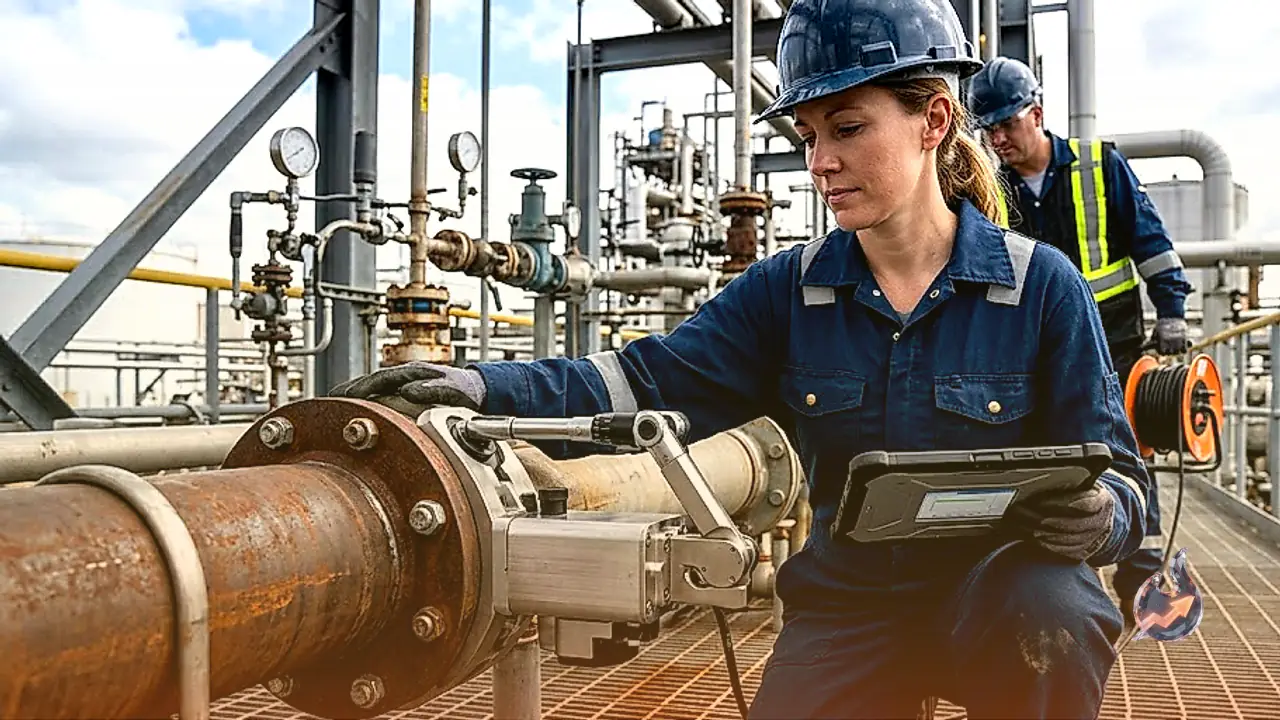
Drawing on years of operational experience as a former engineer and planner at ExxonMobil, Lindsey Elliott set out to rethink how critical energy transport infrastructure is maintained. After engaging with industry specialists at gatherings like the 13th annual Bolting Symposium, Elliott focused her startup, Nexterity, on automating manual bolt handling. The resulting robot is built in two primary sections that clamp securely around an industrial pipe. Operating entirely on battery power, the device slides smoothly along the pipe surface once installed and simultaneously loosens or torques four bolts at a time.
Single-Worker Portability and Equipment Rental Strategy
Nexterity engineered multiple configurations of the device to match standard industrial pipeline dimensions, yet every variation remains remarkably compact. Each unit fits snugly inside a standard Pelican case, allowing a single technician to carry and transport it without needing heavy cranes or multi-person lifting teams. This streamlined form factor is central to the startup's commercial strategy, which aims to distribute the robotic systems across work sites much like standard rental construction equipment.
Standardized Diameters Open a Vast Global Market
The startup honed its hardware specifications after extensive discussions with technical specialists, including members of the Pressure Vessels and Piping Division within the American Society of Mechanical Engineers. Field data indicates that approximately 80% of industrial pipes fall between two and eight inches in diameter, standard sizes designated as NPS2 through NPS8. This widespread uniformity makes bolted flange maintenance an ideal environment for automated intervention. Beyond the petroleum sector, identical piping joints are fundamental to clean water systems, wastewater treatment facilities, food and beverage processing, mining, nuclear power generation, and green manufacturing plants, creating immense commercial runway for automated pipefitting tools.