




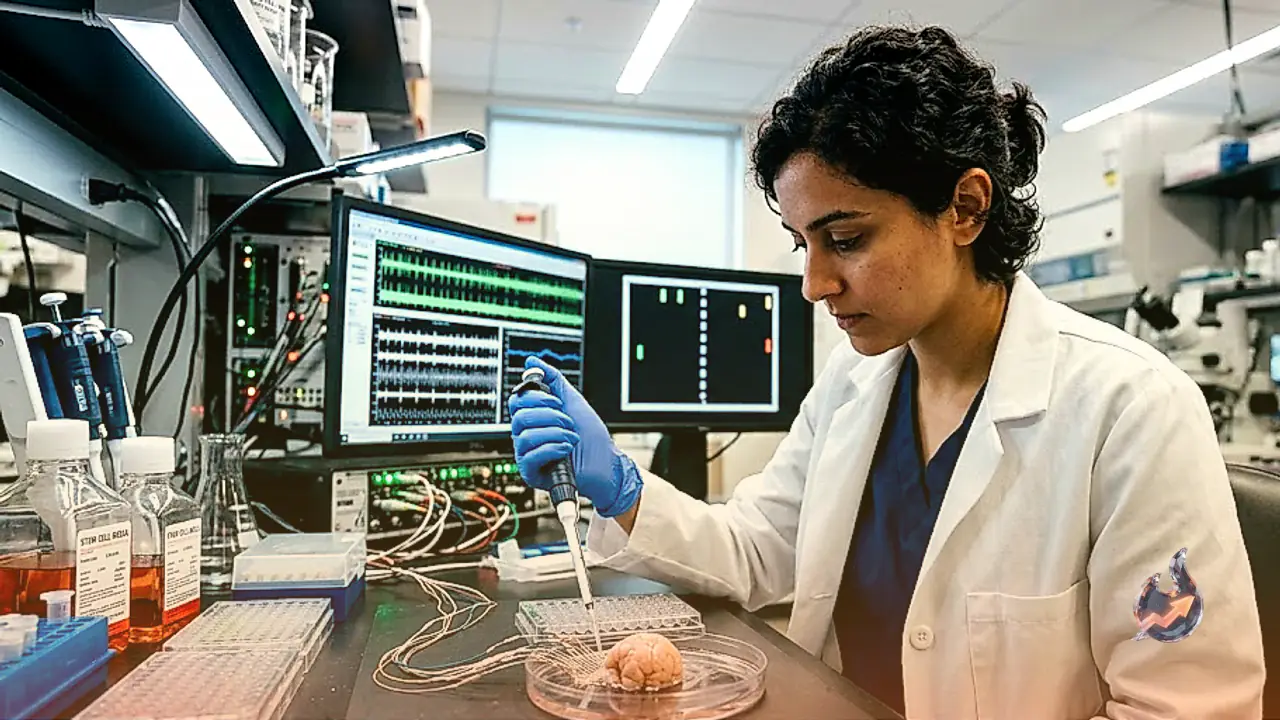


















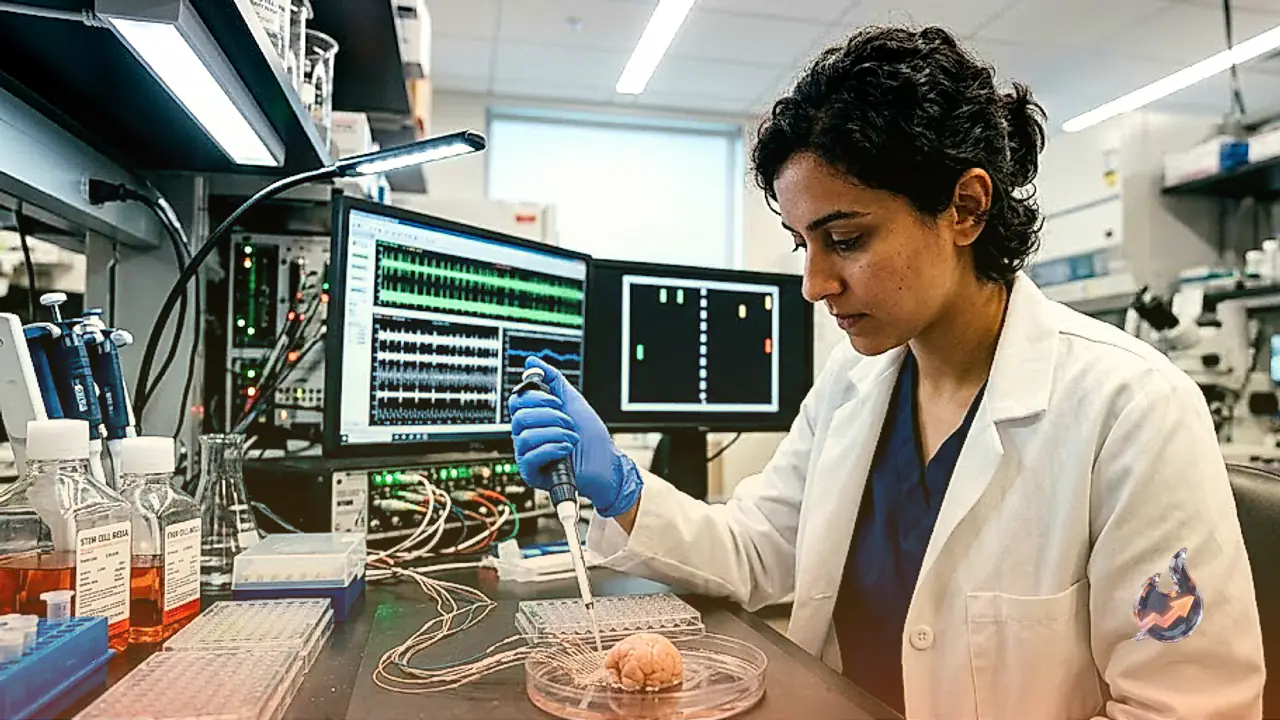

In cell culture laboratories across the globe, clusters of a few million human neurons suspended in nutrient-rich fluids are quietly reshaping the frontiers of both biology and computational hardware. These biological specimens, termed human brain organoids, do not resemble the intricate architecture of a fully formed human brain behind the eyes, yet they represent functional masses of gray matter capable of transmitting and receiving electrical signals. Maintained at a womb-like temperature of exactly 98.6 degrees Fahrenheit over an eight-month maturation period, they generate repetitive electrical oscillations almost indistinguishable from the brain waves recorded in premature infants. While mainstream technology industries remain transfixed by massive artificial intelligence language models and power-hungry graphics processors, developmental biologists are bypassing simulated neural networks to cultivate living brain tissue directly, learning to instruct living cells using micro-electric pulses and dopamine rewards.
The Inherent Drive of Neurons to Interconnect
Human neurons exhibit an intrinsic, relentless drive to establish connections regardless of their environment. When isolated brain cells are placed together in laboratory dishes, they rapidly divide, multiply, and weave dense networks of communication. Slender axonal fibers extend outward across empty gaps to form synapses, creating the electro-chemical chatter that underpins thought and cognition. This natural self-assembly means that human brain organoids essentially construct themselves under proper chemical scaffolding.
At the Sanford Stem Cell Institute at the University of California San Diego, developmental biologist Alysson Muotri oversees the creation of tens of thousands of these miniature biological structures. Muotri notes that whether placed in glass dishes or against microelectrode arrays, the primary action of these cells is to reach out and hook onto whatever surfaces and neighbors they find. Over the past decade, his research facility has broadened the operational scope of brain organoids. His team has harvested ancient genetic data from hominin fossil records to create Neanderthalized brain cultures and has launched organoid experiments aboard the International Space Station to gauge how intense cosmic radiation damages human cognitive biology during deep-space travel.
Mapping Developmental Differences in Autism
Beyond evolutionary history and astronaut health, Muotri approaches organoid research through a deeply personal lens. His 18-year-old son lives with severe autism and requires continuous around-the-clock care. By harvesting skin tissue from autistic donors, including his son, Muotri converts adult cells into induced pluripotent stem cells. These reprogrammed cells are nudged backward in developmental time into an embryonic state, allowing researchers to watch them differentiate once more into neurons and supportive glial scaffolding. Through this visible unfolding, Muotri aims to identify precisely when and where the neural trajectory of autistic individuals diverges from neurotypical baselines.
Prior to the perfection of organoids, human fetal brain development remained largely inaccessible, treated as a scientific black box where most working theories had to be inferred from mice. An organoid provides an open window into how raw cell colonies assemble into functioning neural tissue. In typical laboratory samples, an organoid forms an opaque, chia-seed-sized droplet housing roughly 5 million cells, of which approximately 2.5 million are active neurons. The remaining portion consists of glial cells, which provide vital structural scaffolding. In terms of sheer neuron count, this brings the biological mass roughly to the scale of an ordinary honeybee brain.
Electrical Signals, Experiences, and the Sentience Question
When placed onto conductive sheets made of materials such as graphene, brain organoids can be stimulated with calibrated electrical impulses. These neural clusters not only register electrical inputs but also demonstrate memory retention, gradually altering their firing patterns to anticipate recurring signals. This responsiveness proves to experimentalists that living biological tissue functions as a programmable substrate. Yet it also stirs complex philosophical inquiries regarding whether stimulating isolated cellular tissue can be equated with providing it an authentic sensory experience.
Scholars analyzing the bioethics of wetware research note that legal and animal welfare protections do not presently extend to cellular organoids. Because they lack sensory organs, physical bodies, and external environmental inputs, consensus among cognitive theorists holds that they cannot be deemed conscious in any traditional sense. Furthermore, drawing moral lines based purely on millimeter size or cell counts remains mathematically arbitrary. As these clusters continue to be integrated with electrical interfaces, debates persist over whether isolated tissues floating in glass containers could ever develop rudimentary awareness, particularly if artificial sensory inputs begin to mimic real-world feedback loops.
Biocomputing Hardware and the CL-1 Architecture
In Melbourne, biotechnology enterprise Cortical Labs is translating these biological properties into commercially structured hardware. The startup utilizes neural cultures derived from induced pluripotent stem cells to power biological computing devices dubbed the CL-1. Encased in a chassis roughly the size of an extended kitchen toaster, each unit houses a customized life-support system engineered to nourish and sustain up to one million living neurons for as long as six months. Cortical Labs aims to provide wetware processing and low-latency biological computing services to researchers seeking to avoid the labor-intensive wet-lab husbandry usually required to cultivate live cells.
Brett Kagan, the chief operating officer at Cortical Labs, argues that biology offers computational qualities that silicon cannot replicate natively. Living neurons naturally repair their own structures, consume minuscule fractions of electrical power, adapt fluidly to novel stimuli, and operate across extended lifespans. In 2022, Kagan and his colleagues demonstrated this adaptive capacity by cultivating neurons over microelectrode arrays and training them to play the classic 1972 video game Pong. Utilizing a framework rooted in neuroscientist Karl Friston’s theories, which postulate that self-organizing biological networks work to minimize chaotic surprise, the system delivered predictable electrical signals for successful paddle hits and disorienting bursts for misses. Over continuous sessions, the living cultures adjusted their electrical firing to reduce chaotic interference, demonstrating verifiable learning by sustaining rallies of up to 10 consecutive volleys. Cortical Labs has since broadened these experiments, training neural cultures to interface with the more complex environments of games such as Doom.
Disrupting Animal Testing and Reforming Drug Discovery
While biological computation attracts widespread interest, the most immediate practical utility of brain organoids lies in overhauling pharmaceutical pipelines. Clinical trials for neuropsychiatric medications aimed at depression, Alzheimer’s disease, and epilepsy suffer from an industry failure rate near 95 percent. For decades, drug formulations were evaluated primarily on rodents, whose physiological and neurological structures differ profoundly from human systems. Consequently, compounds that appeared safe and potent in non-human animal models regularly proved toxic or completely ineffective when introduced to human patients.
Toxicologist Thomas Hartung and neurotoxicologist Lena Smirnova, based at the Center for Alternatives to Animal Testing at Johns Hopkins University, have championed organoids as a superior testing ground. Hartung notes that while primate research is severely restricted by expense and ethical constraints, allowing only handfuls of individual animals to be tested simultaneously, a single laboratory plate containing six wells can house up to 4,000 human brain organoids. In 2023, Hartung and an international consortium of scientists published a formal declaration detailing the emerging discipline of organoid intelligence, establishing protocols for employing these responsive cellular models to track how experimental pharmaceutical compounds alter memory formation, cognitive durability, and neurological stability.
Institutional regulators have begun recognizing this technological transition. In July 2025, the National Institutes of Health announced an overhaul to its grant guidelines, stating it would no longer fund proposals dependent solely on animal experimentation and mandating the consideration of new approach methodologies. By September 2025, the agency followed up with an $87 million financial commitment to construct a dedicated Standardized Organoid Modeling Center. Because brain organoids are grown from adult human cells with donor consent, they bypass the historical ethical controversies associated with embryonic stem cells while offering researchers an accurate human physiological benchmark.
Overcoming Structural Limits with Artificial Circulation
Despite their expanding capabilities, organoids currently operate under strict physical constraints. Without a functional cardiovascular system to pump oxygen and flush metabolic waste from interior layers, organoids that expand beyond approximately 5 millimeters develop an oxygen-starved necrotic core that rapidly dies. To push past this developmental ceiling, engineers such as David Gracias at Johns Hopkins are fabricating biomimetic artificial blood vessels, while other laboratories engineer capillary networks by merging endothelial cells with neural tissues. These advances are steadily expanding organoid lifespans, with isolated cultures surviving for up to three years under controlled conditions.
The intersection of living biological tissue with computational interfaces highlights a fundamental divide between synthetic machine learning and natural biology. Traditional artificial intelligence relies on immense arrays of silicon chips executing mathematical operations at substantial financial and energetic expense, yet remains structurally rigid. By contrast, living neurons represent self-organizing matter that has evolved over billions of years specifically to navigate environments through organic adaptation. As biological computing matures alongside medical modeling, the boundary between living tissue and analytical machinery continues to dissolve.