




















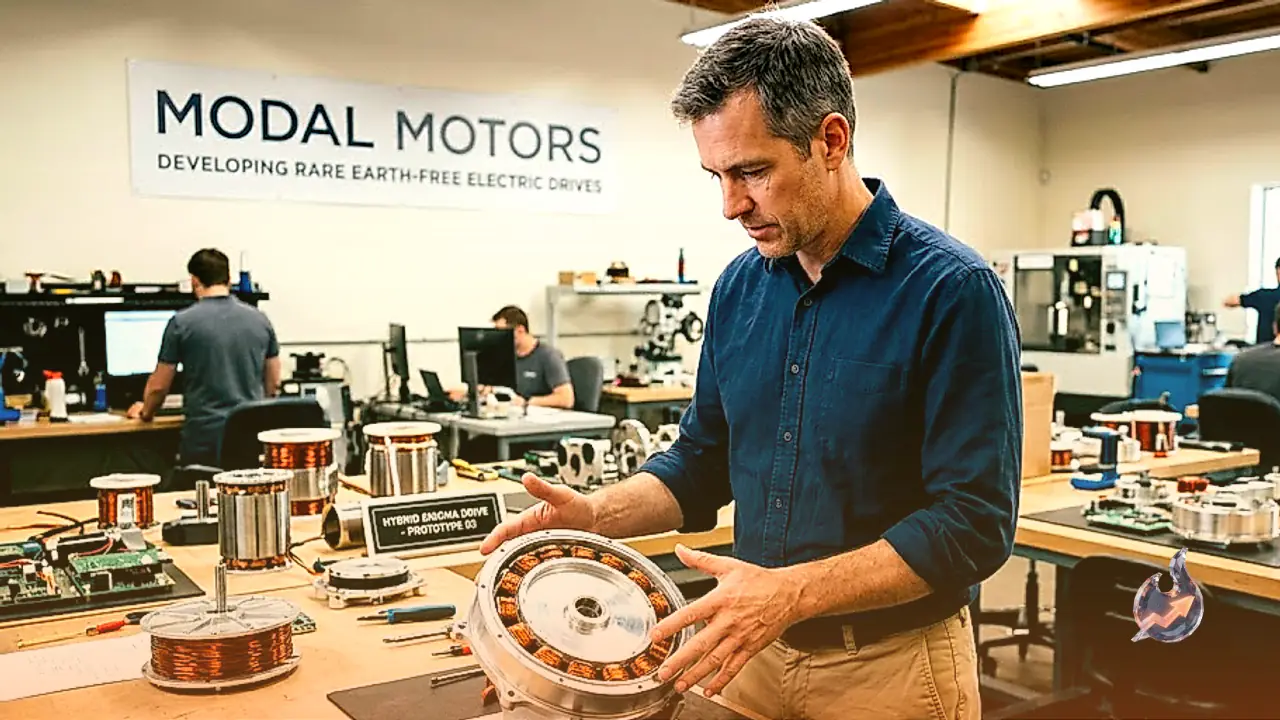

Efforts to bring domestic manufacturing back to the United States are gaining significant momentum, particularly across hard-tech sectors such as robotics and unmanned aerial drones. Michael Van Steenburg believes his approach is already well ahead of current industry efforts. After spending the past decade manufacturing a wide variety of electric motors across North America and the U.S., Van Steenburg is embarking on a fresh initiative with his new startup venture, Modal Motors. His primary mission this time is to completely eliminate rare-earth permanent magnets from electric motors, directly untangling American hardware production from Chinese supply networks.
Challenging the Flawed Reshoring Approach
The geopolitical urgency around raw material access has sharpened as China has repeatedly restricted exports of critical rare-earth commodities. While multiple domestic firms are actively building electric motor production lines within the United States, Van Steenburg contends that most of these competitors are pursuing a deeply flawed strategy. By continuing to design around rare-earth materials, these initiatives remain chained to external inputs because a mature, independent domestic supply chain for these elements remains several years away from reality.
Van Steenburg points out that conventional reshoring operations are essentially duplicating Chinese motor architectures and assembling them domestically. These operations rely on the hopeful assumption that local mining, refining, and magnet manufacturing ecosystems will mature rapidly, though replacing Chinese mineral capacity will actually require a prolonged timeline.
The Engineering Behind the Hybrid Enigma Drive
To overcome this resource bottleneck, Modal Motors has introduced an unconventional planar motor layout named the Hybrid Enigma Drive. This ultra-flat architecture allows powerful electric propulsion to fit directly into compact, low-profile compartments where standard bulky motors cannot operate, offering high utility for robotics and specialized hardware applications without needing scarce magnetic minerals.
Van Steenburg is applying decades of direct automotive engineering background to bring these robust, magnet-free systems into commercial production. The shift toward removing China entirely carries historical irony for the founder. Back in the late 1990s, he developed a hybrid gasoline-electric drivetrain intended for integration into the Chinese state project known as the People's Car.
A Quarter-Century of Supply Chain Realities
Reflecting on that early collaboration, Van Steenburg observes the dramatic changes in the global industrial landscape, while noting that his outsider perspective and appetite for tough technical challenges have remained constant.
He highlights that the warning clock began ticking roughly 25 years ago. Over that entire span, international observers witnessed a gradual monopolization as China systematically secured overseas mineral concessions, acquired global mining operations, and consolidated absolute control over processing channels for rare-earth elements. Modal Motors is positioning its new motor architecture as a decisive technical departure from that concentrated ecosystem.