






















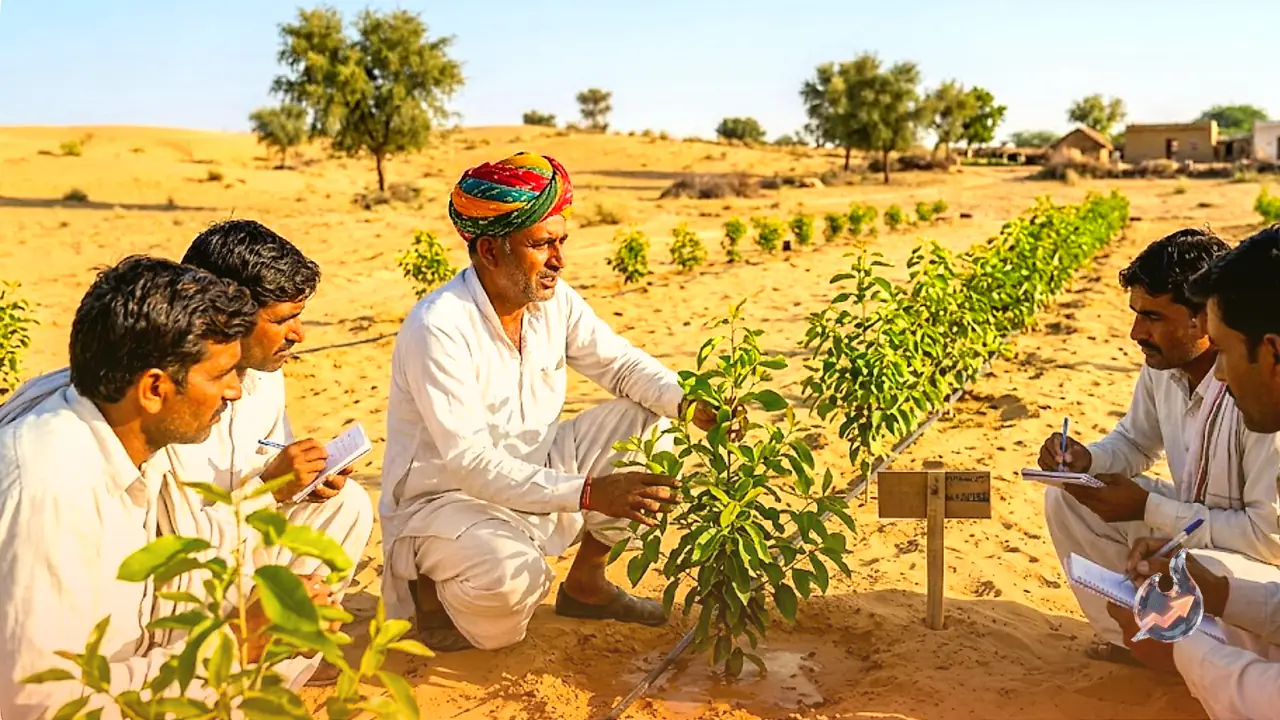

A farmer in Rajasthan's Sikar district has pulled off something local farmers once thought impossible, growing sandalwood on sandy desert land. Manoj Hudda from Gangiyasar village has planted sandalwood saplings on his sandy field, and the young trees are now thriving where only bajra and mustard were ever expected to grow.
A shift away from traditional crops
Rajasthan has long been known for its sand dunes and for crops like bajra and mustard. But as times change, farmers across the state are moving beyond traditional farming toward newer, more profitable crops. The story from Gangiyasar village in Sikar district is a striking example of this shift. On land where people could once barely imagine sandalwood cultivation, green sandalwood saplings are now flourishing. It is being seen as a one of a kind first attempt in the region. Manoj says that if farming is done scientifically and with proper planning, even desert land can give farmers better profits.
Soil and water tested before taking the plunge
Manoj Hudda says he did not rush into sandalwood farming. Before starting, he first got the soil and water on his field scientifically tested. Only after the test report showed that conditions were favourable for sandalwood did he decide to move forward. The whole idea began with advice from a friend, after which Manoj gathered detailed information about sandalwood cultivation and started the venture with full preparation.
103 saplings brought from Karnataka, all still standing
Manoj ordered 103 sandalwood saplings from Karnataka and planted them on his field. Planted roughly a year ago, all 103 saplings are safe today and developing well. Their survival has boosted Manoj's confidence considerably. He says many people initially called the experiment risky, but he refused to give up and kept caring for the plants continuously. Regular irrigation, proper nutrition and management based on expert scientific advice have kept the saplings healthy.
A tree ready in 12 years, worth lakhs of rupees
According to Manoj, sandalwood farming is a long term investment, but the payoff is just as big. With proper care and favourable conditions, a single sandalwood tree, ready in about 12 years, can fetch a value running into lakhs of rupees. That is why farmers in several states across the country are now being drawn toward sandalwood cultivation.
Now an inspiration for neighbouring farmers
Manoj Hudda's experiment is fast becoming an inspiration for farmers in the surrounding area. Several farmers are visiting his field to understand the finer points of sandalwood cultivation and to gauge its potential. Manoj believes that if farmers adopt new, high value crops alongside traditional farming, their income can rise significantly. Through sheer determination, scientific thinking and hard work, he has proved that the fragrance of sandalwood can spread even across sandy dunes.