


















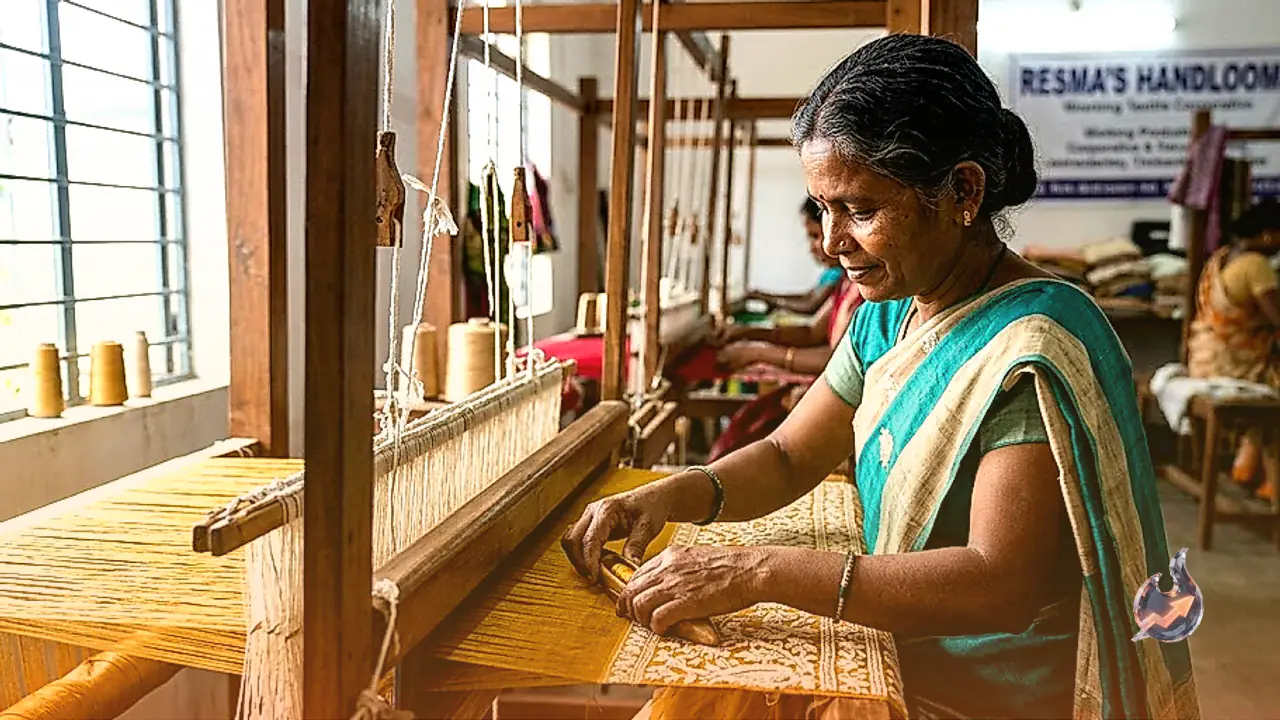

A resident of Jharkhand's capital city, Ranchi, Reshma has carved out a unique space in the traditional apparel sector through creative craftsmanship. Her business revolves around an unconventional pairing that stands apart in standard fashion markets. By blending the regional legacy of Jharkhand's traditional Tussar silk with the delicate art of Chikankari embroidery, she crafts distinctive kurtis and salwar suits that highlight artisanal excellence.
The Fusion of Regional Handlooms and Heritage Needlework
The defining element of Reshma's collection is the harmony between the texture of Tussar silk and the elegance of Chikankari needlework. The base garment is fashioned from pure Tussar silk, upon which specialised artisans execute intricate patterns. Rather than sourcing ready-made templates, Reshma oversees every step of the creative cycle, managing the design process personally to ensure the final piece remains completely authentic and exclusive.
Pure Handmade Production Taking 25 Days Per Suit
Strict adherence to manual craft forms the backbone of her brand. No machinery is employed at any stage of manufacturing. From cutting and tailoring the salwar suit to stitching the fine embroidery on top, the entire workflow is performed by hand. Creating a single suit requires the collaborative labour of 4 to 5 artisans working patiently over a period of 25 days.
Because of this intensive time commitment and meticulous handiwork, the standard pricing of these suits ranges between Rs 5000 and Rs 20,000, with prime handcrafted sets commanding up to Rs 25000. Alongside these premium silk combinations, she also provides standard Chikankari apparel featuring a spectrum of at least 25 to 30 colour choices. Reshma personalises the hues according to customer preferences, handling both garment styling and dyeing internally.
Focusing on Originality and Expanding to Metros
Reshma built her venture on an uncompromising commitment to premium standards. Her founding principle was to offer customers genuinely authentic pieces rather than mass-produced alternatives. She prioritized quality over sheer volume, deciding that even if she sold only a couple of garments, each one should represent exceptional beauty and craftsmanship. That strategy proved effective, generating steady orders from South Indian hubs such as Bengaluru and Chennai.
Now completely self-reliant at the age of 47, Reshma notes a meaningful shift in her personal life. While she previously enjoyed financial security through her husband, establishing an enterprise through her own talent brings a different level of satisfaction. The business has also broadened her horizons, providing opportunities to travel and showcase her creations at exhibitions across major cities.