




















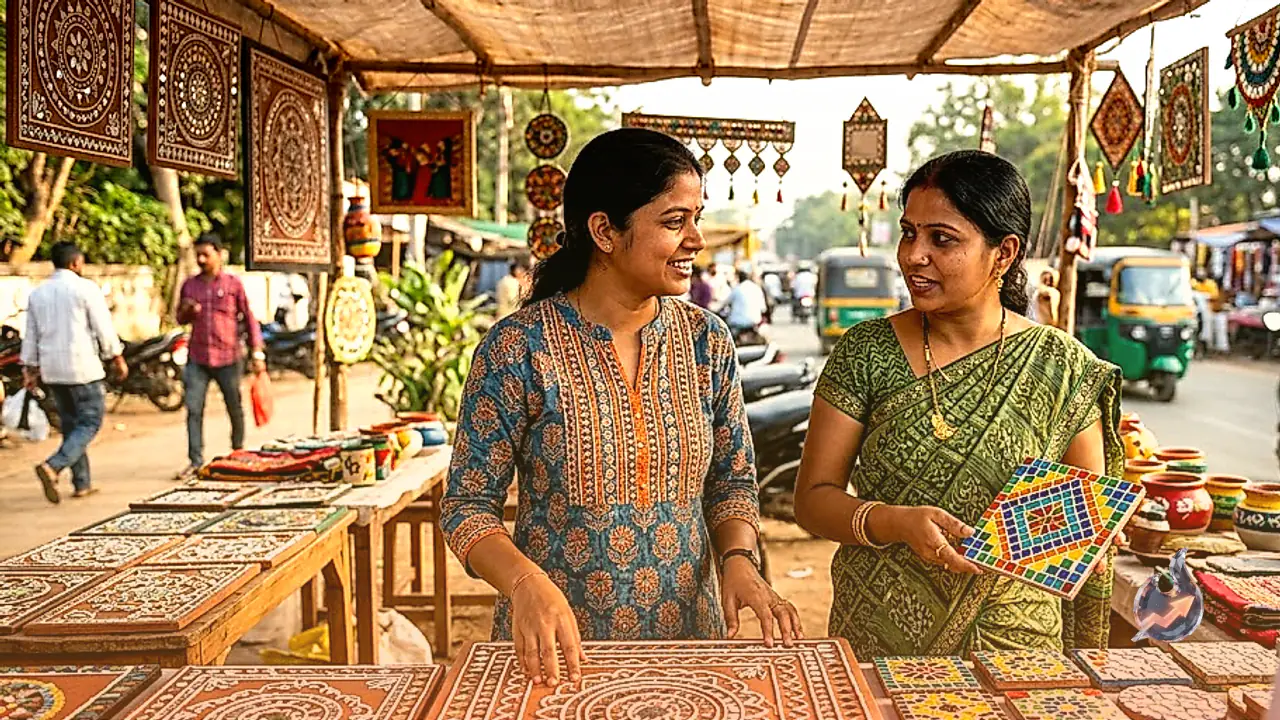

At a roadside stall in Chhattisgarh's Surguja district, two sisters are selling handcrafted mosaic art and lippan art, and their story breaks the usual mould associated with such stalls. There is no financial hardship pushing them into this trade, only a determination to turn their craft into a recognised career.
No shortage of money, yet they chose to sell on the street
At first glance, it would be easy to assume the stall exists to support the family's income, as is often the case with such setups. But Mrigakshi, who runs the stall, said there is no financial shortage in her household at all. Her father works as an engineer in a government department, and the family has every comfort it needs. After completing their 12th grade studies, Mrigakshi and her sister Mrinali chose not to follow the usual path of chasing a job, and instead decided to make their art their profession. That decision could not have been easy, since most families expect their children to look for employment as soon as their education is done.
A hobby that slowly turned into a career path
In their free time, Mrigakshi and Mrinali used to make mosaic art, lippan art, gift hampers and various decorative pieces at home. Mosaic art involves piecing together small fragments of glass, tile or stone to form a design, while lippan art is a traditional mud and mirror-work craft. Over time, this hobby grew into something the sisters no longer saw as a mere pastime but as a way of building their own identity. They are now taking these handmade products to a wider audience and working to establish them as a proper brand.
The story behind the name Lianbi
The sisters have named their brand Lianbi. It is not a random word; it was formed by combining the meanings behind the names Mrigakshi and Mrinali. The word Lianbi is believed to carry associations with a lotus flower and a fawn. For the sisters, the brand is not just a way to sell products, but an attempt to give their work a distinct identity that reflects their own thinking and effort.
Art from Rome and craftsmanship from Kutch, now in Surguja
The stall carries ancient Roman-style mosaic art, the well-known lippan art of Gujarat's Kutch region, attractive hampers and several kinds of handmade decorative items. Such artworks are usually found only in big cities and tend to come at a higher price there, but Mrigakshi and Mrinali have made them accessible to people in a smaller city like Surguja. That means local residents no longer need to travel to a metro to find this kind of craftsmanship.
Friends have become a source of encouragement
Throughout this journey, the sisters' friends have stood firmly by their side. Friends who visit the stall not only buy the products themselves but also spread the word to others. This support keeps boosting the confidence of Mrigakshi and Mrinali and gives them the courage to push their venture further.
A message the sisters have for other young people
Mrigakshi and Mrinali say that passion and hard work can turn even a hobby into a successful career. They believe young people should not limit themselves to chasing conventional jobs, and should also consider turning their talent and creativity into a source of livelihood.
The initiative undertaken by Mrigakshi and Mrinali shows that big dreams can be realised in small cities too, not just in metros. The products they craft by hand are winning over local buyers, and in the process, they are giving Surguja a fresh identity in handicrafts and creative entrepreneurship.