






















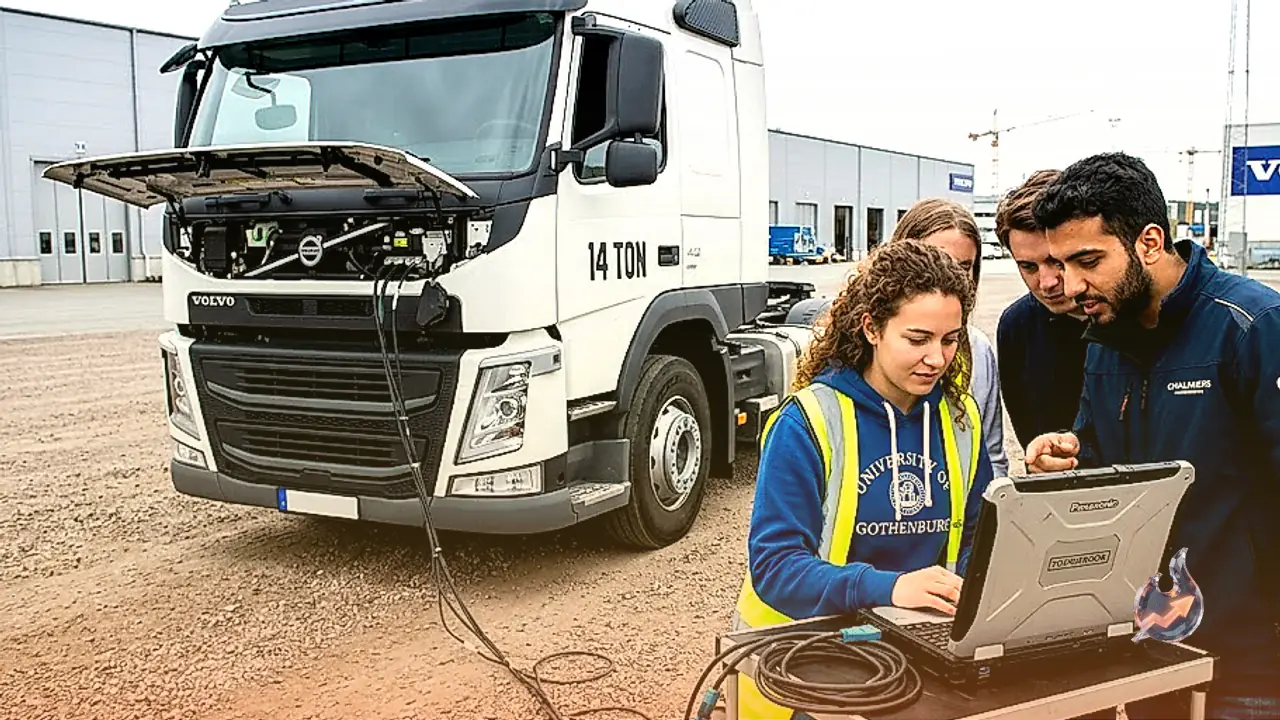

In Gothenburg, Sweden, a group of university students demonstrated that software code running on an ordinary laptop can directly operate a massive 14-ton commercial truck. During the unique "Hack-a-Truck" event, participants took control of a Volvo vehicle's critical functions, including steering, braking, and acceleration, using standard programming languages such as Python, Rust, and C++.
A High-Stakes Competition with Strict Time Limits
The competitive hackathon saw intense interest, drawing applications from 33 different student groups. However, only three teams consisting of three members each were selected to enter the final testing arena. The structure of the challenge put severe pressure on the participants. Each trio received a brief 20-minute window on the test track to execute their code on the real truck, followed by a single hour back in the lab to debug errors and refine their algorithms.
Unconventional Controls and the Winning Solution
To command the heavy vehicle, teams experimented with creative input methods, ranging from Xbox game controllers to digital musical instruments. One group notably gathered attention by managing the truck's steering mechanism using a digital guitar. The ultimate victory went to a team from the University of Gothenburg, comprising students Riyadh Santir, Valentina Rrustem, and Wesam Al-Joenat. Their system successfully guided the 14-ton Volvo along a straight path and commanded it to perform a complete autonomous circle.
Precision Timing at the Kernel Level
The core technical hurdle facing the coders was time synchronization. The electronic accelerator on the heavy vehicle required millisecond precision to process commands without stalling or failing. The winning team solved this by locking their software execution directly to the kernel clock of their system. This precise timing allowed them to build features like autonomous forward and reverse movement, GPS-guided circular paths, straight-line cruise control, and manual driver input through a PS4 controller.
Guidance and Expert Oversight
To ensure safety and technical preparation, Hackathon Manager Dr. Srijita Basu conducted two days of foundational workshops prior to the main track day. She instructed the students on heavy vehicle mechanics, laptop-to-truck network communication, safety protocols, and potential failure scenarios. Dr. Basu monitored every live run during the event and provided unbiased technical insights to assist a panel of three judges in evaluating the outcomes. Dr. Basu has served as a postdoctoral researcher at Chalmers University of Technology and the University of Gothenburg for two years, following her PhD at IIIT Kalyani and prior experience as a senior research engineer at Jadavpur University.
Bridging Classroom Code and Real Machines
The event organizer, Professor Miroslav Staron, highlighted the immense practical value of connecting academic learning with physical industrial hardware. He noted that such hackathons allow young developers to transform their technical standing within a single day. Professor Staron stated that even in an era where artificial intelligence can automatically generate code, identifying real-world engineering problems and crafting simple, robust solutions remains an indispensable skill. For the master's and bachelor's students from both participating universities, the opportunity provided rare hands-on experience with commercial hardware, significantly strengthening their professional credentials.