






















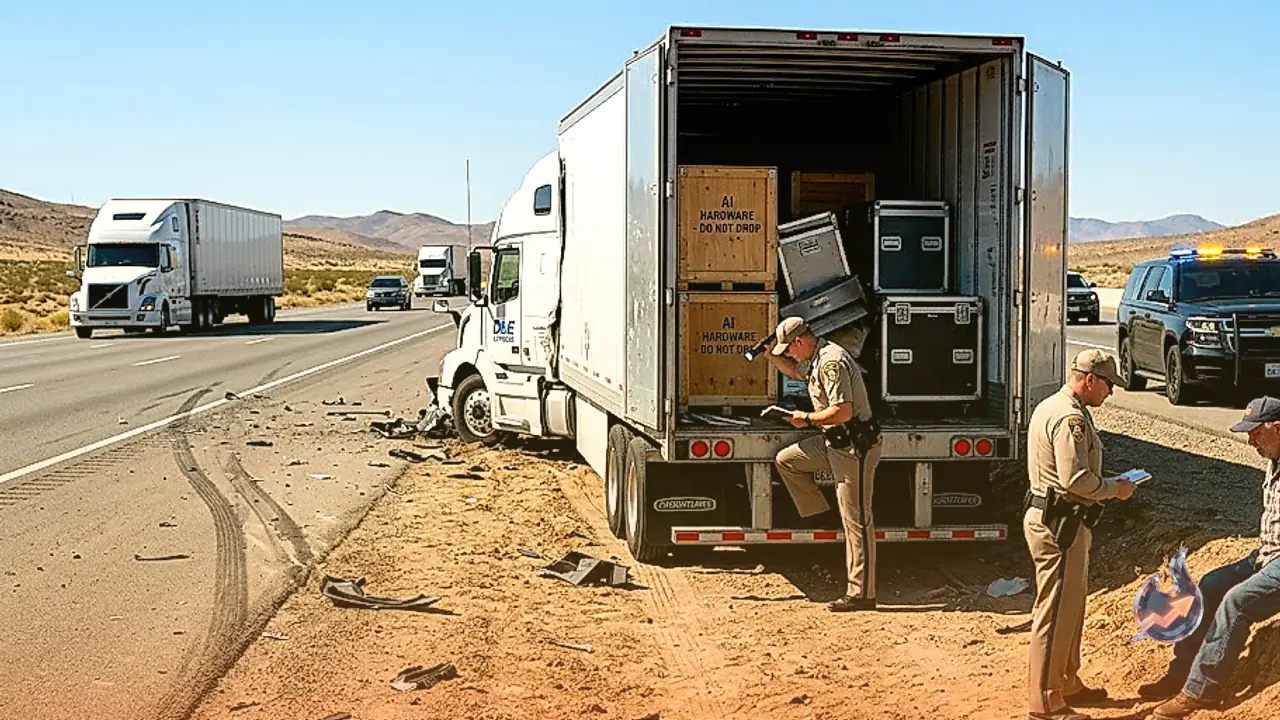

Violent highway ambushes and sophisticated digital identity theft targeting high-value artificial intelligence hardware shipments traveling from Silicon Valley to Southern California have raised severe alarms among law enforcement agencies and logistics security experts. Transported inside semitrucks escorted by private security teams in unmarked vehicles, these multi-million-dollar shipments were intended to reach data centers under heavy guard. However, hours into their transit, suspect vehicles deliberately disabled the escort cars. In one instance, a pursuing automobile rear-ended an escort in a hit-and-run maneuver, forcing it off the road. In a separate incident, attackers executed a precision PIT maneuver, nudging the escort vehicle into a tailspin before speeding away from the scene. Once stripped of their defensive escorts, the primary freight trucks continued along their routes without stopping, yet failed to arrive at their designated destinations, leaving millions of dollars in advanced data center components completely unaccounted for.
Industry insiders and security professionals who analyzed these incidents confirm that the escorts were deliberately immobilized to isolate the high-value cargo. While five state and local law enforcement agencies maintained confidentiality to safeguard ongoing criminal investigations, freight security experts independently corroborated the pattern of attacks. J.J. Coughlin, chairman of the nonprofit intelligence-sharing organization Southwest Transportation Security Council, confirmed receiving immediate notification from an escort company whose vehicle came under attack while guarding high-value technology. Danny Ramon, director of intelligence and response at freight-monitoring software firm Overhaul, characterized the highway incidents as a coordinated assault explicitly targeted at AI hardware. Industry authorities including Pachuca, Coughlin, and Ramon noted that while no physical injuries were reported, investigators suspect the truck drivers may have colluded with the perpetrators, reflecting a growing trend of insider complicity in modern freight crime.
Surging Demand for AI Data Centers Drives High-Value Freight Crime
Freight theft has surged continuously since the onset of the Covid pandemic, initially fueled by the sudden expansion of e-commerce and home delivery networks. More recently, the explosive growth of the artificial intelligence sector has created an extraordinarily lucrative target for organized criminal syndicates. Construction expenditures for AI data centers in the first half of this year alone surpassed the total spending recorded for the entire year of 2025. Data released by risk assessment firm Verisk CargoNet reveals that while the total volume of reported cargo thefts dropped 26 percent year-over-year in the most recent quarter, the aggregate financial value of stolen merchandise more than doubled over the same timeframe. This stark divergence highlights how criminal networks have shifted their focus away from low-margin consumer goods toward concentrated, high-value technological assets.
Metals, particularly industrial copper, alongside enterprise-grade computing and networking equipment, represent the primary targets for cargo thieves. Because these high-tech components are frequently transported using standard commercial logistics procedures, a substantial vulnerability emerges between the immense financial value of the cargo and its routine transit security profile. For example, an April heist resulted in the theft of 34,560 optical transceiver cables and 96 network switch modules en route from Olive Branch, Mississippi, to Richardson, Texas. These specialized optics and networking modules are essential for interconnecting high-density server racks within modern AI computing clusters, making their loss particularly disruptive to infrastructure developers.
Private security firms providing specialized escort services report unprecedented demand across all four quarters of the year. Michael Duffy, CEO of Solutions Group International, noted that whereas security escorts were historically requested mainly during peak pre-holiday retail seasons, demand is now constant year-round. Logistics companies transporting liquid cooling components, high-density servers, and semiconductor chips have emerged as his primary client base. Having guarded over 13,000 high-value shipments over the past four years without a single loss, Duffy emphasized that surging asset values have forced technology firms to deploy continuous armed or monitored protection along major transit corridors.
Digital Fraud and Motor Carrier Identity Exploitation
While physical highway ambushes represent a dangerous escalation, the vast majority of modern cargo thefts rely on digital impersonation rather than physical force, lock-cutting, or door-breaking. Criminal syndicates systematically exploit the fragmented structure of the freight industry, where hundreds of thousands of independent owner-operator truck drivers negotiate load assignments through digital freight brokers and online job boards. Fraudsters deploy phishing campaigns and social engineering tactics to compromise the email accounts of legitimate trucking operators. Once inside, they commandeer the carrier's corporate identity, utilizing its official motor vehicle registration credentials to secure high-value freight loads from unsuspecting shippers. To cover their tracks, thieves spoof or disable onboard GPS tracking units immediately after taking possession of the trailer.
In another prevalent scheme, legitimate motor carrier operators illegally sell their federally assigned Motor Carrier numbers to illicit brokers on the black market. These unique identifiers, issued by federal transportation regulators, allow fraudsters to assume the identity of an established freight business complete with historical safety records, verified phone lines, and official email domains. Investigators confirmed that recent thefts involving escort vehicle ambushes, as well as high-profile server switch thefts in California, relied on recently transferred Motor Carrier numbers and forged carrier paperwork. Ben Wilkens, cybersecurity director at the National Motor Freight Traffic Association, emphasized that these operations are conducted by highly sophisticated, well-funded criminal syndicates operating across multiple state jurisdictions.
Law Enforcement Seizures and High-Profile Asset Recoveries
Despite the sophistication of these theft networks, law enforcement task forces have successfully intercepted and recovered multi-million-dollar shipments of stolen computing hardware. In May, authorities in Southern California seized $4 million worth of stolen freight, which included specialized data center cooling systems developed by Deepcool AI, leading to the arrest of one suspect. In June, the California Highway Patrol launched an investigation following a alert from an alert buyer who recognized that a wholesale hardware offer was suspiciously underpriced.
Sergeant Omar Morales of the California Highway Patrol reported that subsequent enforcement operations recovered more than $2.2 million in stolen merchandise across three separate incidents. Among the recovered goods were eight pallets of high-performance server switches manufactured by Celestica for Meta, valued at $550,000. On the same day as the California recovery, law enforcement officers in the Chicago metropolitan area located a stolen freight trailer containing approximately $1 million in data center equipment. These simultaneous seizures demonstrate that stolen computing infrastructure is rapidly distributed through nationwide fencing networks immediately following a heist.
Regulatory Systems, Corporate Countermeasures, and International Smuggling
To combat widespread carrier impersonation, federal regulators have introduced a upgraded digital platform known as MOTUS. Designed to streamline federal registration management, MOTUS enables shippers and freight brokers to verify the legitimacy of motor carriers in real time. Regulators reinforced these measures by issuing an industry bulletin clarifying that federal registration numbers may only be transferred as part of legitimate corporate acquisitions and must be formally reported to federal authorities.
Shipment providers continue to face daily digital attacks aimed at hijacking cargo loads. Jaclyn Giles, director of operational support at Georgia-based FLS Transportation Services, revealed that her team intercepts fraudulent carriers attempting to steal loads on a daily basis. Although continuous employee training and paid carrier-verification services prevent the vast majority of thefts, periodic operational oversights still result in significant losses. FLS recently suffered the loss of a $650,000 tool shipment, forcing the company to replace its primary insurance provider due to rising coverage restrictions on high-value cargo.
Skyrocketing insurance premiums have discouraged many logistics providers from reporting cargo thefts, prompting firms to adopt supplemental coverage policies or divide high-value loads across multiple separate trailers to limit financial exposure. Shippers are also implementing physical tracking innovations; FLS now attaches embedded GPS devices directly inside individual product crates, while tech logistics carriers in California have deployed license-plate recognition cameras from Flock to detect surveillance vehicles scouting high-value loading docks. Similarly, Tesla implemented enhanced driver identity verification protocols following the theft of battery trailers directly from its facilities.
Federal authorities and freight security analysts warn that strict export restrictions on advanced semiconductors have created lucrative overseas black markets for stolen AI hardware. Location pings transmitted when stolen servers are powered on suggest that a significant portion of stolen hardware is illicitly exported to countries such as China. Overcoming these crimes remains challenging due to decades of freight deregulation, inconsistent state reporting standards, and historically low prosecution rates, which collectively render high-tech cargo theft a high-reward, low-risk criminal enterprise.