























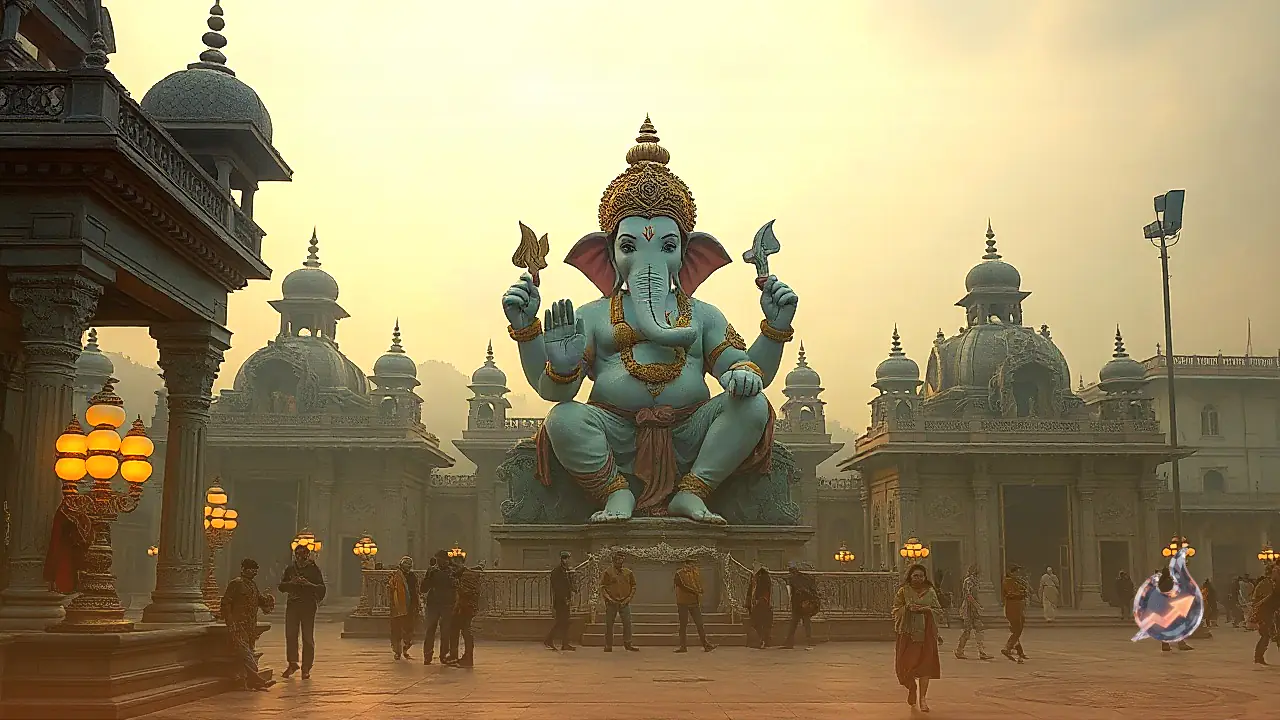

In Sanatana traditions, every auspicious endeavor and sacred ritual commences with invocations addressed to the remover of obstacles. While worshippers are most accustomed to venerating Lord Ganesha in his familiar elephant-headed, pot-bellied form, classical texts and oral lore preserve an ancient account of his origin known as Adi Ganesh. Across regional customs and festive celebrations, this designation refers to the primordial and foundational manifestation of Ganpati before and during the transformational events that defined his divine role. Rather than existing as a simple birth chronicle, this narrative integrates profound themes of maternal devotion, cosmic duty, and spiritual symbology involving both Goddess Parvati and Lord Shiva.
The Guardian Created at the Threshold
According to classical scriptural accounts, the journey toward this revered form began when Goddess Parvati prepared for her bath. Desiring a dedicated guardian to protect her inner chambers, she gathered the herbal paste from her own body and sculpted the form of a young boy. Breathing life into this creation, she embraced him as her son and assigned him a singular responsibility: under no circumstances was anyone permitted to cross the threshold while she was bathing. Taking his mother's words as supreme law, the dutiful youth took up his guard at the doorway.
Shortly thereafter, Lord Shiva arrived at the entrance, intending to step inside. The young guardian, unfamiliar with the deity's identity and committed solely to the mandate given by Goddess Parvati, blocked the path. Shiva, unaware of the boy's origin or his sacred charge, insisted on entering. As the youth remained steadfast in his refusal to yield, an intense confrontation unfolded. Consumed by fury at the defiance shown at his own abode, Shiva struck the boy, severing his head from his body.
A Mother's Wrath and the Journey North
When Goddess Parvati emerged and learned of her son's demise, her grief turned into immense distress and indignation. She insisted that her creation be restored to life without delay, making it clear that her divine sorrow could destabilize the cosmic order. Recognizing the gravity of the situation and seeking to heal the breach, Lord Shiva formulated a resolution to revive the youth. He summoned his attendants and instructed them to embark on an immediate search.
Shiva directed his followers to march directly toward the north and retrieve the head of the very first living creature they encountered along their journey. As documented in traditional lore, the attendants traversed the path until they came upon an elephant facing northward. Respecting the divine command, they secured the head of the animal and returned to Mount Kailash to place it before Shiva.
Adorning the Elephant Head and Becoming Ganpati
Lord Shiva affixed the elephant's head onto the youth's body and infused it with vitality, restoring the boy to conscious life. With this revival, the transformed child was welcomed as Ganesha, earning profound veneration across the celestial realms. In acknowledgment of his courage and newly restored presence, Shiva appointed him as the supreme commander of his divine attendants, formally bestowing upon him the title of Ganpati, the lord of the celestial hosts.
Scholars and devotees find deep metaphorical significance in this unique physical form. In traditional philosophy, the elephant head embodies supreme intellect, enduring strength, discernment, and grounded wisdom. The broad ears represent the capacity to listen attentively and gather knowledge, while the dexterous trunk symbolizes precision, adaptable power, and the ability to distinguish subtle truths in the material and spiritual realms.
Significance of the Primal Name and Lasting Values
Linguistically, the Sanskrit root 'Adi' signifies the beginning, primal source, or origin. Within the broader devotional landscape, referring to Adi Ganesh highlights his earliest, purest existence and the sacred process through which he assumed his universal form. While textural details vary among different regional recitations and puranic compilations, the underlying moral teachings remain coherent across all traditions.
The legend emphasizes absolute dedication to parental guidance, unwavering integrity in fulfilling assigned duties, and the application of wisdom when facing formidable obstacles. Because of these timeless attributes, the worship of Ganesha transcends mere ritual; it fosters thoughtful discernment, moral fortitude, and an auspicious approach to every new undertaking. During festive commemorations such as Ganesh Chaturthi, reciting the many titles of the deity serves as an enduring reminder of this transformative origin.