























Offering modak to Lord Ganesha remains a cherished ritual across countless households throughout the auspicious period of Ganesh Chaturthi. While sweetshops offer countless festive platters, home cooks increasingly prefer preparing pure, preservative-free offerings in their own kitchens. A blend of desiccated coconut and mawa presents a velvety, rich delicacy that captures the festival's spiritual essence without demanding complicated cooking skills or prolonged kitchen time.
Gathering the Basic Kitchen Ingredients
The beauty of this sweet lies in its minimalist ingredient requirements. You will need 1 cup of coconut powder, 1 cup of milk powder, and roughly 1 cup of powdered sugar to form the core foundation. Complement this base with a pinch of aromatic cardamom, several saffron strands, and an appropriate splash of milk to bring the mixture together. Adding mawa elevates both richness and body, yielding a luscious mouthfeel. Furthermore, chopped dry fruits such as almonds, cashews, or pistachios can be gathered for the interior filling. If fresh mawa happens to be missing from your larder, simply relying on milk alone yields a perfectly workable dough.
Blending the Base and Infusing Saffron
Begin by emptying the coconut powder and milk powder into a spacious mixing bowl. Grind the granulated sugar alongside fragrant cardamom pods until you achieve a silky powdered consistency, then whisk it into the dry powders so the sweetness distributes evenly. In a separate small dish, steep a few strands of saffron in lukewarm milk for several minutes until the liquid transforms into a vibrant yellow hue. Gradually drizzle this scented saffron milk into the dry powder bowl, ensuring the moisture distributes smoothly across the entire mass.
Kneading the Dough and Prepping Nut Fillings
Patience during the kneading phase is paramount. Pouring excess liquid all at once risks creating a sloppy, runny batter that refuses to hold any structure. Work the mixture with your fingertips or a wooden spoon until it gathers into a pliable, pliable dough. Those incorporating mawa should crumble it into the bowl at this very stage, kneading everything until totally uniform. Concurrently, finely dice your chosen assortment of cashews, almonds, and pistachios. Stuffing these crunchy fragments into the core introduces an exquisite textural contrast against the soft, milky exterior.
Shaping Methods With or Without Moulds
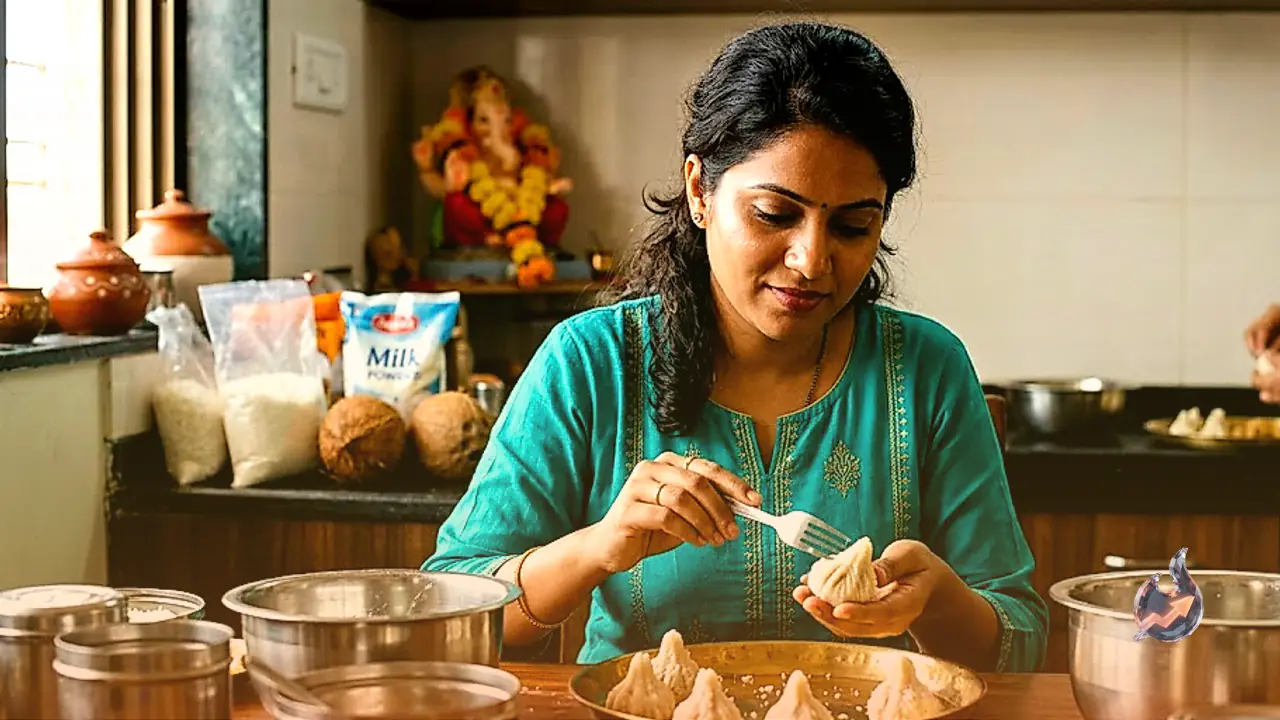
For cooks possessing a conventional modak mould, simply smear a faint glaze of grease on the interior walls. Pack the cavities with dough, hollow out a slight recess in the center to cradle the chopped nut filling, cap the base with additional dough, and gently press the apparatus shut before releasing a sharply contoured sweet. Lack of specialized equipment poses no hurdle. Merely flatten a small ball of dough on your palm, insert the nuts in the center, gather the edges upward into a pointed peak, and score soft vertical ridges along the exterior using the tines of an ordinary fork to mimic the classic indented design.
Setting the Batch Before the Sacred Offering
Once all pieces have been handcrafted, arrange them across a platter and allow them to rest undisturbed for a short interval. This brief setting period lets the milk solids firm up, guaranteeing that the sweets retain their ornate contours when handled. After the modaks achieve a stable consistency, present them reverently before Lord Ganesha as sacred prasad before sharing the festive feast among loved ones.