























A jar of glowing golden honey on the shelf makes most shoppers assume the contents must be pure, but colour, texture or a quick taste on the tongue can't actually confirm whether a bottle is genuine. Complaints about sugar syrup, corn syrup and other cheap sweeteners being blended into commercially sold honey have surfaced for years, which is why buyers keep asking the same question every time they bring a bottle home: how do you actually know if it is the real thing? A glossy label or a steep price tag is no guarantee either, since neither says anything about what's actually inside.
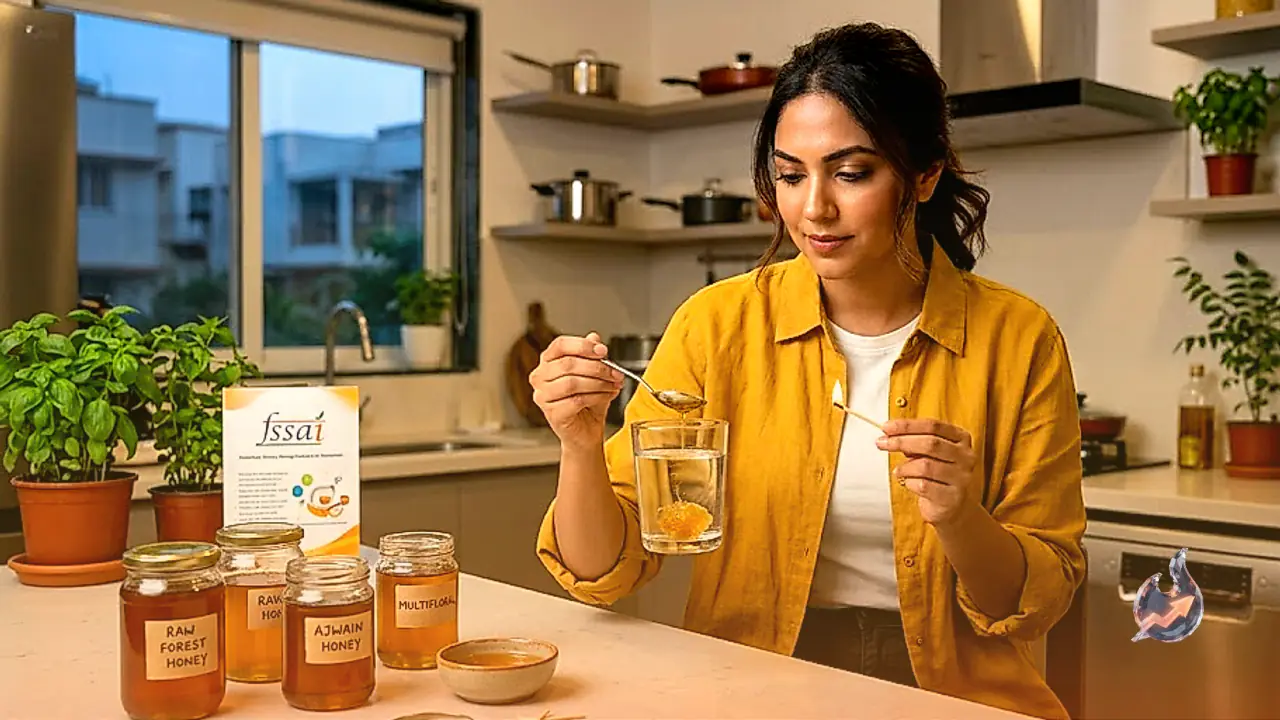
Social media is full of tricks involving a glass of water, a lit matchstick or a drop on the thumb, but none of these kitchen experiments count as final proof on their own. FSSAI itself lists a few quick checks that can be tried at home, while stressing that only a proper scientific lab test can settle the matter with certainty.
What the water-glass trick actually shows
Among FSSAI's DART tests is a method to spot sugar-syrup adulteration by dropping a bit of honey into a glass of clean water. According to the agency, pure honey tends to hold its shape and does not dissolve quickly, whereas an adulterated sample starts spreading or breaking apart in the water. This should be treated only as a first-level clue, because declaring a bottle 100 percent pure purely on the strength of one glass of water would be premature.
How reliable is the matchstick burn test
Using fire or a matchstick to judge honey purity is another trick that circulates widely online. An older FSSAI DART reference describes burning honey-soaked cotton and notes that the outcome changes when the sample contains excess water. Even so, this improvised home experiment does not give a complete or precise picture of adulteration, so treating it as conclusive evidence before buying or discarding a bottle would not be wise.
Don't judge purity by colour or thickness alone
Not every bottle of honey is the same shade or the same consistency, and that is normal. Its colour and texture change depending on the flowers and plants that bees have drawn nectar from in a given region. FSSAI's own quality standards for honey include several distinct physical and chemical parameters precisely because of this variation. That means assuming a darker shade is automatically genuine and a lighter one is fake is the wrong approach. Crystallisation inside the bottle should also not be read as proof of adulteration by itself, since it can simply be a natural process that honey undergoes over time, especially in colder weather.
Lab testing remains the most dependable confirmation
When doubts about purity are serious, a scientific laboratory test is the most reliable route available. FSSAI's 2024 manual on Honey and Other Bee Hive Products refers to analytical methods such as C3/C4 sugar testing, isotope ratio analysis and detection of foreign oligosaccharides. The quality benchmarks the agency has set for honey also include parameters like diastase activity, the 13C/12C ratio and markers linked to rice syrup contamination. In practical terms, this means the small tests done at home can only offer an early hint, never the final word, and a sample genuinely in doubt needs to go to an accredited lab.
What to check on the packaging before buying
Before picking up a bottle, it is worth reading the FSSAI licence number on the packaging along with the label, the listed ingredients and the manufacturer's details. Treating a very cheap product as automatically the better deal is also not a smart move, since an unusually low price often raises the odds of adulteration rather than lowering them. In the end, genuine honey is identified not by how attractive the bottle looks on a shelf but by accurate labelling, a trustworthy brand and, where necessary, an actual laboratory test.