





















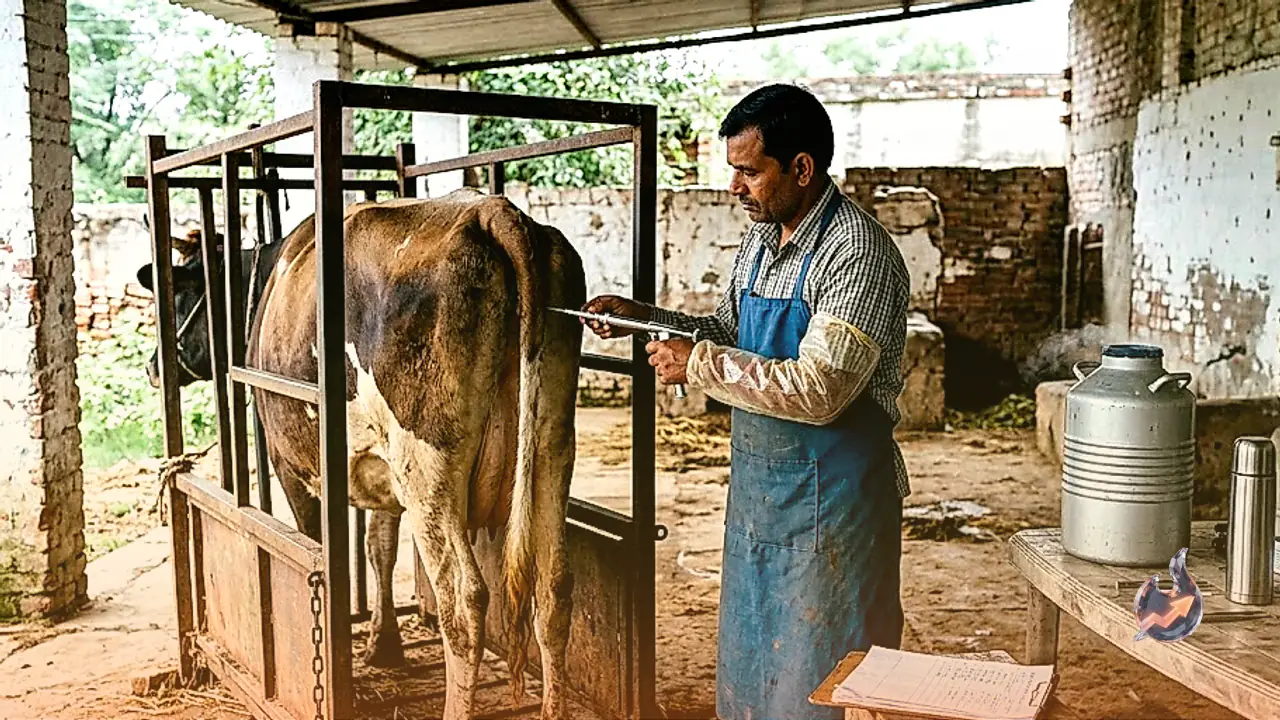

Dairy farmers managing indigenous and crossbred cattle frequently struggle with the economic burden of rearing male calves, whose practical utility has declined drastically with modern agricultural mechanisation. To resolve this imbalance, the animal husbandry department in Saharanpur has operationalised advanced artificial insemination methods centered on sorted semen. This intervention is designed to significantly raise the proportion of female calves born across dairy holdings in the district.
Laboratory Process and High Probability of Female Births
The core mechanism of this intervention relies on laboratory-sorted semen, where sperm cells are meticulously processed and categorised before distribution. Through this scientific sorting, the probability of producing a female calf through artificial insemination reaches roughly 90 percent. Conventional artificial insemination models typically result in a 50-50 probability between male and female offspring. By pushing female calf likelihood to nearly nine out of ten conceptions, this protocol drastically cuts unwanted male calf births at the source.
Addressing the Crisis of Abandoned Cattle
Explaining the rationale behind this initiative, Chief Veterinary Officer Dr. Madan Pal Singh Gaur stated that the proliferation of unutilised male cattle has become a widespread concern. Because draft power and manual tilling are no longer commonplace in contemporary farming, bull calves often become an unsustainable cost for rural households. Consequently, many cattle owners release male animals into public spaces, creating a sharp rise in stray cattle that obstruct roads and strain public resources. Dr. Gaur emphasised that curbing male birth rates offers an effective long-term solution to this predicament.
Dairy Productivity and Breed Enhancement
Beyond reducing stray herds, sorted semen brings direct financial benefits to cattle owners. By ensuring the birth of high-grade heifers, the programme systematically improves overall herd quality and long-term milk yields. Smallholder farmers, who rely heavily on milk sales for seasonal liquidity, stand to gain steady returns without expending scarce fodder on unproductive stock. Departmental officials point out that this intervention acts as both an economic shield for dairy producers and a tool for genetic upgrading.
Widespread Availability at Local Centres
To ensure this method translates into village-level results, the animal husbandry department has made sexed semen stocks available across all primary veterinary hospitals and designated artificial insemination centres throughout Saharanpur district. Local livestock rearers can access the specialized semen by visiting their nearest government veterinary facility. The department is now focusing on wider farmer outreach to ensure maximum adoption across rural pockets, hoping to systematically transform local dairy economics.