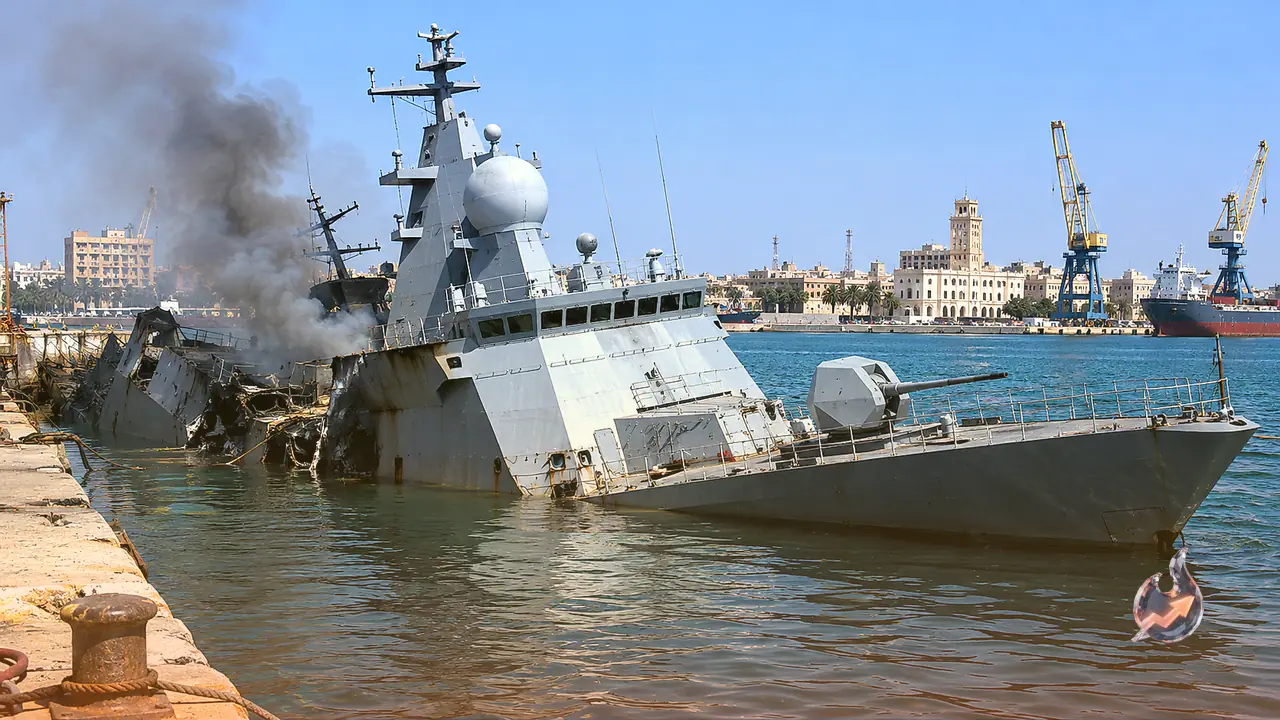

The ongoing armed conflict between Russia and Ukraine has expanded far beyond its conventional operational theaters, reaching deep into the strategic maritime waters of the Mediterranean Sea. Ukrainian forces, previously focused on contesting Russian naval dominance across the Black Sea, have demonstrated an unexpected long-range expeditionary reach by launching an attack against Russian naval assets docked at the port of Benghazi in eastern Libya. The targeted warship, Mercury, was successfully sunk following an assault involving unmanned surface vessels. This vessel was far from an obsolete platform, having been commissioned into the Russian Navy as recently as 2023.
Ukrainian President Volodymyr Zelenskyy confirmed the operation, stating that military units executed the strike utilizing seven domestically produced naval drones. According to his account, defensive countermeasures failed to prevent Mercury from sinking. Furthermore, a Russian Ka-27 military helicopter stationed aboard the vessel was destroyed in the blast, while an accompanying Russian military logistics carrier, MV Angara, sustained damage during the coordinated raid.
Strategic Value of the Project 20380 Corvette Mercury
Commissioned into active service in 2023, the warship Mercury belonged to the Russian Navy's Project 20380 class of corvettes. While distinct from major aircraft carriers or heavy cruisers, these vessels serve as modern, versatile warships engineered for coastal patrol, anti-submarine defense, surface warfare, and maritime convoy protection. The Security Service of Ukraine, known as SBU, asserted that Mercury was actively deployed to safeguard sensitive Russian military supply convoys traversing international waters.
Corvettes of this class represent a vital component of naval task forces, responsible not only for securing territorial access but also for escorting cargo ships transporting munitions and essential military hardware across contested sea lanes. The loss of such an advanced, recently introduced warship delivers a substantial blow to naval escort capabilities and logistical integrity outside Russia's home waters.
Strike Assessments and Confirmed Vessel Damage
President Volodymyr Zelenskyy took to social media on November 23 to announce the strike, framing it as a direct and proportional Ukrainian countermeasure against Russian military infrastructure. He detailed that seven maritime drones manufactured within Ukraine carried out the precision attack against the assigned targets. The operation specifically singled out Mercury along with the cargo carrier MV Angara, which Ukrainian authorities accuse of transporting armaments to support military operations.
A clear operational distinction exists between the status of the two targeted vessels. Ukrainian officials claimed the total sinking of Mercury, whereas MV Angara was described as having been directly struck and damaged. Independent confirmation regarding whether Angara sank remains unavailable. Early photographic evidence emerging from the port depicted two support tugs actively spraying water onto both sides of the cargo ship to counter damage. For its part, the Russian Ministry of Defense did not release an immediate public statement concerning the incident.
The Geopolitical Role of Libya's Benghazi Port
The choice of Benghazi as the operational target underscores the strategic significance of eastern Libya to Moscow's logistical network. The port serves as a critical maritime staging ground rather than a routine port of call. According to the regional administration governing eastern Libya, Mercury had docked at the facility under a formal bilateral cooperation agreement to take on fresh fuel, provisions, and routine technical supplies, reflecting longstanding political ties between Moscow and the eastern Libyan authorities.
The Mediterranean basin forms the operational backbone for Russian overseas military movements. The SBU highlighted that vessels like MV Angara have routinely served along the maritime logistics arteries commonly dubbed the Syrian Express and the Libyan Express. These routes facilitate the steady transit of weaponry, heavy defense gear, and material to regional garrisons and allied outposts. Striking these assets within Benghazi directly disrupts the maritime supply chain underpinning those expeditionary deployments.
Deployment Logistics: How Drones Reached the North African Coast
One of the most consequential technical revelations of the Benghazi operation involves the mechanics of traversing the immense geographic distance between Ukrainian territory and the North African coastline. Information released by the Security Service of Ukraine indicated that the seven maritime attack drones were transported close to the operational zone aboard a larger commercial or support vessel acting as a mother ship before being deployed into the water.
Utilizing a mother ship platform eliminated the requirement for the relatively compact surface drones to navigate the entire voyage across the Black Sea and Mediterranean on their own power reserves. However, crucial operational specifics remain classified, including the identity and registry of the mother vessel, its port of departure, and the exact navigation corridor it used to deliver the drone swarm to the vicinity of Benghazi.