













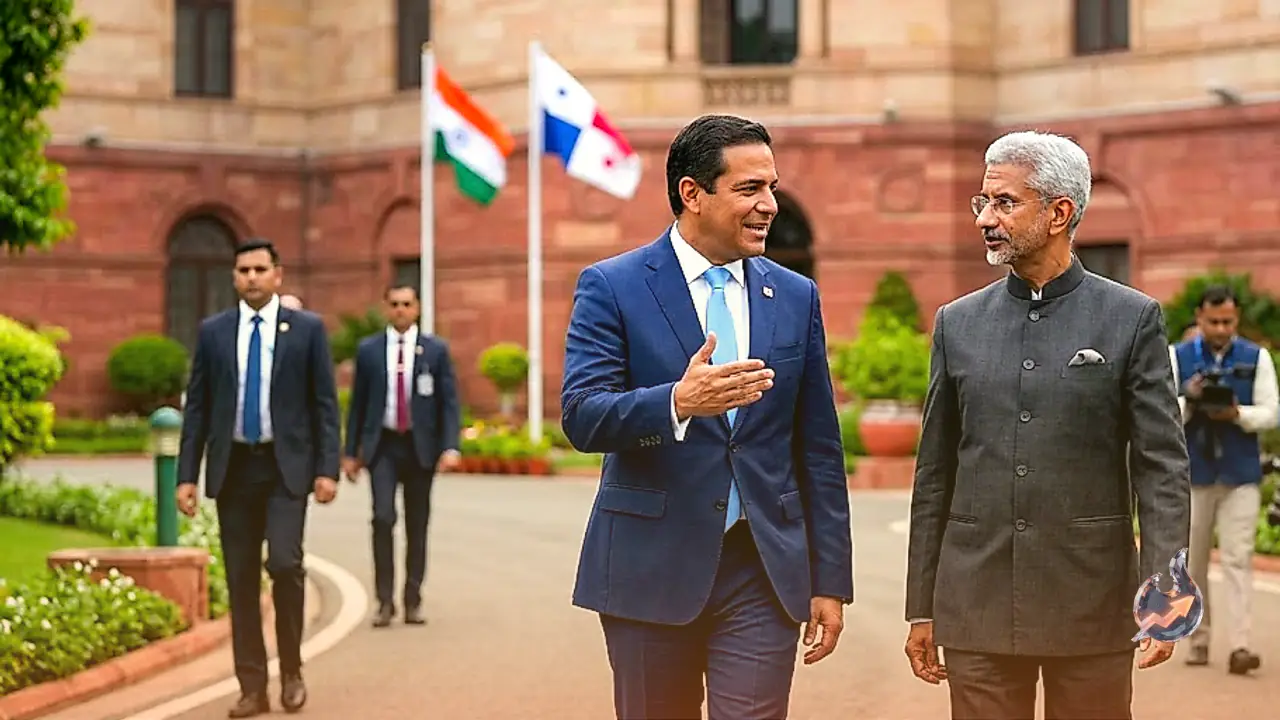

Panama's Foreign Minister Javier Martinez-Acha Vasquez used his Monday visit to New Delhi to deliver an unusually direct message: in his country's eyes, India isn't an emerging power, it has already arrived. During delegation-level talks with External Affairs Minister S. Jaishankar, Vasquez called for turning the six-decade-old India-Panama relationship into a long-term strategic partnership and urged New Delhi to deepen trade, investment and economic ties, describing Panama as the natural gateway for India into Latin America and Central America. He said it was an honour to visit at a moment when India is playing a defining role in shaping the global order of the 21st century.
'For Us, India Is Already a Superpower'
Vasquez said that while several analysts still describe India as a rising power, Panama's assessment is different. He put it plainly
"For us, India is already a superpower."
He explained that Panama does not see India merely as a large economy but as a civilisational force whose global voice keeps growing stronger, and that the scale of transformation India has undergone in recent years has pushed several countries, Panama included, to set bigger goals for their own futures. He added that his trip was not simply about marking six decades of friendship between the two nations, but about laying the groundwork for a far stronger, lasting partnership whose impact would be felt for decades to come.
Jaishankar himself shared pictures from the meeting on X, offering a glimpse of the discussions between the two ministers.
Size Doesn't Define Strength, Connectivity Does
Turning to Panama's own standing, Vasquez pushed back against the idea that a small country carries limited weight on the world stage, arguing instead that a nation's strength lies not in its size but in its ability to connect the world. He explained that just as India connects ideas and innovation, Panama connects markets, describing the Panama Canal as far more than an engineering marvel, a dependable platform for global trade. Vasquez acknowledged that geography separates the two nations by a considerable distance, but argued that shared democratic values bring them closer than the map suggests. He added that it falls on democratic nations to demonstrate that openness, innovation and cooperation remain the surest route to shared prosperity.
A Push for Deeper Trade and Investment
Vasquez argued that India should treat Panama as a central piece of its international economic strategy, since no other country offers as direct a gateway into the markets of Latin America and Central America. To formalise the push, he proposed setting up a High-Level Trade and Investment Working Group between the two countries. He noted that Panama already has a strong legal framework in place to protect and promote foreign investment, and said his government wants Indian multinational companies to invest there. Vasquez listed the sectors he sees as ripe for joint work, pharmaceuticals, medical services, semiconductors, AI, data centres, advanced manufacturing and regional distribution hubs among them, summing up his pitch with the line that India produces for the world while Panama connects the world, which is exactly why he believes there is no more suitable regional base than Panama for Indian companies eyeing expansion into Latin America.
What Comes Next
Vasquez's proposal is being read as the opening move toward a fresh chapter in India-Panama relations. Should the High-Level Trade and Investment Working Group take shape, it would give institutional structure to cooperation that has so far rested largely on diplomatic goodwill. With the Panama Canal already anchoring the country's role in global trade, Panama's pitch to India now extends into newer sectors such as pharmaceuticals, semiconductors and data centres, a shift that could shape the economic relationship between the two countries in the years ahead.