
















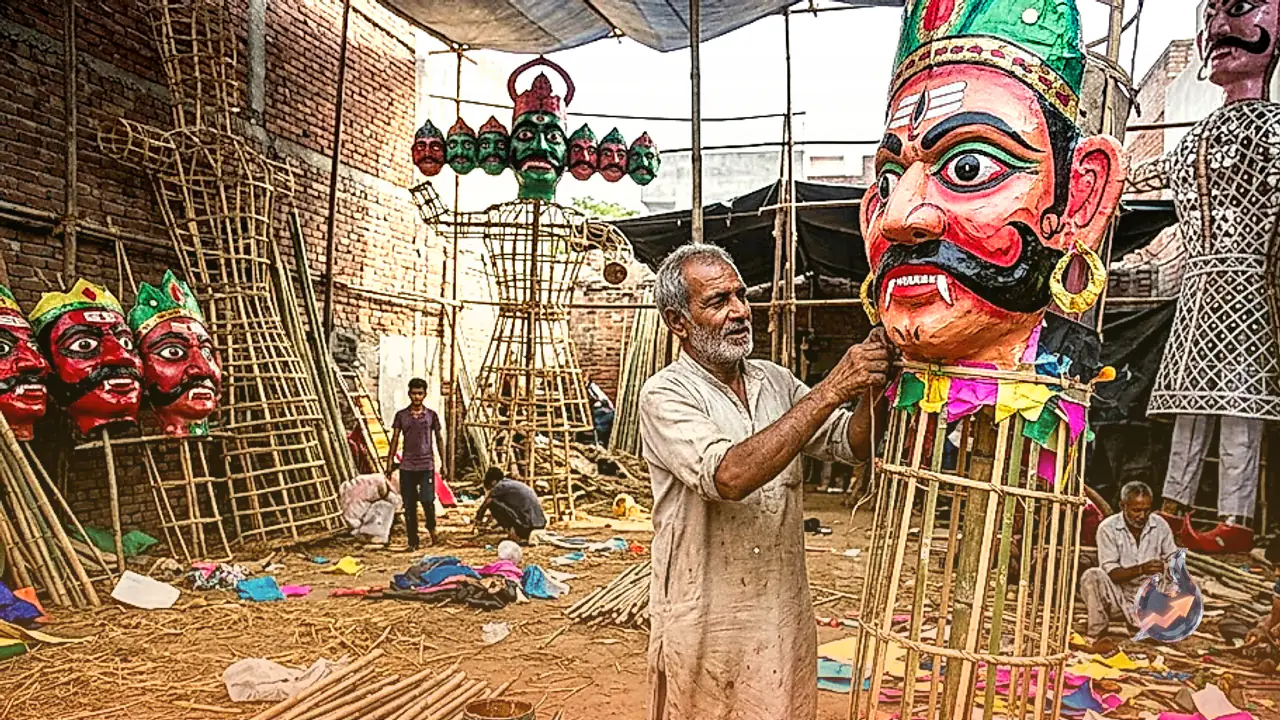

When the towering effigies of Ravhan, Meghnad, and Kumbhakarna go up in flames at the Rambagh Ground in Ambala during Dussehra, the fiery spectacle rests on weeks of relentless labor and generations of family heritage. Preparation is currently in full swing at the Kumhar Mandi in Ambala Cantt, where Muslim artisan Mohammed Vakil and his team from Meerut are busy crafting the massive festive structures. What sets Vakil apart is a remarkable backstory: he once secured a government job as a sub-inspector in the Uttar Pradesh Police, but chose to walk away from it driven by deep friendship and an unwavering attachment to his ancestral craft. Today, memories of a friendship spanning over 65 years and three generations of craftsmanship form the core of his existence.
A Family Legacy Passed Down Generations
Detailing his journey, Mohammed Vakil noted that he has been traveling to Ambala for the past 27 years to build Ravhan effigies for Dussehra. Before him, his father and grandfather were deeply involved in the very same profession. He explained that making fireworks and constructing effigies is his family's traditional occupation. This year too, he arrived in Ambala accompanied by a dedicated team of roughly 10 to 12 artisans. Having spent the last 25 days meticulously building the structures and preparing the pyrotechnics, the team is now putting the final touches on everything needed for the upcoming festival.
According to Mohammed Vakil, his team members are currently constructing effigies of Ravhan, Meghnad, and Kumbhakarna at four different locations across Ambala. He shared that local residents appreciate their craftsmanship year after year, and this persistent public admiration gives him the motivation to keep the tradition alive. Constructing large effigies generally requires anywhere from 20 to 30 days of continuous work. While a massive Ravhan effigy can ordinarily command prices ranging from 5 lakh to 10 lakh rupees or even more, the cost of certain effigies being prepared in Ambala this season has been estimated at around 30,000 to 40,000 rupees. Information indicates that organizers have commissioned effigies reaching heights of 45, 50, and 55 feet for the celebrations.
Walking Away From Police Uniform for Friendship
Perhaps the most compelling chapter of Vakil's life involves his steadfast dedication to a lifelong bond. Having completed his education up to high school, he successfully cleared the exams to join the Uttar Pradesh Police as a sub-inspector. However, just four months after beginning his service, he resigned from the post. Vakil recounted that a childhood friend had been by his side through thick and thin, with their bond now stretching across more than six-and-a-half decades. When Vakil took up the police job, his friend began experiencing severe loneliness, constantly telling him that he felt lost and empty in his absence.
Recalling those formative years, Vakil explained that their friendship was profound enough that both considered each other an inseparable part of their lives. Ultimately, he chose to prioritize his bond and his ancestral livelihood over a secure government career. Today, he pursues that very same craft with utter dedication. His story serves as a reminder that life's choices are not solely dictated by salary or career status, as personal relationships and cultural identity often carry equal weight. Aside from the Dussehra season, Vakil spends the rest of the year working on fireworks displays for weddings, films, and theatrical productions. He maintains that as long as his physical health permits, he will continue this work, though he harbors a lingering regret that the younger generation shows little interest in carrying forward this traditional trade.