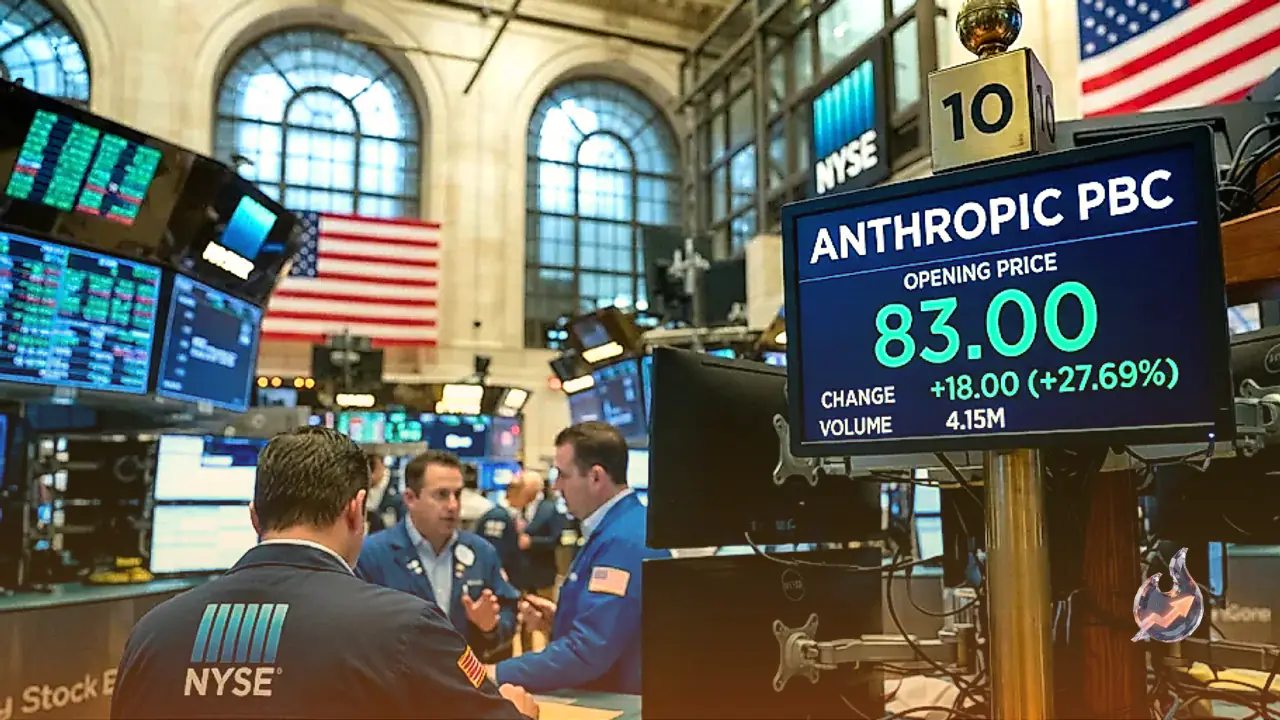

The public market debut of artificial intelligence startup Anthropic at an updated initial public offering price of $83 per share marks a pivotal transition point for the technology industry. While the transaction is set to generate tens of billions of dollars for the firm and its early backers, the most significant dimension of this listing lies in the immense capital returns flowing directly back to major infrastructure suppliers that previously poured money into the entity.
Tech behemoths Amazon and Google, which serve as primary cloud infrastructure hosts for the creator of the Claude intelligence system, maintain equity positions that have ballooned in value. Together, their combined equity stakes reach approximately $307.9 billion based on the $83 per share valuation. Amazon's original investment of $18 billion has expanded into a 14.7% equity holding valued at more than $159 billion. Simultaneously, Google's early investment of $12.3 billion since 2023 has yielded a 13.7% stake worth nearly $149 billion, as detailed in the official ownership records included in the company's prospectus.
Multi-Billion Infrastructure Coalitions and Strategic Deals
Beyond Amazon and Google, a broader coalition of hardware manufacturers and cloud infrastructure providers stands to capture substantial financial upside from the listing. Nvidia, AMD, Microsoft, Broadcom, Micron, and TSMC joined Google in committing $26 billion to Anthropic at its IPO price through a structured private placement.
Since 2023, Google has invested $12.3 billion in direct capital into Anthropic, alongside a conditional commitment of up to $30 billion contingent on Anthropic attaining specific technical and operational milestones. Excluding TSMC, Anthropic has executed multi-billion-dollar strategic agreements with its primary infrastructure supplier-investors, including Nvidia, AMD, Broadcom, Microsoft, and Micron. These binding supply contracts mandate that Anthropic purchase their specialized hardware, networking equipment, and cloud compute services over extended operational horizons.
Unpacking the Dynamics of Circular Financing in the AI Sector
This closed-loop capital structure has frequently drawn skepticism from financial analysts evaluating the long-term viability of the AI investment surge. Referred to across capital markets as circular financing, the arrangement meant that major tech firms functioned simultaneously as key equity investors and as Anthropic's primary vendors. Capital deployed by Amazon and Google into Anthropic would promptly recycle back to those same cloud providers when Anthropic purchased compute capacity to train frontier models or serve Claude to enterprise customers.
While this mechanism created the impression of unprecedented top-line growth for cloud providers and historic fundraising totals for Anthropic, critics argued it represented the movement of identical capital between interconnected balance sheets. Today's IPO marks a structural shift in that financing system, potentially establishing a self-sustaining market foundation. With Anthropic continuing to post net operational losses in the tens of billions of dollars each quarter, future capital requirements will be satisfied through public market equity investors and corporate debt issuances, effectively diluting the structural conflicts of interest that previously concerned observers.
Balance Sheet Strength, Compute Obligations, and Revenue Growth
Following its market entry, Anthropic is projected to hold roughly $220 billion in cash, cash equivalents, and short-term liquid investments. This cash reserve incorporates primary proceeds from the public offering alongside the $26 billion private placement capital. Anthropic also retains the contractual authority to settle selected future infrastructure commitments through equity issuance.
Joey Brookhart, who leads the Tokenomics team at SemiAnalysis, estimates that Anthropic will require approximately $280 billion in cumulative top-line revenue over the next four years to service its aggregate compute liabilities. Brookhart considers this operational target achievable relative to the company's forward revenue trajectory. Joey Brookhart stated, "The ownership stake is very worthwhile, and those companies no longer need any more support from suppliers." He noted that Amazon is no longer required to prop up the business because top-line growth is being driven by broader commercial adoption.
Despite this financial footing, infrastructure overhead remains elevated. According to an official regulatory filing, Anthropic has committed to spend $900 billion, primarily allocated toward compute resources and physical data center capacity. Although specific provider contracts contain conditional termination provisions, market analysts view Anthropic as well-positioned to fulfill these obligations. Anthropic generated $17 billion in third-quarter 2026 revenue, establishing an annualized revenue run-rate of $68 billion.
Debt Market Access, Credit Ratings, and Neocloud Comparisons
Gil Luria, head of technology research at D.A. Davidson, highlighted the sheer scale of liquidity secured through the transaction. Gil Luria stated, "By the time the IPO is done, Anthropic’s going to have more cash on hand than any company has ever had." Luria detailed that the entity raised approximately $141 billion in gross capital, securing about $91.7 billion in net proceeds at the $83 per share offer price, providing a substantial cash reserve rather than rapid capital depletion.
The public listing enhances Anthropic's standing within credit markets, facilitating institutional debt issuance despite recent reports indicating credit rating agencies may assign the firm a junk-tier rating post-debut. Luria distinguished Anthropic's capitalization model from neocloud infrastructure firms such as CoreWeave, which rely heavily on direct vendor intervention. Brookhart similarly argued that Anthropic's capital structure is not purely circular, maintaining that its deployment adds tangible structural capacity to the broader computing ecosystem.
Frontier Model Competition Risks and Enterprise Cloud Resilience
The primary risk confronting Anthropic revolves around maintaining technological leadership in frontier AI development. The firm's valuation remains tied to its position at the cutting edge of generative AI systems. Should rival developers such as OpenAI, Google DeepMind, or open-weight model initiatives eclipse Claude's capability benchmark, commercial demand could shift rapidly. Gil Luria warned, "If we’re all using other people’s models, then Anthropic’s not worth a trillion and a half dollars."
Even under scenarios where model dominance shifts, underlying infrastructure vendors remain insulated from significant downside. While lower token pricing and heightened market competition could compress software margins, cloud infrastructure demand will continue to expand. Gil Luria stated, "For Amazon and Google, the risk isn’t actually that high because in that scenario, we’re using other models." Ultimately, the aggregate volume of AI workloads will continue to grow, ensuring that data center infrastructure operated by Amazon, Google, and Microsoft remains essential across the technology sector.