















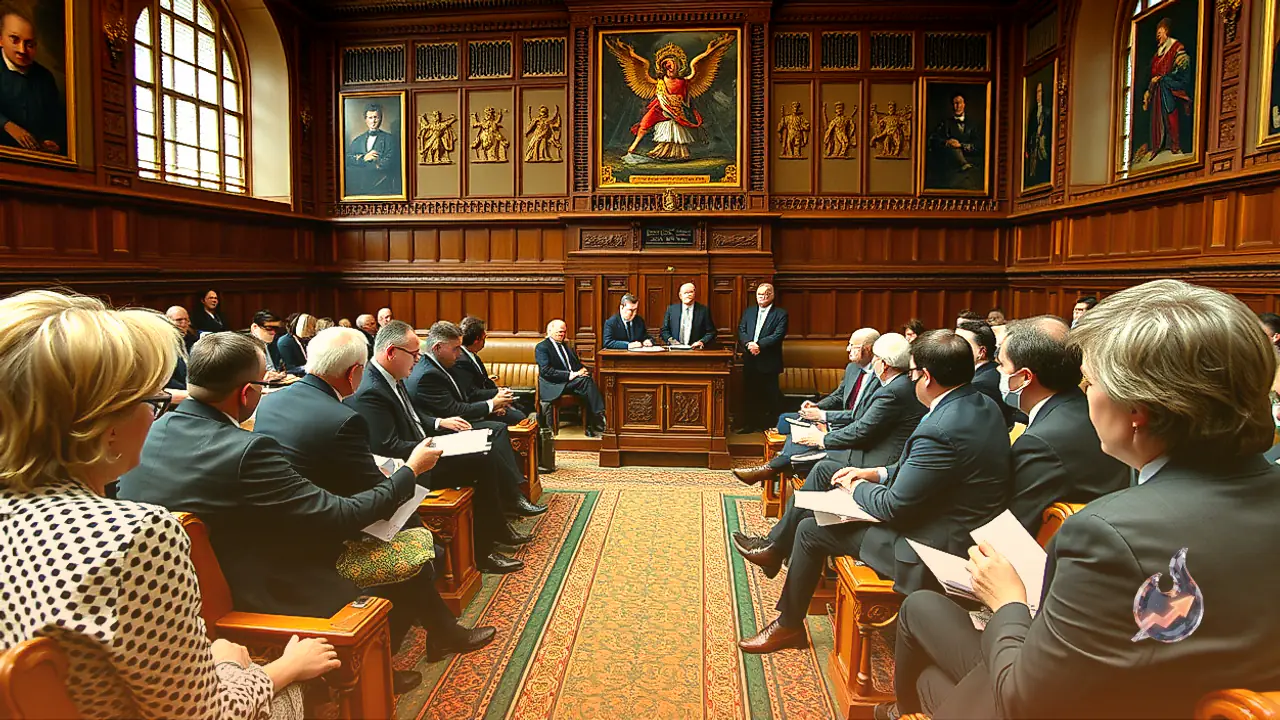

A high-stakes parliamentary evidence session in London has laid bare a sharp and fundamental division among the world's most prominent artificial intelligence developers regarding how their technologies should be governed. Appearing before the Business, Innovation, Science, and Trade Committee, senior executives from frontier AI labs, former researchers turned whistleblowers, and top British civil servants clashed over whether statutory legal mandates must replace the current regime of voluntary commitments.
Anthropic and OpenAI Advocate Statutory Frameworks
Taking a definitive stand before lawmakers, Anthropic head of Europe Liam Booth-Smith stated that safety obligations must not remain optional. When cross-examined by MPs on whether frontier safety demands a clear legislative framework, Booth-Smith explained that his organisation has steadily maintained that binding statutory rules are necessary, arguing that voluntary industry promises fall far short of ensuring public safety.
Echoing the push for formal regulation, OpenAI vice president Tom Duff Gordon adopted a slightly more cautious yet supportive position. Duff Gordon endorsed both a statutory foundation and an overarching international convention, insisting that critical components of oversight must be made mandatory for the entire sector. He argued that mandatory incident reporting should serve as an immediate starting point, noting that relying exclusively on good faith voluntary arrangements represents an inadequate long-term safeguard against catastrophic frontier risks.
Google DeepMind and Meta Defend Existing Oversight
The push for binding legislative constraints met firm resistance from competing frontier companies. When pressed directly by lawmakers on whether he would endorse a statutory framework, Google DeepMind representative Owen Larter demurred, explaining that his organisation prefers directing energy toward establishing technical benchmarks rather than imposing new legislative restrictions.
Rob Sherman of Meta similarly pushed back against the prospect of bespoke legal mandates. Pointing to the broad array of established regulators already functioning across the United Kingdom, Sherman reminded the committee that lawmakers are not writing on an empty slate. In his view, existing statutory bodies and consumer protection regimes are already equipped to supervise the sector without saddling developers with redundant legislative structures.
Parliamentary Scrutiny Highlights the Limits of Self-Regulation
Select committee chair Liam Byrne explained that highlighting these contrasting postures was a deliberate goal of the inquiry. Byrne stated that the hearing was organised specifically to place the deep policy rift dividing some of the planet's wealthiest corporations on the official legislative record, demonstrating definitively that market self-regulation is entirely insufficient to safeguard society.
Underscoring the urgency of the committee's work, Britain's intelligence leadership issued a stark public warning only a short distance away in Whitehall. MI5 director Ken McCallum used his annual national security address to identify the biological domain as the most pressing hazard stemming from advanced systems. McCallum warned that while not yet fully realised, the misuse scenario commanding the greatest concern is artificial intelligence's capacity to dramatically escalate the dangers posed by existing pathogens or facilitate the creation of entirely new bioweapons. Citing McCallum's warning, Byrne remarked on the striking contradiction within government, pointing out that while the nation's chief of counterintelligence sounds alarms over catastrophic capabilities in the hands of bioterrorists, the Cabinet Office admits the country's AI regulatory framework remains purely voluntary.
Government Watchdogs Admit Lack of Enforcement Powers
In the final phase of the session, senior civil servants acknowledged to MPs that the state holds very little legal authority over frontier labs. While the UK AI Security Institute (AISI) conducts pre-deployment evaluations of cutting-edge models, it operates entirely at the discretion of the technology companies and foreign administrations.
AISI director Henry de Zoete confirmed to the committee that the institute lacks compulsory access powers and depends wholly on voluntary cooperation. Cat Little, the permanent secretary at the Cabinet Office overseeing the institute, conceded under questioning that the entire British oversight regime is presently voluntary. When questioned regarding the consequences if AISI were to find an upcoming model dangerously hazardous, de Zoete acknowledged that the institute has no statutory authority to halt or delay its commercial release.
De Zoete clarified that the institute does not function as an official certification authority or issue a kite mark signifying formal safety clearance. He explained that because the primary frontier systems are produced exclusively by American and Chinese corporate entities, a mid-sized sovereign state like the United Kingdom faces severe structural constraints in compelling foreign developers to comply.
Geopolitical Dependencies and Whistleblower Concerns
The testimony further demonstrated that Britain's ability to examine advanced systems remains tethered to approvals granted in Washington. Duff Gordon explained that OpenAI provides its frontier models prior to launch to the US counterpart agency CAISI, adding that the firm will maintain its pre-deployment submissions to the UK AISI only for as long as permissible under US government policy.
Anthropic's Booth-Smith pointed to the practical complications of this dynamic, revealing that the company was previously unable to grant full, unhindered access to its Mythos 5.1 model to British evaluators because regulatory authority resided with Washington. Booth-Smith confirmed that British authorities have since received access, but the episode highlighted the secondary status of foreign regulators.
Four former lab researchers, appearing as whistleblowers, offered grim assessments of internal laboratory culture. Former OpenAI researcher Daniel Kokotajlo told lawmakers that tech companies cannot be trusted to supervise themselves responsibly. Steven Adler, who parted ways with OpenAI in late 2024, voiced a complete lack of confidence in safety standards across the frontier industry. Researcher Geoffrey Irving dismissed claims that labs are helpless participants in an unstoppable corporate arms race, telling lawmakers that the notion that private labs cannot simply halt deployment is false.
Pursuing an International Coalition Across the G20
Following the session, Byrne indicated that the committee will examine Britain's strategic leverage as a diplomatic middle power. He urged government ministers to capitalise on the UK's approaching G20 presidency, collaborating with subsequent chair South Korea to negotiate a binding multilateral safety convention that remains insulated from political transitions in Washington. Byrne observed that a multinational framework established through the G20 would outlast the White House tenure of Trump, warning that frontier hazards are multiplying at a velocity far exceeding the administrative capacity of current safety institutions.