





















Global manufacturers are accelerating efforts to untangle their critical supply chains from Chinese vendors, and Indian startup Scimplify has secured fresh capital to fuel that shift. The venture has closed a $25 million all-equity strategic funding round designed to scale its AI-enabled production of specialty chemicals and vital raw materials, targeting rapid growth across semiconductors, aerospace defense, and advanced energy hardware.
The investment round was spearheaded by Hitachi Ventures, with corporate clients Henkel and Teknor Apex participating as new strategic backers. Longtime investors Accel India, Bertelsmann India Investments, Omnivore, and 3one4 Capital also recommitted capital. The transaction pushes the post-money valuation of the Bengaluru-headquartered company to $250 million, climbing from the $150 million mark reached during its $40 million Series B funding in March 2025. With this infusion, Scimplify has raised $80 million in total equity financing to date, although executive leadership opted not to officially disclose the exact valuation figure.
Compressing Lab-to-Market Timelines with AI
While advances in artificial intelligence and computational biology have sharply reduced the time needed to design new chemical formulas, moving from laboratory discovery to commercial scale remains an arduous bottleneck. Industrial buyers typically endure lengthy cycles of designing pilot processes, qualifying contractor sites, and validating tight purity thresholds, all while relying on heavily concentrated geographic corridors. Scimplify focuses directly on dismantling this turnaround friction.
Established in 2023, the startup has repeatedly shrunk project cycles from initial client specifications to bulk product handover down to just two months. Under standard industry conditions, identical workflows routinely take between 12 and 18 months, according to co-founder Sachin Santhosh. By cutting these development windows, the enterprise enables hardware and chemical clients to react to market disruptions and secure certified alternatives far faster.
The Scinode Platform and Contract Manufacturing Hubs
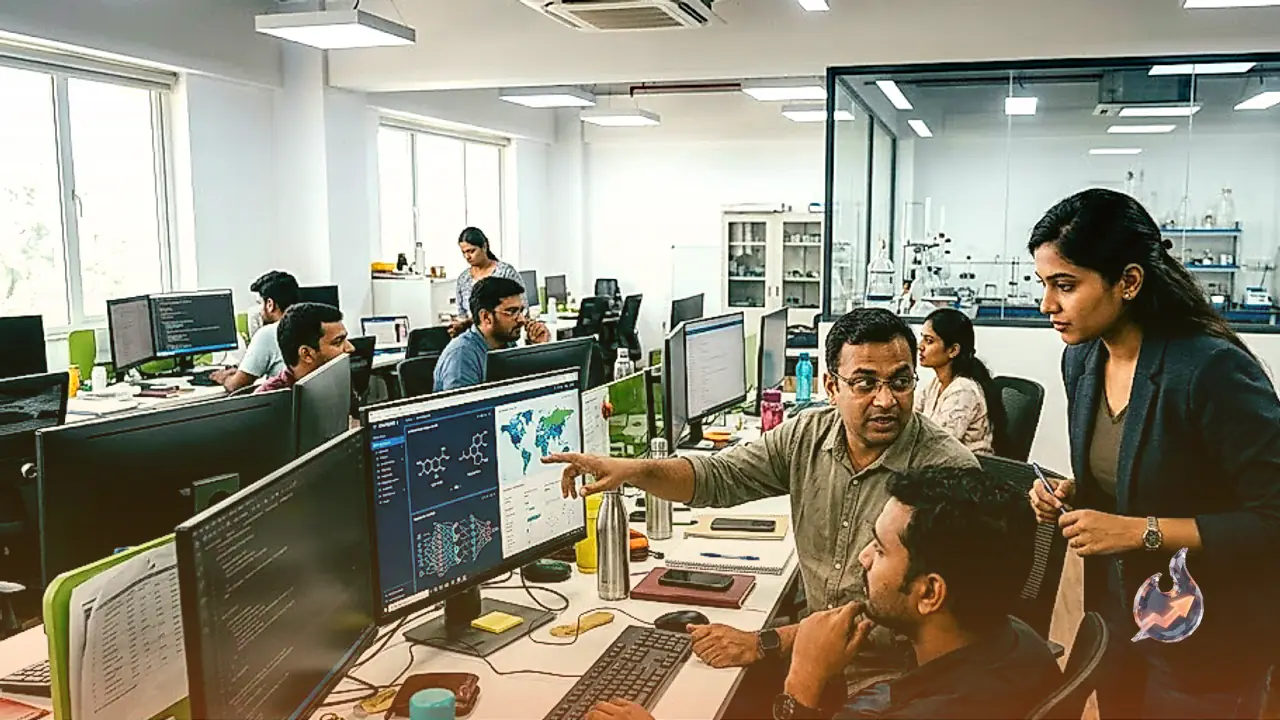
Upon taking in a client mandate, Scimplify develops synthetic routes inside its proprietary research and development hubs in Bengaluru and Hyderabad before handing off execution protocols to vetted partner factories. The entire transition is coordinated by Scinode, its proprietary AI platform that maps feasible synthesis pathways, screens compliant manufacturing infrastructure, and oversees regulatory compliance checks.
Santhosh explained that the software uses dedicated AI agents tailored for distinct tasks across synthesis design, factory production, and quality assurance. As Santhosh put it,
"Each of these agents is basically solving for what [a customer] would want, working backward from the customer's requirement."He noted that this architecture allows teams to execute far quicker while preserving technical context for recurring client orders. A technical roster of scientists and process engineers monitors this output across an external footprint spanning over 500 manufacturing plants.
Expansion in the US and Global Revenue Momentum
India currently hosts approximately 90% of Scimplify's operating production, but the company plans to establish localized manufacturing nodes across both the United States and Japan within the coming twelve months. Expanding into the North American market has already yielded substantial gains: the startup's annualized revenue run rate in the US jumped sixfold over the past year, rising from $10 million to around $60 million.
US contracts now generate roughly 30% of aggregate sales, and international clients outside India account for more than half of overall revenue, representing a steep increase from less than 5% eighteen months earlier. Overall, Scimplify serves over 1,000 corporate clients across more than 40 nations, reaching an annualized revenue run rate of approximately $200 million, a three-fold rise year over year. Looking ahead, management is targeting a $400 million annualized run rate over the next year. On the profitability front, the enterprise has logged positive EBITDA over the past two months and projects reaching post-tax profitability this month.
Targeting Tungsten Scrap and Rare-Earth Refining
Industrial demand shifts have restructured Scimplify's revenue profile. Sectors spanning electronics, defense, and energy now account for between 45% and 50% of top-line earnings, compared with less than 15% a year earlier. This surging uptake mirrors the broader AI boom, which requires heavy volumes of specialty materials for chipsets and power hardware, alongside rising procurement from defense contractors responding to ongoing conflicts.
Operationally, Scimplify is working to derive high-value tungsten compounds directly from scrap waste, giving buyers a secure substitute for supply pools dominated by Chinese producers. The team is also advancing processing capabilities for rare-earth materials, another category vulnerable to severe supply constraints. The startup counts prominent industrial enterprises among its partners, including Japanese electronics maker TDK, German chemical group BASF, and Hitachi. Out of the latest $25 million financing, roughly $7.5 million is designated for scaling US operations and contract networks, with another $2 million earmarked to upgrade the Scinode computational platform. The venture employs around 340 personnel, including roughly 70 research scientists, with regional hubs operating in India, the US, Japan, Indonesia, and the UAE.