

















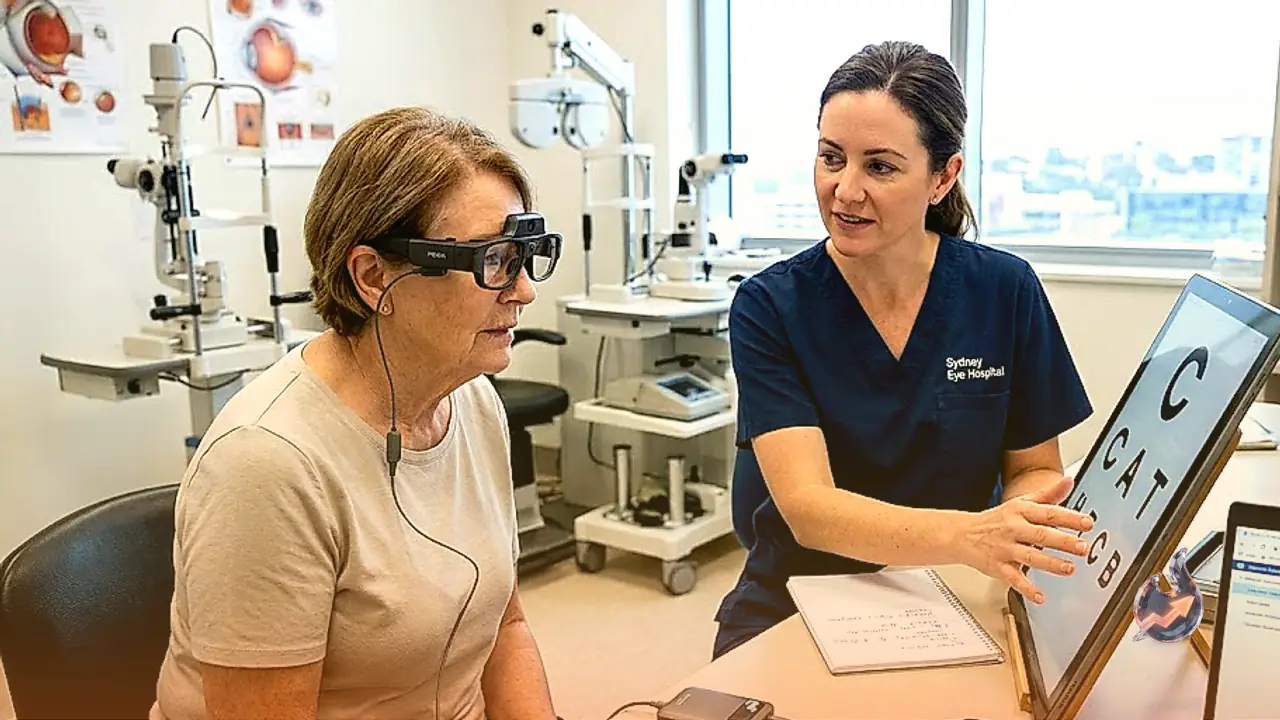

A breakthrough in neurotechnology and ophthalmic medicine has emerged with the first surgical implantation of a sight-restoring microdevice into a person living with Stargardt disease. Developed by Science Corporation, the PRIMA retinal implant was fitted during a procedure conducted at the Sydney Eye Hospital in Australia in May as part of an active clinical trial. The patient made rapid progress during early rehabilitation appointments, recognizing a single letter during the opening session and successfully reading an entire word in the second. The milestone marks a major step forward against a condition long regarded by clinicians as incurable.
Understanding Stargardt Disease and Outer Retina Damage
Stargardt disease directly targets the outer layer of the retina, triggering the gradual degradation and death of photoreceptors, the specialized cells responsible for sensing incoming light. In many cases, the inner retina remains intact, leaving the biological pathways that convey visual signals to the brain undamaged. As photoreceptors fail, patients develop an expanding blind spot directly in the center of their visual field. Worldwide, roughly 150,000 individuals have lost their sight because of this degenerative genetic condition.
Max Hodak, founder of Science Corporation, described the scientific foundation underpinning the technology, noting that the retina functions as an integral component of the central nervous system. In his view, cochlear devices, retinal systems, and motor prosthetics all represent different expressions of brain-computer interfaces. When treating the brain as an information processor, visual perception boils down to electrical activity moving along the optic nerve. Transmitting properly formatted electrical impulses through the optic nerve enables the brain to construct visual perception artificially.
How the PRIMA Implant and Camera Glasses Function
Receiving the device involves a surgical operation lasting approximately one hour. The surgeon positions a tiny microchip at the posterior wall of the eye, directly where the patient's native photoreceptors have decayed. Following recovery, the user wears specialized spectacles outfitted with an integrated camera. This camera captures the surrounding environment and beams the visual data directly to the implanted microchip, which takes over the role of artificial photoreceptors.
The implant deployed in this trial measures two millimeters by two millimeters, giving the user a narrow perspective comparable to gazing through a drinking straw. It does not provide full-color, wide-angle sight, but instead projects a high-contrast, black-and-white visual patch directly within the central field of view. Because the contrast and edge definition are exceptionally sharp, the patient can resolve several letters simultaneously.
Hardware Scaling and Future Human Trials
Engineering teams are now focused on widening the visual boundary offered by the technology. Expanding the field of view requires designing larger hardware that conforms smoothly to the eye's natural curvature, alongside shrinking the microelectrodes to capture native levels of visual detail. Max Hodak indicated that development is progressing steadily, with a next-generation implant scheduled to enter human trials within the next year. Over the coming five years, the enterprise expects to approach the visual acuity of natural human sight.
PRIMA already holds commercial authorization in Europe for treating individuals blinded by geographic atrophy, an advanced stage of age-related macular degeneration. The underlying technology is designed for broad deployment, and developers intend to validate its utility across multiple retinal conditions beyond geographic atrophy, including Stargardt disease.
Science Corporation's Platform and Skull-Based Sensors
Max Hodak launched Science Corporation in 2021 following his departure from Neuralink, aiming to advance the fields of neural engineering and brain-computer interfaces. Rather than moving straight to general computing peripherals, the company chose to prove clinical viability and establish financial sustainability by addressing vision loss first.
Beyond ocular devices, the company is preparing brain-computer interface hardware designed to sit beneath the skull while resting gently atop the brain's surface. This configuration differs fundamentally from Neuralink's architecture, which penetrates deep into cerebral tissue. Placing the sensor across the cortical exterior could support new diagnostic monitoring methods for neurological issues, such as tracking brain tumor progression.
Treating Strokes and Severe Neurodegenerative Illness
The firm plans to disclose its initial major clinical program soon, targeting a widely recognized neurodegenerative disorder. Stroke rehabilitation forms another key research pillar. When a stroke damages or destroys localized brain regions, establishing synthetic pathways between two separate deep-brain structures could allow clinicians to graft entirely new cortical functional zones into the brain, a feat impossible with legacy electrode designs.
Company leadership anticipates that brain-computer interfaces will eventually become common medical equipment for people reaching their 60s and 70s, rather than consumer gadgets for healthy 40-year-olds. The long-term objective centers on expanding the healthy human health span rather than merely lengthening biological life, while unraveling how biological brains produce consciousness to eventually build engineered brains.