






















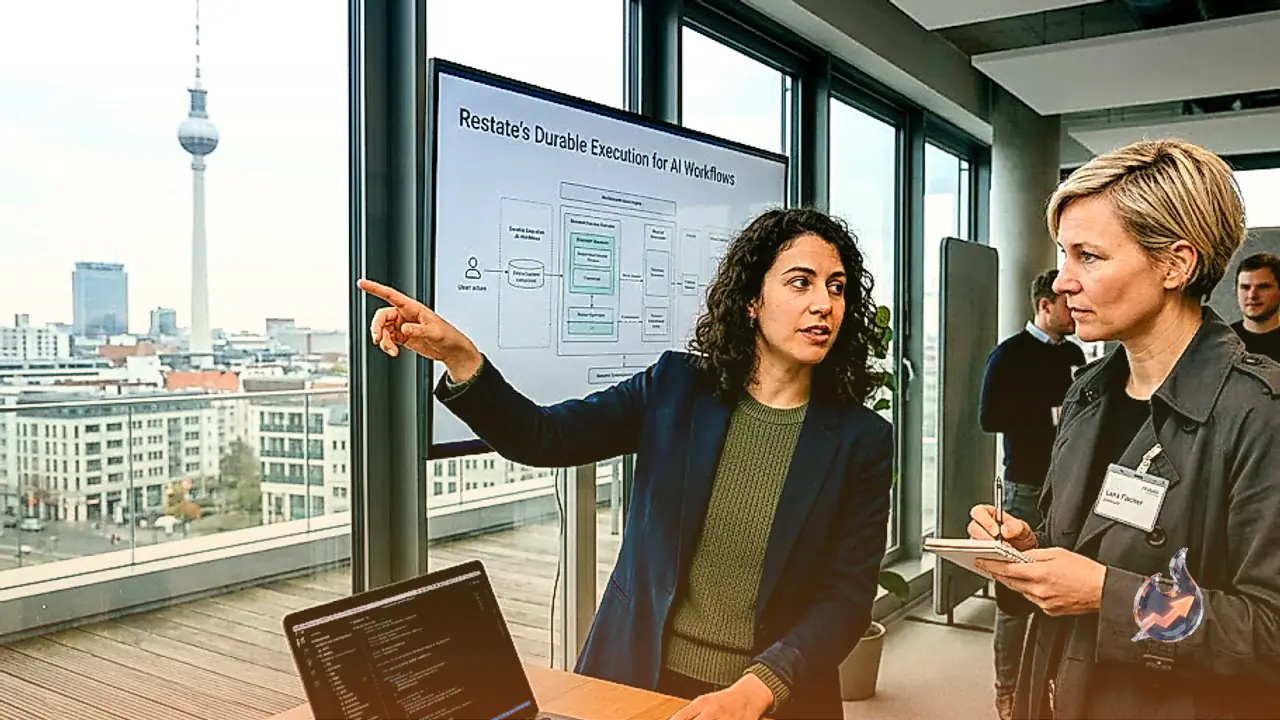

Autonomous software systems and dynamic machine learning workflows are demanding unprecedented levels of operational resilience. Unlike deterministic legacy programs, autonomous agents make decisions across prolonged sessions, exposing enterprise stacks to network breaks, unexpected timeouts, and sudden host failures. Addressing this growing pain point, Berlin-based engineering startup Restate has raised a $20 million Series A financing round to scale its durable execution platform. The investment round was led by Singular, with active participation from Redpoint Ventures and Capital One Ventures.
The Critical Demand for Durability in Agentic Software
Traditional computing tasks execute predictable sequences, making standard error recovery relatively straightforward. Multi-step artificial intelligence agents operate quite differently, traversing lengthy and fundamentally non-linear paths depending on real-time inputs. If an infrastructure layer crashes halfway through an agent action, recovering lost progress without re-running expensive compute cycles becomes a major challenge. Co-founder Stephen Ewen established the company in 2022 to provide crash-resilient multi-step execution. While the engine was not originally architected solely for agents, it emerged as an ideal technical match for the operational hurdles these agents encounter. Ensuring every single step is logged accurately guarantees that tasks remain fully reproducible and deliver dependable results regardless of environment glitches.
Proprietary Engine Design and Expanding Enterprise Traction
Rather than layering its resilience layer on top of third-party transactional databases, the startup developed its own purpose-built storage, data replication, and redundancy tiers from scratch. This custom low-level architecture ensures that execution remains lightweight and remarkably fast. Traditional distributed systems often treat durability as an expensive, heavyweight overhead, but this streamlined framework delivers continuous reliability with significantly lower overhead. Market reception has accelerated, with the business closing multiple enterprise contracts worth six and seven figures in recent months. The platform already powers high-profile developer environments such as vibe coding platform Replit, alongside global Fortune 500 enterprises in the financial sector. Across these diverse deployments, the core enterprise requirement remains identical: automatically restoring state and resuming execution without manual troubleshooting whenever mid-process failures occur.
Challenging Incumbents and Proven Distributed Systems Pedigree
The fresh injection of institutional capital equips the startup to compete directly with category incumbent Temporal. Established in 2019, Temporal cemented its heavyweight status earlier this month by announcing a massive $550 million Series E at a $12.55 billion valuation. Even as an agile challenger against an established giant, the startup leans heavily on its leadership team's deep engineering lineage. Before launching the venture, Stephen Ewen co-created the widely adopted open-source stream-processing framework Apache Flink. He subsequently served as Chief Technology Officer at Data Artisans, the commercial entity built around Flink. Following Alibaba's acquisition and rebranding of Data Artisans as Ververica in 2019, Ewen continued guiding technological development as CTO for three years. He co-founded the current business alongside former Data Artisans and Ververica colleagues Igal Shilman and Till Rohrmann.
Scaling Bay Area Presence and Broadening Industry Relevance
The enterprise plans to deploy its newly secured funding across critical commercial and development functions. Key priorities include assembling a dedicated go-to-market organization, bringing aboard senior distributed systems engineers, and growing its presence across the San Francisco Bay Area to remain proximate to primary enterprise accounts. Technical leadership maintains that durable execution engines will rapidly expand beyond native software builders. Over the coming years, automated recovery frameworks are expected to mirror databases in universal adoption, establishing an essential operational utility for organizations of every scale and industry vertical.