























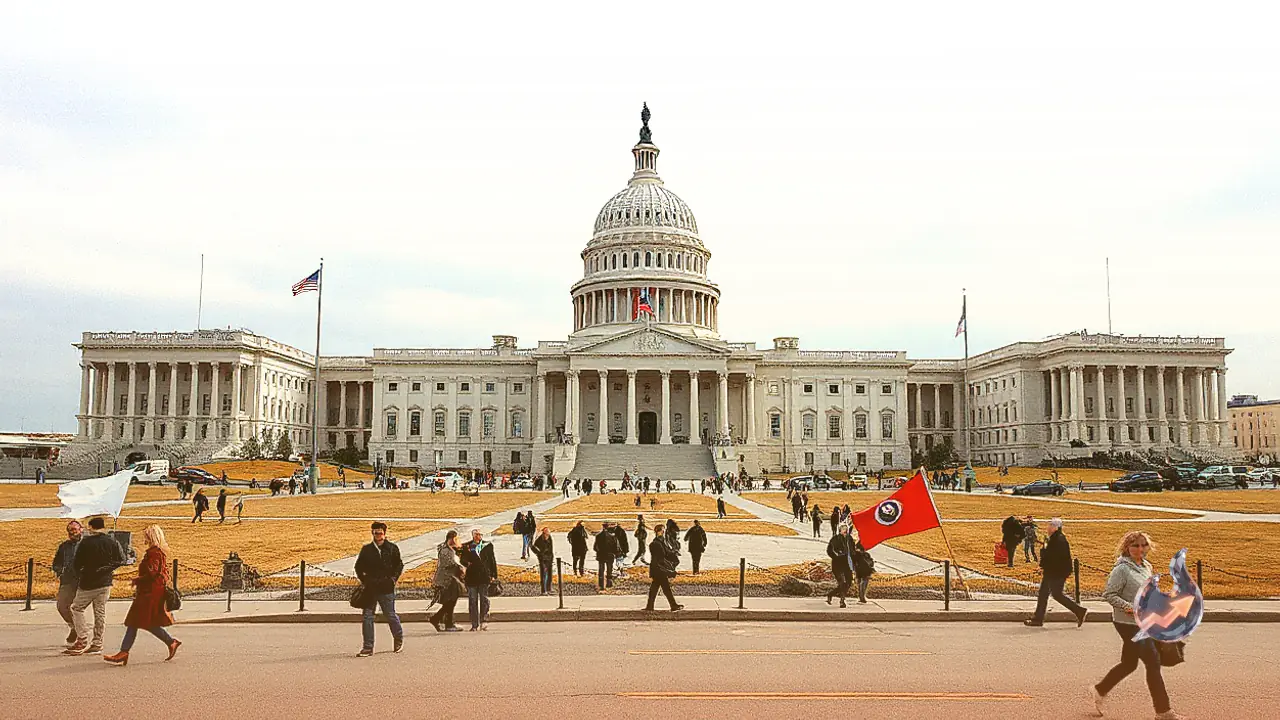

A sweeping political transformation has dramatically redrawn the legislative landscape in Washington as the latest midterm election results established Democratic control across Capitol Hill. In American political terminology, routine victories are often described as waves, but when electoral shifts exceed broad projections and fundamentally dismantle entrenched partisan fortresses, analysts invoke the term tsunami. The emergence of a Blue Tsunami signifies that the Democratic Party has captured majorities well beyond conventional forecasts while handing the Republican Party damaging losses in key battlegrounds, leaving Donald Trump and his legislative allies facing a reshaped balance of power.
The Symbolism of Party Colors and the Definition of a Blue Tsunami
The two-party framework of American politics is universally associated with distinct color alignments. The Democratic Party is represented by blue, whereas the Republican Party is designated by red. Political commentators routinely employ the phrases Red Wave and Blue Wave to depict electoral cycles where either party gains momentum and captures a meaningful batch of seats at the expense of its rival.
A Blue Tsunami, however, describes a rare electoral reality where the margin of victory far exceeds standard polling predictions and baseline expectations. It indicates a scenario where the prevailing public mood tilts so decisively that Republican candidates are defeated even in long-standing conservative strongholds. While Blue Tsunami holds no official constitutional or legal standing in United States electoral statutes, observers measure the phenomenon through concrete data: the raw net turnover of seats, unprecedented victory margins across multiple states, and successful inroads into districts historically dominated by the opposition.
The Structural Anatomy and Calendar of Midterm Elections
Presidential elections in the United States occur every four years, and midterms are conducted precisely at the two-year mark of a presidential administration. Under this statutory calendar, the presidential contest took place in November 2024, leading to Donald Trump taking the oath of office for his second term in January 2025. Following two years of governance, the nationwide midterm polls were held on November 3, 2026. While the presidency itself is not on the ballot during midterm voting, the outcome establishes the governing majorities of the United States Congress.
The bicameral structure of the United States Congress consists of two distinct chambers with specific electoral mechanics
- The House of Representatives: Functioning as the lower chamber of the federal legislature, the House comprises 435 voting members. Because representatives serve two-year terms, all 435 seats are contested simultaneously during every midterm election, putting entire control of the body directly on the line.
- The Senate: Serving as the upper legislative body, the Senate contains 100 members, with exactly two senators representing each state. Senators serve staggered six-year terms, meaning approximately one-third of the chamber faces election every two years.
Because of this framework, voters in midterm elections ultimately determine which party wields authority over Capitol Hill during the final two years of a president's term. Consequently, these contests serve as a direct popular verdict on the sitting president's administrative priorities and executive record.
Why This Midterm Outcome Qualifies as a Blue Tsunami
The latest midterm results caused a structural rupture in legislative math. Prior to this vote, the Republican Party held majorities in both legislative branches, providing administrative alignment with the executive branch. However, the Democratic Party successfully secured majorities across both the House of Representatives and the Senate, entirely stripping Republicans of legislative control.
The defining element that elevated this victory to a Blue Tsunami was geographical reach. Democratic contenders did not simply turn out high numbers in traditional blue states; they made decisive breakthroughs in states and districts that had consistently elected Republican lawmakers for years. Flipping longstanding strongholds alongside simultaneous takeovers of both legislative bodies fulfilled the classic criteria of a historic electoral wave.
Legislative Gridlock and Consequences for the Executive Agenda
Losing majorities in both congressional chambers carries immediate and severe governance repercussions for an administration. When the opposing party controls both the House of Representatives and the Senate, the White House encounters severe obstacles in advancing statutory proposals. Over the subsequent two years, securing approval for federal budgets, enacting policy initiatives, and passing signature legislation will require navigating an adversarial legislative branch. The November 2026 elections have thus placed significant legislative constraints on Donald Trump's governing agenda for the remainder of his term.