

















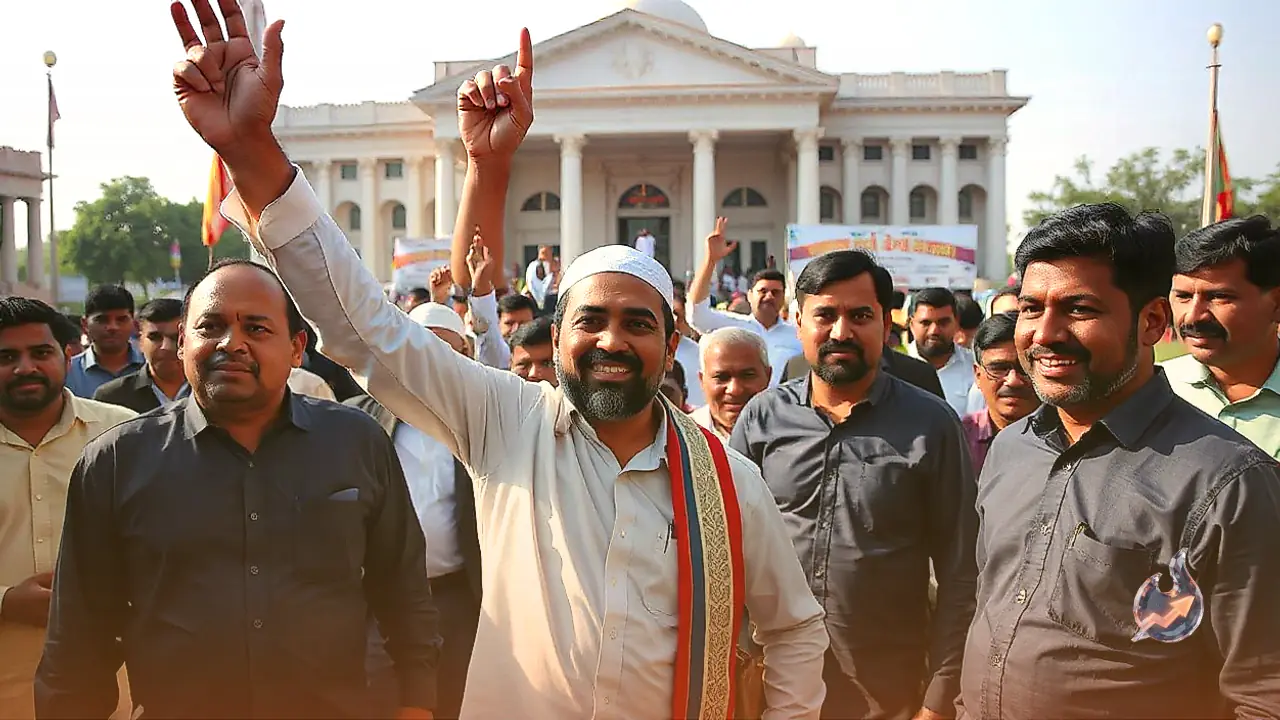

A historic milestone has been reached in American legislative history as Michigan voters chose Abdul El-Sayed as their next representative in the upper chamber of the United States Congress. Contesting on the Democratic ticket, El-Sayed defeated Republican contender Mike Rogers by an impressive margin of more than 1.27 lakh ballots. The victory arrives after a contentious campaign where Donald Trump had publicly branded Abdul a 'jihadi', yet the decisive tally now establishes him as the first Muslim senator in US history. While the political earthquake reshapes expectations in Washington, lively festivities have broken out across the world in the coastal town of Bhatkal, nestled in Karnataka. Home to around 46 thousand residents, the municipality is celebrating because the newly minted American lawmaker happens to be their son-in-law.
The Maritime Roots of the Jukaku Household in Karnataka
Abdul El-Sayed's direct kinship with India flows through his marriage to Sara Jukaku, whose family tree runs deep into the soil of Bhatkal. Known historically for its centuries-old seafaring trade, the coastal settlement served as the childhood home of Sara's father, Dr. Jukaku S. Tayob. Her paternal grandfather, Jukaku Shamsuddin, was also a prominent political figure in Karnataka, having served as a deputy minister handling the finance portfolio under Mysore Chief Minister BD Jatti. Although several branches of the Jukaku clan later relocated to Bengaluru, their pioneering social and academic efforts in Bhatkal remain well remembered.
A Landmark Intersection Honoring Public Service
Decades ago, when formal learning institutions were scarce across the region, Sara's grandfather Shamsuddin played an instrumental role in establishing local schools and community organizations. He is widely credited with bringing electrification and essential municipal civic services to Bhatkal and adjoining villages. In appreciation of his civic leadership, residents dedicated one of the most prominent road crossings in the center of the town as 'Shamsuddin Circle', an intersection that remains a bustling focal point today.
From Bangalore Medical College to Detroit Practice
Dr. Jukaku S. Tayob completed his primary schooling in his birthplace before graduating from Bangalore Medical College in 1976. Looking for greater professional avenues, he immigrated to Michigan in the United States, ultimately establishing a medical career in the Detroit metropolitan area. Celebrating the news from Washington, Sara's cousin noted that the family takes immense satisfaction in watching the couple step into the national spotlight, adding that El-Sayed embodies the same public integrity and dedication to public welfare that defined grandfather Shamsuddin.
University Days and Medical Paths in Michigan
Following in her father's footsteps, American-born Sara pursued medicine alongside liberal arts. At the University of Michigan, she completed dual degrees in sociology and Near East studies before traveling to the University of Oxford for a master's degree. She earned her medical credentials from the Vagelos College of Physicians and Surgeons at Columbia University. Sara subsequently served in a senior psychiatric capacity at University of Michigan Health before opening her private psychiatric practice, Mind Work Psychiatry, based in Ann Arbor.
The couple's personal journey began during their collegiate tenure at the University of Michigan, where both took part in activities organized by the Muslim Students Association. Abdul proposed during Sara's freshman year, leading to their wedding in May 2006 when she was 19 years old. Today, they raise two young daughters, eight-year-old Emmalee and three-year-old Shireen. Highlighting her husband's unyielding principles, Sara once remarked that no corporate donor, billionaire, or political lobby dictates how Abdul governs.
Two Decades as a Son-in-Law to an Indian Family
On multiple public occasions, Abdul El-Sayed has shared lighthearted observations regarding his deep familiarity with Indian household traditions. Speaking about his domestic life, he observed that spending twenty years as a son-in-law to a South Indian family has made him feel thoroughly assimilated, remarking that he often feels more Indian than Arab. He added that his entire life has been anchored by desi women, surrounded every day by his wife and their two young daughters.