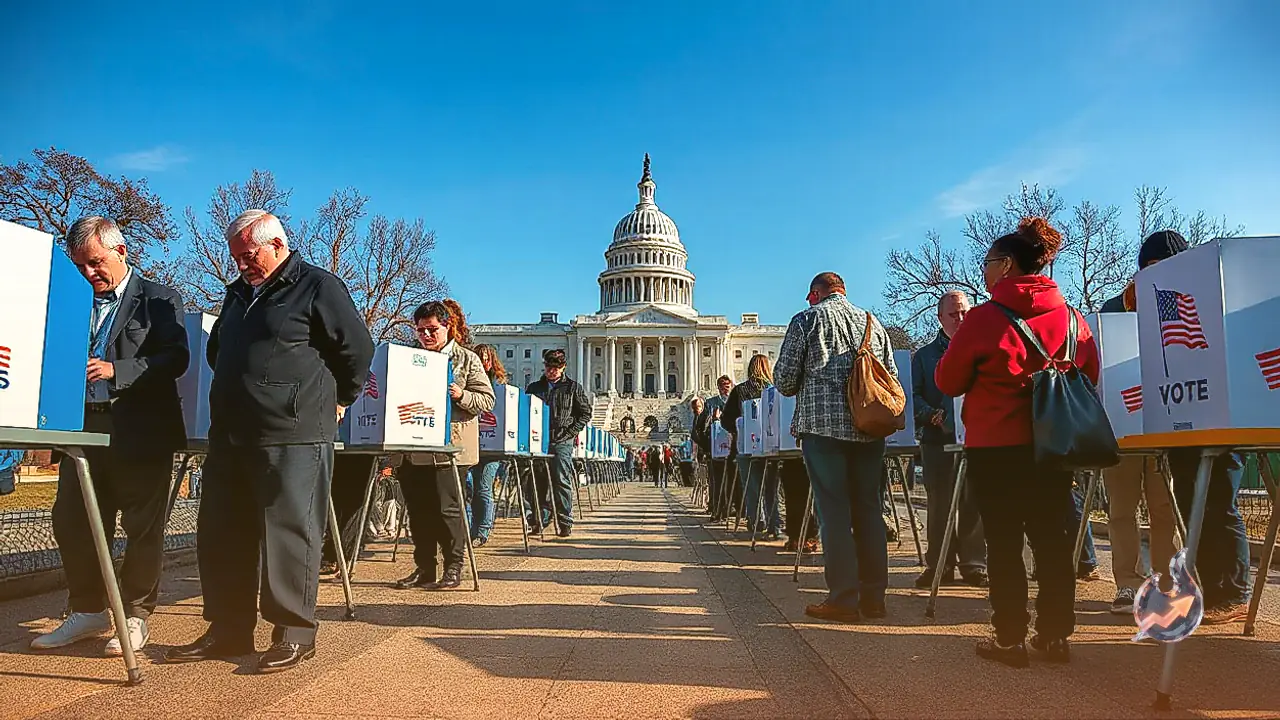
























Voting commenced across the United States on November 3 for the pivotal 2026 midterm elections, marking the exact halfway point of President Donald Trump's second term in the White House. This nationwide electoral exercise extends far beyond filling legislative seats; it serves as a high-stakes referendum that will determine the precise scope of executive power Donald Trump will command over the next two years. The overarching question dominating Washington is whether the president will command the majorities needed to push forward his core policies, or whether an emboldened opposition will establish roadblocks at every legislative turn. With over 50 million Americans having already cast their ballots before November 3, the final count will decide how much governing authority stays within the administration's grip.
The Balance of Power Across Both Chambers of Congress
Midterm elections in the American constitutional framework are held at the exact midpoint of a president's four-year term. In 2026, voters are not electing a commander-in-chief, but rather choosing members of Congress as well as governors across various states. The federal legislature is divided into two distinct chambers, where the true equilibrium of federal power is established.
The lower chamber, the House of Representatives, comprises 435 voting seats, and every single one of those 435 seats is on the ballot this cycle. Securing a working majority in the House requires any party to capture at least 218 seats.
In the upper chamber, the Senate, there are 100 seats in total, with 35 seats contested in this election. Entering election day, the Republican Party holds a 53-seat majority, while Democrats occupy 45 seats alongside 2 independent senators who caucus with them.
Historical trends illustrate that midterm cycles almost invariably represent the steepest hurdle for any sitting administration. In 20 of the past 22 midterm elections, the incumbent president's party has suffered net seat losses. Consequently, these contests are broadly viewed as the public's direct performance appraisal of the president's first two years in office.
Three Scenarios That Could Reshape Washington's Agenda
Policy experts and observers are monitoring three plausible outcomes from the ballot count, each carrying vastly different consequences for the federal government.
The first scenario involves a sweep by the Democratic Party. If widespread voter frustration over persistent inflation and signature administration policies, including the war with Iran, steep import tariffs, and local pushback against AI data centers, tilts the electorate toward the Democrats, the opposition could take control of both the House and the Senate. Such an outcome would inflict a massive blow on Donald Trump. Democratic majorities would immediately launch aggressive investigations into administration policies, official appointments, and executive actions. Passing new budgets or federal legislation would become virtually impossible for the White House, while the prospect of impeachment proceedings would loom over the remainder of the term.
The second possibility is a split outcome that leaves Capitol Hill divided. Under this scenario, Democrats might secure a slim majority exclusively in the House of Representatives, while the Republican Party defends its hold over the Senate. A divided Congress of this nature would plunge Washington into immediate legislative gridlock. Neither party would possess the leverage to advance major legislation independently, compelling continuous cross-party bargaining and protracted friction to achieve even basic governance.
The third trajectory entails the Republican Party maintaining unified control of Congress. If Republicans defy pollsters and historical projections by retaining majorities in both the House and Senate, Donald Trump's final two years would proceed with minimal legislative friction. The administration could enact domestic initiatives and pursue foreign policy directives without facing committee subpoenas or statutory barriers, cementing an extraordinarily advantageous position for the party heading into the 2028 presidential contest.
The Veto Weapon as an Executive Countermeasure
Anticipating the possibility of an opposition-led Congress, Donald Trump has already outlined a confrontational governing posture rather than signaling conciliation.
During an appearance on Miranda Devine's podcast 'Pod Force One', Donald Trump stated unequivocally that if the Republican Party loses its congressional majorities, he will simply assume the persona of 'Mr. Veto'.
Under the United States Constitution, the president commands the executive authority to veto and reject any legislative bill passed by both houses of Congress before it can take effect as law.
Detailing this plan, Donald Trump affirmed that he would not permit an opposition majority to disrupt his objectives. He outlined a strategy wherein any bill approved by an opposing Congress and sent to his desk would be promptly vetoed. According to his calculations, after a month or two of seeing their entire legislative output systematically struck down, opposition lawmakers would be forced to return to the negotiating table to hammer out mutual compromises.
Congress does maintain a constitutional mechanism to override an executive veto, but the procedural threshold is deliberately demanding. An override requires a two-thirds supermajority vote in both the House and the Senate, an alignment that occurs only under exceptionally rare political circumstances.
Voter Priorities and the Road to the 2028 Election
Several decisive issues are driving voter sentiment across the country as ballots are tabulated. Everyday cost of living and inflation stand as the foremost priority, cited by 34% of voters as their single most pressing concern. Foreign affairs have also weighed heavily, with the military conflict involving Iran and the economic fallout from tariff policies directly influencing voter perspectives. Domestically, the rapid expansion of tech-backed AI data centers has met widespread resistance, with 66% of the public voicing opposition, creating local electoral friction in several states. Simultaneously, sharp legal disputes regarding mail-in ballots and voter registration rolls, notably in states like California, have triggered battles between election officials and the courts.
While Donald Trump's residency in the White House is not directly on the ballot in 2026, the midterm results will fundamentally shape the landscape for the 2028 presidential campaign. A Democratic resurgence across both chambers would solidify the party's momentum and provide a potent platform to challenge the administration on every policy front. Conversely, if Republicans preserve their congressional majorities, Donald Trump will navigate the remainder of his term on his own terms, reinforcing his political legacy ahead of the 2028 election.