

















Citing ongoing indirect discussions with Iran during remarks delivered in Florida, US President Donald Trump stated that one or two Iranian nuclear locations remain to be addressed, pointedly identifying Pickaxe Mountain as a site that could be targeted very rapidly. The warning brings renewed focus to a heavily fortified subterranean complex carved deep into a rugged ridge just two kilometres away from Iran's flagship nuclear establishment at Natanz. The direct mention of the site by the American leadership has once again raised pressing questions across Middle Eastern security circles about what is actually taking place beneath the surface of the mountain and why Washington views this specific subterranean footprint with such acute urgency.
Geographic Layout and the Strategic Terrain of Kuh-e Kolang Gaz La
Located in the central Iranian province of Isfahan, the ridge is referred to locally as Kuh-e Kolang Gaz La. The Persian word Kolang translates to a pickaxe or digging implement, giving rise to its commonly used English designation, Pickaxe Mountain. Positioned roughly two kilometres south of the primary Natanz nuclear facility and approximately 220 kilometres from the capital city of Tehran, the site occupies an exceptionally strategic point in Iran's nuclear infrastructure map.
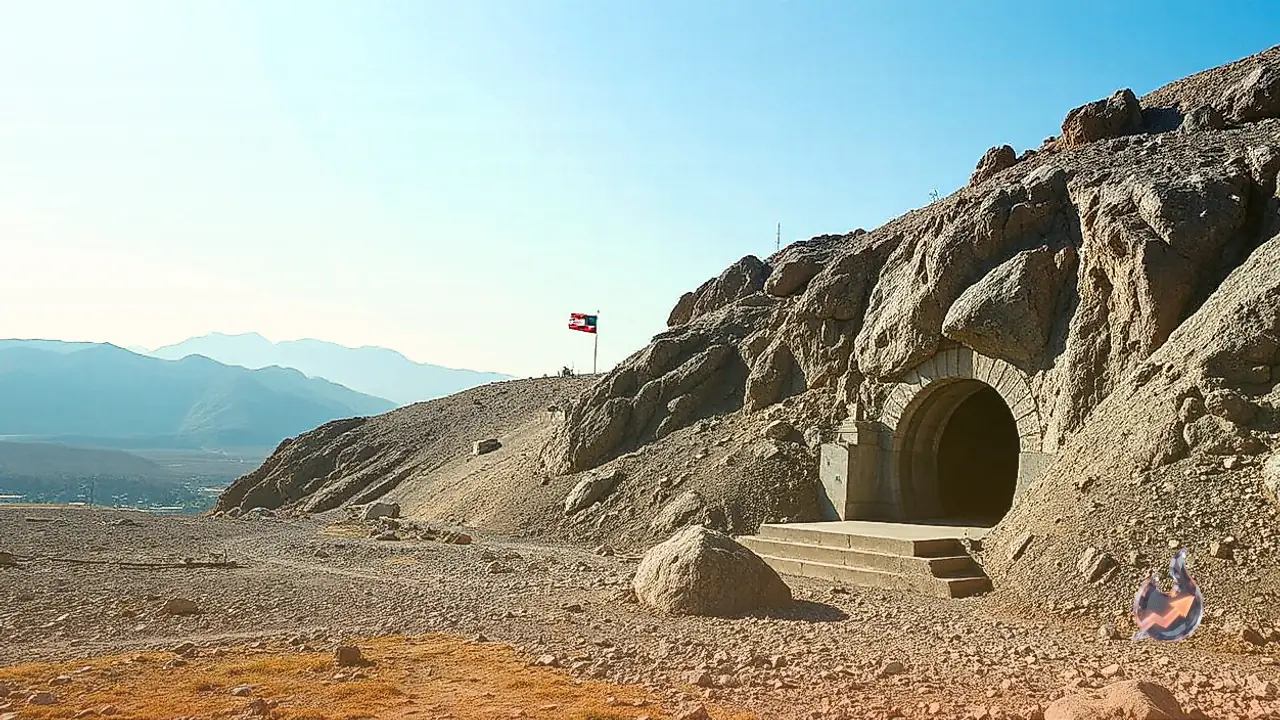
The defining structural feature of the site is an extensive network of tunnels burrowed into the subterranean core of the mountain. Engineers have constructed an expansive underground complex served by two separate tunnel access points. By driving the infrastructure straight into the interior of the massif, the design provides natural, heavy protection from external air raids and precision standoff strikes, ensuring that any operations planned for inside remain well insulated from conventional surface bombardments.
Concerns Surrounding Uranium Enrichment and Fuel Cycle Mechanics
The primary concern voiced by Western nuclear observers centres on the potential functionality of such a deeply buried installation. Multiple non-proliferation analysts evaluate the location as a candidate for a hardened uranium enrichment facility engineered specifically to withstand foreign air operations.
Uranium enrichment is the industrial and physical procedure of raising the concentration of a specific isotope within uranium feed material. When processed to lower concentration levels, the resulting material serves as reactor fuel for commercial civil energy grids. However, if the enrichment cascade is operated to achieve high concentrations, the very same material can be configured into the fissile core of atomic weaponry. This dual-use dynamic explains why the United States and its Western partners remain deeply alarmed by the prospect of an operational complex deep under the ridge, as such a heavily protected venue could allow Iran to maintain enrichment capabilities regardless of external kinetic actions.
Satellite Surveillance and Unverified Field Intelligence
Independent monitors have been tracking progress across the mountain using commercial satellite imagery. A detailed report dated 16 October 2026 by the Institute for Science and International Security recorded that earthen mounds continue to block the tunnel portals. This physical evidence suggests that the interior complex is not currently sustaining routine day-to-day operations and that visible large-scale excavation or construction work on the surface has tapered off.
Nevertheless, the institute's assessment highlighted that significant machinery or material could already have been transferred inside prior to the sealing of direct sightlines. Back in July, media claims citing Israeli intelligence assessments alleged that Iran had transported centrifuges along with associated components into the subterranean chambers. That assertion has not been independently corroborated by neutral observers. Consequently, the precise inventory of what currently sits behind the portal berms remains an open, unresolved question.
Granite Formations Versus the GBU-57 Bunker Buster
American operational planners face difficulties that go beyond the nuclear implications of the facility, rooted in the forbidding geology of Pickaxe Mountain itself. The underground chambers are enveloped by thick layers of dense granite rock, offering structural shielding far superior to conventional concrete bunkers against standard airstrikes.
The United States military fields the massive GBU-57 precision-guided penetrator, a heavy ordnance piece designed explicitly to crack reinforced, subterranean installations buried deep underground. Yet engineering specialists point out that neutralising a facility nestled beneath deep crystalline granite is an extraordinary operational challenge. A concentrated precision strike might successfully collapse the tunnel openings, sever high-voltage power feeds, disable airflow ventilation infrastructure, and shatter external auxiliary buildings. However, such exterior devastation does not guarantee the destruction of the reinforced halls hidden deep inside the rock.
Moreover, planners confront the operational requirement of rendering any internal equipment or radioactive material permanently unusable. Merely entombing the entrances under rock falls or scorched earth leaves open the possibility of future re-excavation, meaning that conventional air munitions alone may fall short of permanently eliminating the site.
A Shifting Nuclear Landscape Beyond Natanz and Fordow
Over the past decades, established installations such as Natanz and Fordow have occupied the centre of international crises, covert operations, and targeted sabotage. In the wake of repeated pressures against those surface and hillside facilities, Pickaxe Mountain has emerged as the next focal point of strategic tension. The rhetoric from Donald Trump confirms that the current administration in Washington maintains a live target portfolio focused directly on components it views as vital to Iranian nuclear continuity.
Nonetheless, declaring an intent to strike a heavily fortified location differs substantially from achieving its complete physical eradication. The sheer burial depth and dense rock shield of Pickaxe Mountain render any kinetic option exceptionally complex, carrying high military and diplomatic risks.
Crucially, the International Atomic Energy Agency (IAEA) has not carried out on-site verification inside this specific subterranean complex. Without formal international inspections, no independent body has been able to confirm which types of equipment are housed within, whether any enrichment activities have commenced, or what the ultimate operational parameters of the site are intended to be. While Iran has consistently maintained that its nuclear developments are strictly geared toward peaceful domestic energy and research purposes, the combination of buried engineering and lack of outside access ensures that the standoff between Washington and Tehran will remain intense.