























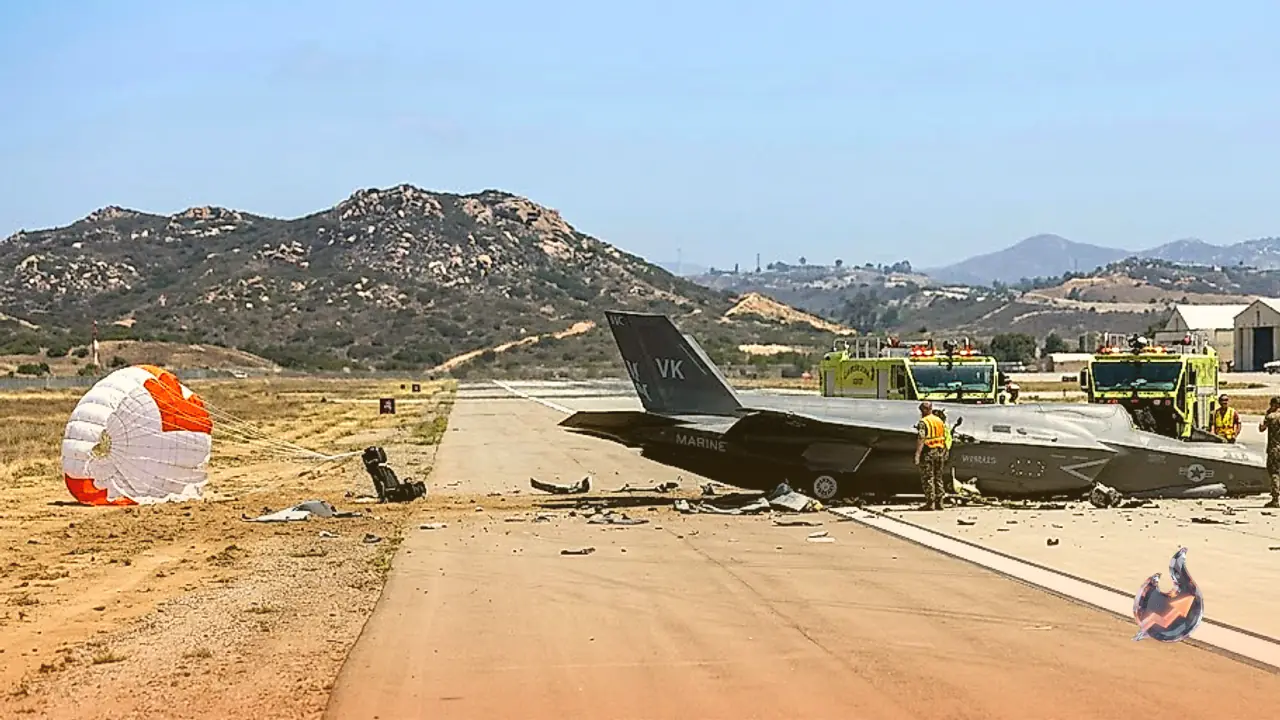

A US Marine Corps F-35B Lightning II stealth fighter jet crashed during a landing attempt at Marine Corps Air Station Miramar in San Diego, California. The incident occurred near the airbase runway around 10 a.m. local time, causing the multi-million-dollar aircraft to split into two major components and catch fire upon impact. Fortunately, the pilot managed to eject safely from the cockpit just before the crash landing. Emergency medical personnel transported the pilot to a regional hospital, where medical officials confirmed the pilot is in stable condition.
Landing Incident and Emergency Response
Military representatives confirmed that the crashed aircraft was actively assigned to Marine Aircraft Group 11 within the 3rd Marine Aircraft Wing. Preliminary findings indicate that the jet came down short of reaching the designated runway strip. Responding emergency crews quickly arrived at the crash site to extinguish the heavy smoke and fire resulting from the wreckage. US Marine Corps authorities have formally initiated a thorough investigation to identify the technical or operational factors that led to the mishap.
Unique STOVL Capabilities of the F-35B Variant
The F-35B is a short takeoff and vertical landing, known as STOVL, variant within the broader F-35 Lightning II aircraft family. Designed specifically for expeditionary operation, the STOVL configuration allows the fighter jet to operate from short runways and execute helicopter-like vertical landings. This capability enables military commanders to deploy the platform effectively from restricted forward airbases, amphibious assault ships, and aircraft carriers during expeditionary combat scenarios.
Fifth-Generation Stealth Architecture and Advanced Avionics
As a 5th-generation stealth combat aircraft, the F-35B features a radar-evading airframe engineered to penetrate contested airspace undetected. The aircraft integrates cutting-edge avionics suite including an Active Electronically Scanned Array, or AESA, radar, an Electro-Optical Targeting System, or EOTS, and a Distributed Aperture System, or DAS. Supported by advanced sensor fusion technology, these systems provide the pilot with an integrated 360-degree tactical picture of the battlefield. The multirole fighter can execute both air-to-air combat and air-to-ground strike missions while armed with long-range precision missiles and laser-guided munitions.