





















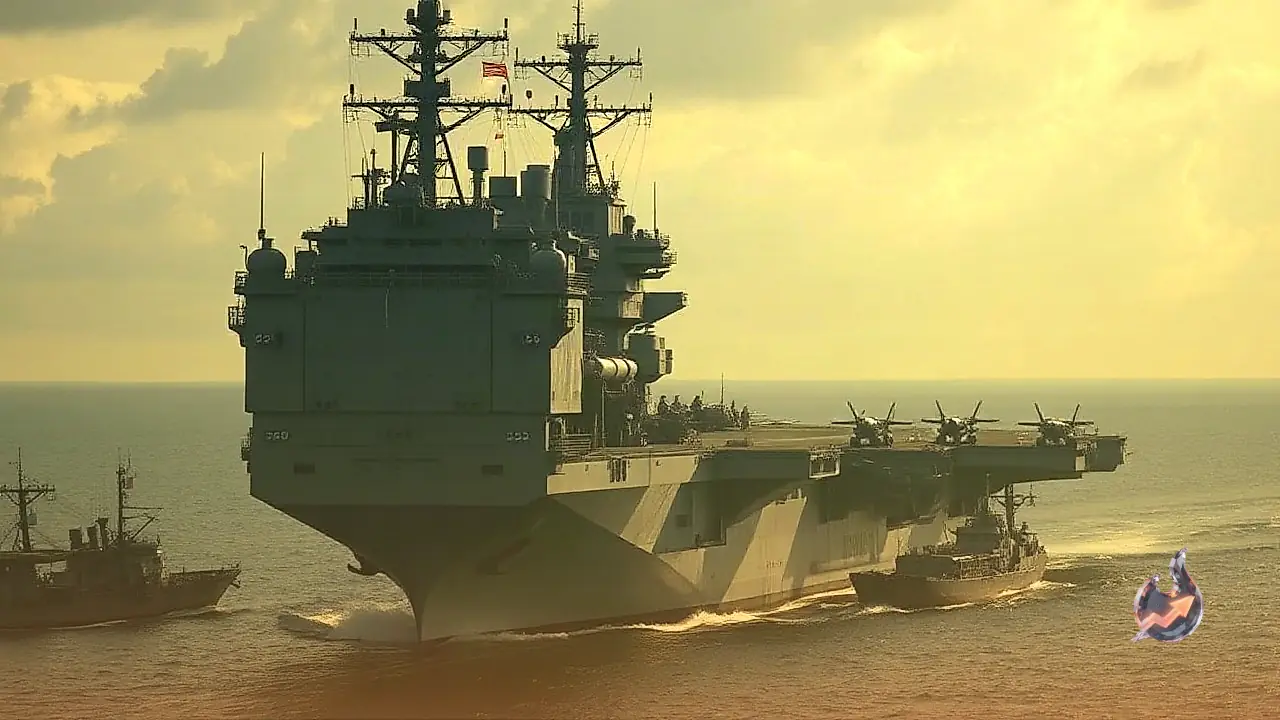

The extended deployment of the aircraft carrier USS Abraham Lincoln, one of the most formidable warships in the United States fleet, has raised fundamental questions about the operational readiness and structural resilience of the US Navy. Personnel stationed aboard the massive vessel endured months of grueling maritime conditions. Reports from crew members highlighted a series of debilitating onboard challenges, including poor quality food, contaminated drinking water supplies, unsanitary shower facilities, and an acute shortage of everyday essential items. This prolonged stint at sea without routine shore relief has severely impacted crew morale and brought the Navy’s operational logistics under intense public scrutiny.
260 Days at Sea and 240 Days Without Port Calls: The Human Toll
The sheer length of the Lincoln’s mission underscores the depth of the current naval crunch. The carrier spent approximately 260 days at sea, with an extraordinary stretch of roughly 240 consecutive days navigating open waters without making a single port call. On 6 August 2026, navy officials convened a high-stakes meeting at the North Island Naval Air Station in San Diego with more than 200 family members of the deployed sailors. Spouses and relatives voiced deep frustration, noting that sailors had conveyed concerning messages regarding deteriorating living standards aboard the ship. The situation revealed a unsettling contrast between the carrier’s public role as a primary symbol of American military power and the harsh everyday realities faced by its crew.
Eleven Ships on Paper vs the Harsh Reality of Carrier Availability
The primary driver behind the Lincoln’s extended stay in active service is a stark shortage of available replacement warships. While the US Navy officially boasts a fleet of 11 aircraft carriers on paper, that number does not reflect immediate combat readiness. At any given point, multiple carriers are dry-docked for complex multi-year overhauls, others are undergoing routine maintenance, and several are stuck in training certification cycles. Consequently, when the time came to rotate the Lincoln out of its duty station, the Navy lacked a fully prepped and certified carrier ready to relieve it, forcing the ship to remain deployed far beyond its intended timeline.
Anatomy of a Carrier Strike Group and the Inflexible Crew Rotation System
The USS Abraham Lincoln does not operate in isolation; it serves as the command center for an entire Carrier Strike Group. Aboard the Lincoln alone are roughly 3,200 sailors responsible for ship operations, complemented by an air wing of approximately 2,480 personnel dedicated to maintaining and flying strike fighters and support aircraft. The strike group is bolstered by several guided-missile destroyers and typically one or two nuclear-powered attack submarines. In total, a fully staffed strike group encompasses between 6,500 and 7,500 officers and enlisted personnel. Because Navy protocols make mid-deployment crew swaps practically impossible, sailors must remain on duty for the entire duration of the ship’s mission, regardless of how long the deployment is stretched.
A Critical Shortage of 20,000 Sailors and Bottlenecks in Training
Equipment bottlenecks are compounded by a severe deficit of trained personnel across the US Navy. Recent operational assessments indicate a deficit of roughly 20,000 sailors across various technical ratings. Recruitment metrics have consistently fallen short of targets, while seasoned petty officers and technical specialists continue to transition into the civilian workforce. This double hit has strained training pipelines, as a lack of experienced instructors and operational platforms makes preparing new recruits an increasingly difficult hurdle.
From the 1991 Gulf War to Today: A Shrinking Global Naval Presence
A historical look back at the 1991 Gulf War provides a striking benchmark for the Navy’s current force structure. During that conflict, the US Navy maintained four aircraft carriers operating simultaneously in the Persian Gulf alone. Today, despite maintaining an official tally of 11 carriers, the Navy has only three carriers deployed across the entire globe: USS Abraham Lincoln, USS George H.W. Bush, and USS George Washington. This contrast underscores how much the active sea-going footprint of the Navy has contracted over the past three decades.
Strategic Carrier Voids Across the Pacific, Atlantic, and Mediterranean
On 22 August 2026 or shortly thereafter, the Lincoln is scheduled to return to its home port in San Diego for overdue depot-level maintenance. To cover the gap, USS George Washington is departing its station in Japan to take over the Lincoln’s duties. This shift creates a notable strategic vacuum, leaving zero US aircraft carrier task forces present in the Pacific Ocean region. Furthermore, there are currently no US aircraft carriers deployed in the Northern Atlantic, Southern Atlantic, Caribbean, or Mediterranean Sea, illustrating the growing gap between paper strength and real-time power projection.
Maintenance Overhauls and the Fragility of American Global Deterrence
Upon its return to San Diego, the Lincoln faces a lengthy maintenance period. The strain of 260 days of continuous operations has placed intense wear on catapult systems, flight deck equipment, propulsion plants, and onboard infrastructure, requiring months of extensive repairs. During this overhaul, the vessel will be completely offline for operational deployment. For decades, US aircraft carriers have anchored global deterrence and rapid-response capabilities. However, when only two or three carriers can be kept operational at any given time, America’s ability to respond quickly to simultaneous global crises becomes increasingly constrained. The ordeal of the USS Abraham Lincoln is not just the story of a single troubled ship, but a clear signal of deeper challenges facing naval manpower, training pipelines, and fleet maintenance capacity.