




















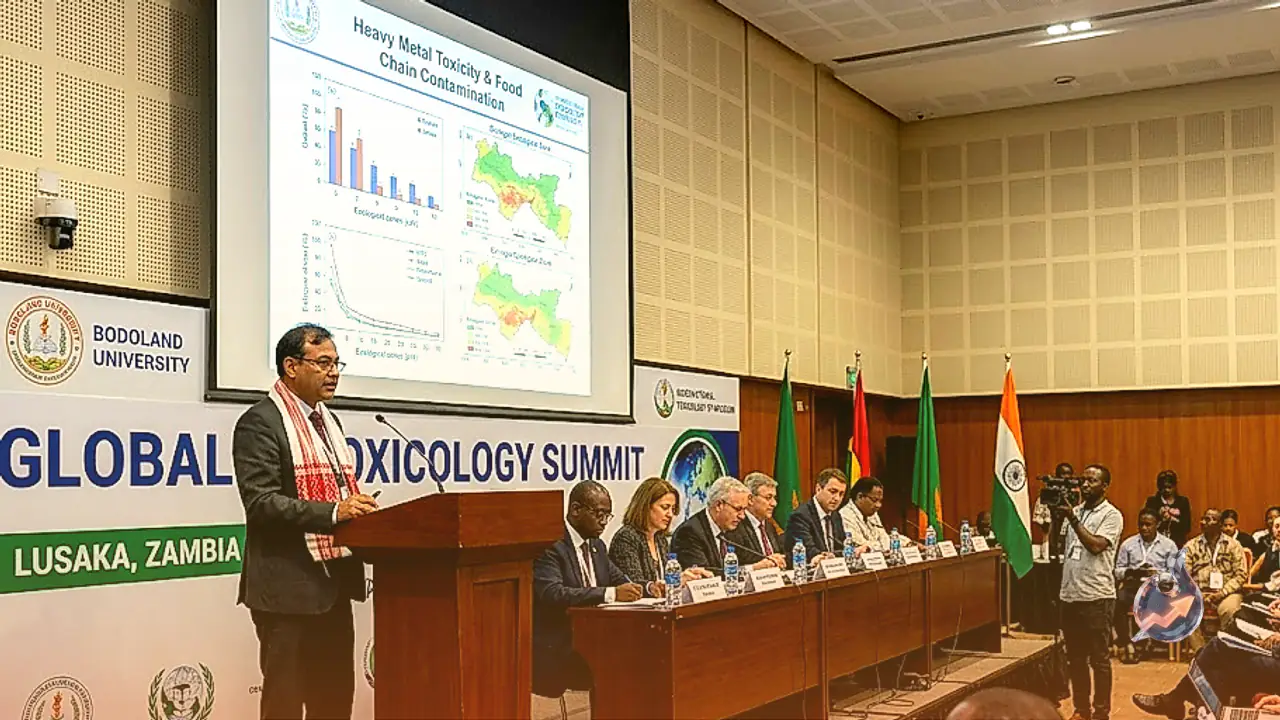

An academic presentation detailing environmental toxicity and soil contamination was recently delivered by Professor Hemen Sarma, who serves as the head of the Department of Botany at Bodoland University in Kokrajhar, Assam. Invited to participate in the prestigious 2026 ZAZINAMBO Project International Toxicology Symposium in Lusaka, Zambia, on October 7 and 8, Professor Sarma addressed global experts and researchers on the severe ecological risks associated with toxic heavy metal accumulation in agricultural and livestock systems.
Global Scientific Assembly in Lusaka
The international gathering brought together renowned researchers, environmental scientists, and academic leaders in the Zambian capital. The symposium was organized in direct conjunction with the JICA Chair and the JSPS International Symposium, which focused comprehensively on evaluating the impact of chemical and biological hazards on environmental quality, animal populations, and human health, alongside the formulation of effective countermeasure strategies.
Several prominent scientific authorities guided the scientific sessions throughout the two-day event. Key participants included Professor Shouta M. M. Nakayama from Hokkaido University in Japan, who serves as the Chief Adviser for the ZAZINAMBO Project, along with Professor Mayumi Ishizuka, also representing Hokkaido University. In addition, Professor John Yabe, holding dual academic appointments with the University of Namibia and the University of Zambia, contributed valuable research insights. A special JICA Chair lecture was delivered by Professor Yoshitaka Hosoi, an official adviser to JICA on the mining sector, who provided an in-depth analysis of the complex balance between mineral development projects and long-term environmental protection.
Research Findings on Heavy Metal Transfer
During his featured oral presentation, titled “Potentially Toxic Metals in Agricultural and Livestock Systems: Transfer, Exposure, and Phytoremediation,” Professor Sarma examined the pathways through which heavy metals enter human and animal food chains. He illustrated how hazardous metallic contaminants move from polluted soil and irrigation water into agricultural crops and grazing livestock, ultimately resulting in serious dietary exposure risks for human consumers.
To address these pervasive contamination risks, Professor Sarma emphasized the practical application of phytoremediation, a sustainable technique that utilizes specific plant species to extract, neutralize, or stabilize environmental contaminants in affected land. He explained that integrating suitable remediation plants with biochar-based soil amendments can enhance soil health, influence metal mobility, and effectively manage polluted agricultural environments.
International Cooperation and One Health Framework
The overarching framework of the ZAZINAMBO Project is funded by the Japan International Cooperation Agency (JICA). Its primary mission is to establish robust environmental monitoring networks and build localized human-resource capacity to combat heavy-metal contamination resulting from extensive mining operations. The initiative encompasses multiple African nations, including Zambia, Zimbabwe, Namibia, and Botswana, collaborating with Japan's Hokkaido University and various international research partners.
Highlighting the critical "One Health" framework, Professor Sarma stressed the interconnected nature of environmental quality, livestock health, and human well-being. Drawing upon published scientific studies from India as well as empirical evidence from mining-affected territories, he detailed soil-plant-animal transfer pathways and advocated for systematic monitoring and sustainable remediation strategies. The participation of Bodoland University successfully presented Indian research perspectives to a global academic forum, showcasing the institution's commitment to international environmental research.