





















When discussing the vertical lift capabilities of the Indian military, legendary legacy rotorcraft like the Chetak and Cheetah often dominate public memory alongside modern attack platforms. However, behind the multi-service fleet guarding India's diverse borders lies a deeper story of indigenous defense engineering that spans over four decades. The Advanced Light Helicopter (ALH) Dhruv stands as India's first domestically designed and developed multi-role rotorcraft, powering demanding operations across the Indian Army, Indian Air Force, Indian Navy, and Indian Coast Guard. The creation of this versatile aircraft was neither immediate nor simple; it represented nearly twenty years of intensive research, challenging test flights, technical hurdles, and the dedication of thousands of Indian engineers.
The 1980s Dilemma and Strategic Imperative
During the early 1980s, the Indian armed forces faced a complex logistical and operational challenge due to the country's vast geographic diversity. Maintaining separate foreign-built helicopter fleets to handle the icy peaks of the Himalayas, the scorching desert environments of Rajasthan, and humid coastal sectors was inefficient and expensive. Operating a single rotorcraft model reliably across these drastically contrasting climates was a formidable engineering task. Furthermore, total reliance on foreign defense procurement for every operational role presented serious financial costs and strategic vulnerabilities during times of conflict. Consequently, the Indian government resolved to design and build a multi-purpose helicopter tailored specifically to domestic terrain requirements.
From Blueprint to First Flight (1984 - 1992)
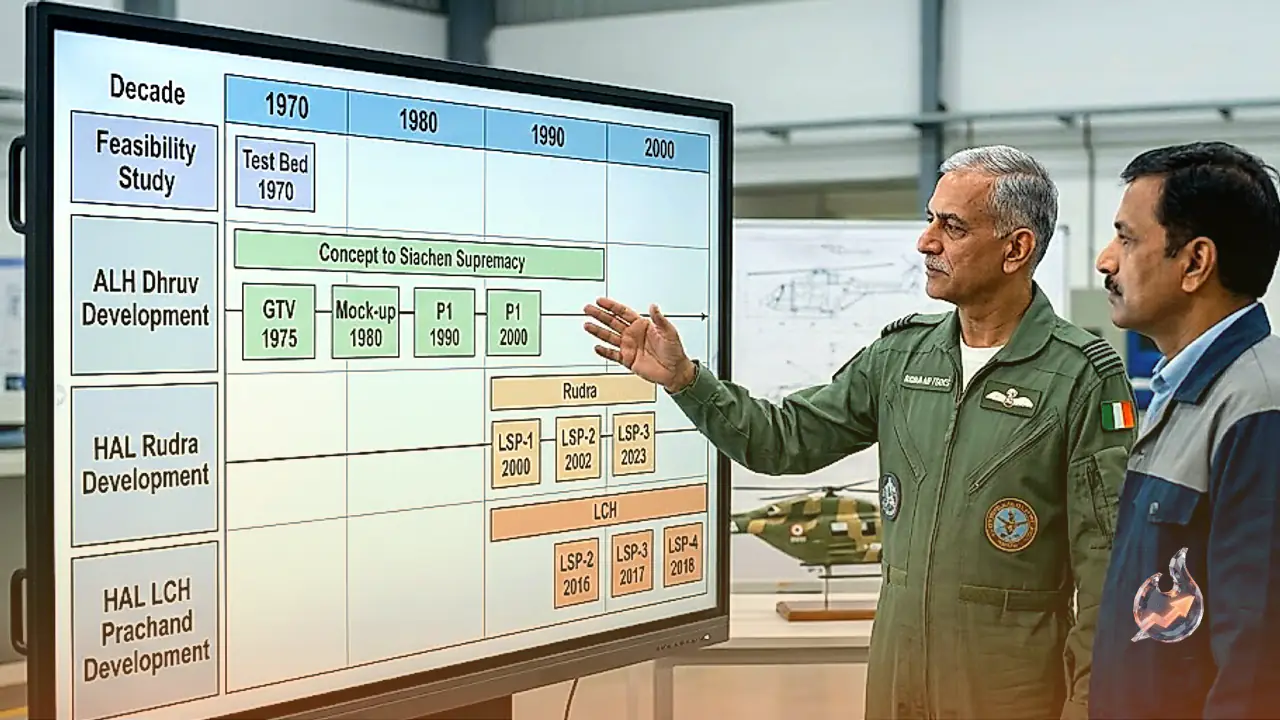
In 1984, the national mandate to build the helicopter was formally entrusted to Hindustan Aeronautics Limited (HAL). Because India's domestic aviation industry had limited prior experience in designing complete helicopter platforms from the ground up, technical collaboration was initially established with the German aerospace firm Messerschmitt-Bolkow-Blohm (MBB). Nevertheless, the main engineering responsibility rested upon Indian technicians, who needed to adapt the system to survive local operating extremes. Following eight years of continuous research, assembly, and testing, a landmark milestone was reached on August 20, 1992, when the prototype completed its maiden flight in Bengaluru. Although that initial test lasted only a few minutes, it proved that India possessed the capability to develop indigenous military rotorcraft. Over the following decade, the prototype underwent exhaustive trials in high mountain zones, hot deserts, and maritime corridors before its official induction into the armed forces in 2002.
Symbolic Naming and High-Altitude Excellence
The choice of the name 'Dhruv' carries profound cultural symbolism, referring to the Pole Star, which represents steadfastness, orientation, and dependability in Indian tradition. True to its designation, the aircraft has delivered steady performance under severe environmental conditions. Designed as a flexible utility platform, Dhruv conducts troop transportation, logistical supply drops, combat search and rescue, medical evacuations, and reconnaissance missions. Its high-altitude capabilities were famously proven in the Siachen Glacier region, recognized as the highest battlefield in the world. Operating and landing at elevations exceeding 20,000 feet presents extreme aerodynamic difficulties, yet Dhruv demonstrated exceptional flight envelope strength in those sub-zero conditions.
Engine Enhancements and Modern Avionics
To meet evolving operational demands, the platform underwent significant technological upgrades over time. Subsequent production variants were equipped with the more powerful 'Shakti' engine, co-developed by HAL in partnership with the French firm Safran. This upgraded powerplant substantially boosted payload capacity and performance margins in high-altitude terrain. Additionally, the integration of modern glass cockpits, advanced digital avionics, and automatic flight control systems enhanced operational safety and reduced pilot workload.
The Legacy: Rudra, Prachand, and Defense Exports
The success of the Dhruv platform extended beyond utility and humanitarian transport. Utilizing the same basic airframe design, HAL developed the HAL Rudra, India's first indigenous armed utility helicopter fitted with a 20mm turret gun, rocket pods, and anti-tank guided missiles. The technical mastery gained from both Dhruv and Rudra later directly informed the development of the Light Combat Helicopter (LCH) Prachand. Today, large fleets of Dhruv helicopters remain active across all services, conducting disaster relief, flood rescue operations, high-mountain supply runs, and urgent medical evacuations. Furthermore, India has exported Dhruv units to friendly nations such as Mauritius, Nepal, and the Maldives, marking a major shift in India's status from a defense equipment importer to an exporter of advanced military aviation hardware.