






















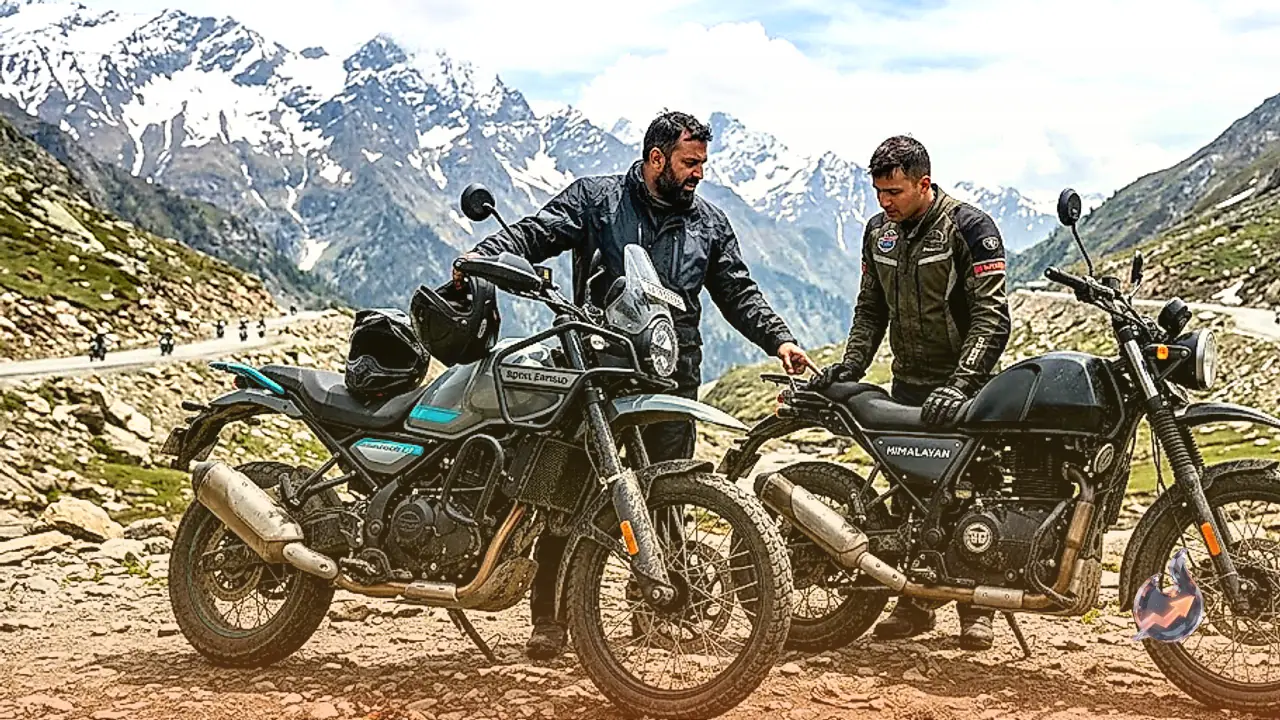

Royal Enfield has diversified its presence in the adventure touring market by offering two clearly differentiated machines for riders. The newly introduced Himalayan 440 enters the market with a starting ex-showroom tag of Rs 2.29 lakh. In contrast, the technologically advanced Himalayan 450 starts at an ex-showroom price of Rs 3.08 lakh for the base trim and extends up to approximately Rs 3.39 lakh for the top-spec variant. This leaves an entry price difference of around Rs 79,000 between the two options.
While both motorcycles carry the established Himalayan nameplate, they are separated by fundamental differences in powertrain architecture, chassis components, and digital instrumentation. The 440 focuses on delivering the straightforward, rugged, and budget-friendly adventure ethos reminiscent of the older 411. On the other side, the 450 is engineered from the ground up to offer cutting-edge mechanical hardware, significantly higher power output, and a more sophisticated long-distance riding package.
Design, Ergonomics, and Tank Capacities
Both models adopt typical adventure body styles, but their aesthetic approach is noticeably distinct. The 440 retains a rugged, simple visual profile closely aligned with traditional adventure builds. The 450 adopts a substantially bulkier, contemporary silhouette with modern panel work. For rough terrain capability, both bikes run a 21-inch spoke wheel at the front coupled with a 17-inch spoke wheel at the rear.
In terms of dimensions, the 440 features a fixed seat height measuring 800 mm alongside a 15-litre fuel capacity. The 450 caters to varied rider heights and touring needs by providing an adjustable saddle that moves between 805 mm and 845 mm, supported by a larger 17-litre fuel tank for extended riding range.
Powertrain Outputs and Gearbox Technology
The mechanical heart of each motorcycle marks the most substantial divergence. The Himalayan 440 relies on a 443cc air and oil-cooled single-cylinder engine delivering 25.4 bhp of power and 34 Nm of peak torque. Conversely, the Himalayan 450 is driven by a 452cc liquid-cooled Sherpa motor capable of generating 40.02 PS of maximum power and 40 Nm of torque.
Both motorcycles employ a 6-speed transmission, but the 450 incorporates an assist and slipper clutch as well as ride-by-wire electronic throttle management. This elevated output enables the 450 to pull ahead decisively on open highways and technical off-road trails, providing a refined and rapid throttle response. The 440, with its modest numbers, stands as a dependable, uncluttered, and economical machine built for daily commuting and light weekend trails.
Chassis, Braking Hardware, and Cockpit Electronics
Differences in suspension and braking components directly influence terrain handling. The 440 is equipped with standard telescopic front forks offering 200 mm of wheel travel paired with a 180 mm travel rear monoshock. The 450 upgrades to premium Showa USD front forks and a rear monoshock, providing a full 200 mm of travel at both ends for superior rough-road absorption. Stopping duties are handled by disc brakes featuring dual-channel switchable ABS on both bikes, with the 440 using a 300 mm front and 240 mm rear setup, while the 450 mounts larger 320 mm front and 270 mm rear discs.
The electronic setups reflect different generations of rider displays. The 440 carries a digital-analogue cluster accompanied by the dedicated Tripper navigation pod. Meanwhile, the 450 features a 4-inch circular TFT screen that supports full Google Maps navigation, smartphone integration, and selectable riding modes comprising Performance and Eco settings.