





















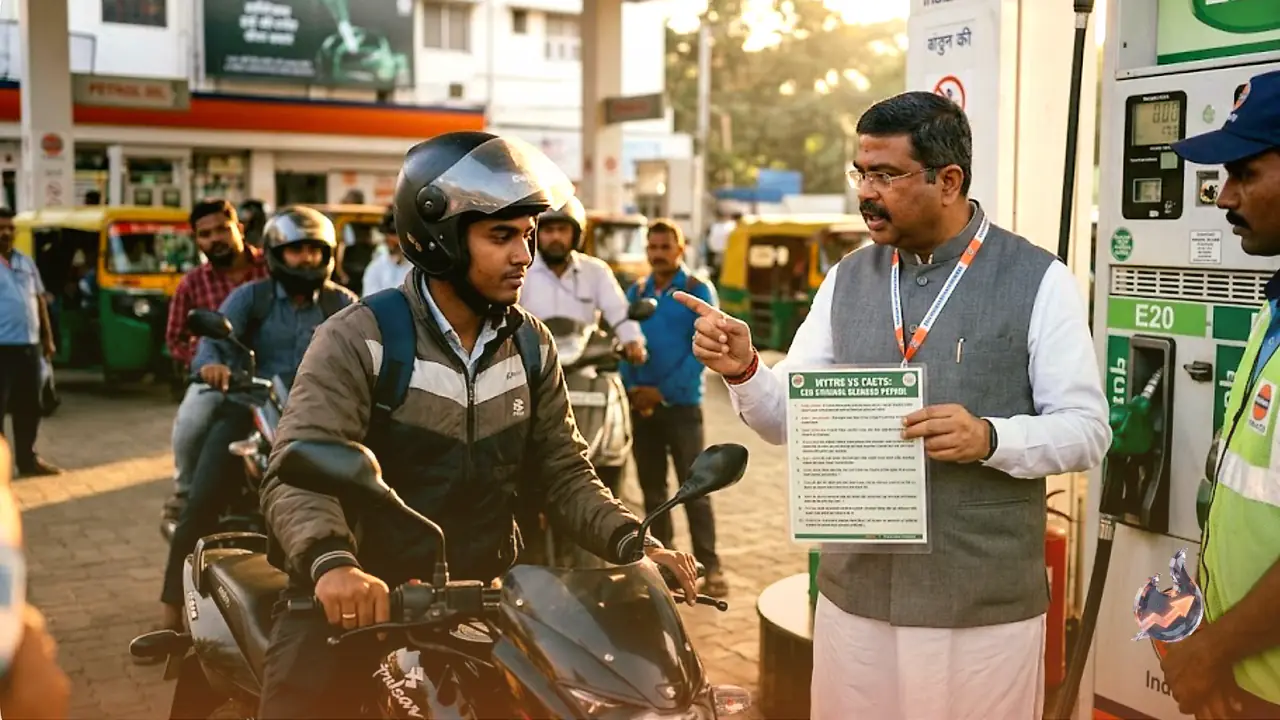

Amid a flood of conflicting claims on social media about India's E20 programme, the government stepped in on Friday to set the record straight. The Ministry of Petroleum and Natural Gas said the information going viral about petrol blended with 20 percent ethanol is completely misleading. Addressing the worries one by one across ten points, the ministry stressed that the entire programme is built on scientific study, global experience and regulatory safety measures. Under the scheme, up to 20 percent ethanol is blended into petrol.
How true is the water consumption claim
The most talked-about claim was that producing one litre of ethanol supposedly guzzles 10,000 litres of water. The ministry rejected this outright. According to the government, ethanol is made only from the surplus rice that is left over after the country's food security needs have been met. In reality, producing a litre of ethanol uses only around 3 to 5 litres of processed water, and that water is now recycled through a Zero Liquid Discharge system. The ministry also pointed out that maize has increasingly become the main raw material for ethanol. Maize cultivation needs far less water than paddy, which is why it is being actively encouraged.
Long trials on cars and two-wheelers
On the question of the effect on vehicles, the government laid out figures. The Automotive Research Association of India (ARAI) ran trials of about 40,000 kilometres on cars and 20,000 kilometres on two-wheelers. These tests found no major negative impact on vehicle performance or fuel efficiency. Only some change in mileage was observed.
Many countries already use it
The ministry reminded people that ethanol-blended fuel is nothing new. The United States, Brazil, Canada, Japan and several European countries have been using it for a long time. Claims about engine damage or voided warranties were also dismissed. According to the ministry, auto companies and insurance companies have already clarified that both the warranty and the insurance of vehicles built for E20 remain valid.
Rumours about ants, bees and engine harm
Another claim doing the rounds was that E20 fuel draws ants and bees towards vehicles. The ministry called this baseless too. The government further clarified that the discussion around the E20 programme in the Supreme Court concerned contractual matters, not any question over the scientific usefulness of the policy. On allegations of engine damage or rusting of vehicle parts, the government said ARAI carried out its study together with Indian Oil Corporation, the Indian Institute of Petroleum and the Society of Indian Automobile Manufacturers.
The fuel tank water and sugarcane juice claim
One more fear being spread was that E20 could let water get into a vehicle's fuel tank. The ministry rejected this as well. Similarly, a viral video claiming that sugarcane juice is mixed into petrol was dismissed as fabricated. The government made it clear that fuel ethanol is produced through industrial processes, not in that manner.