





















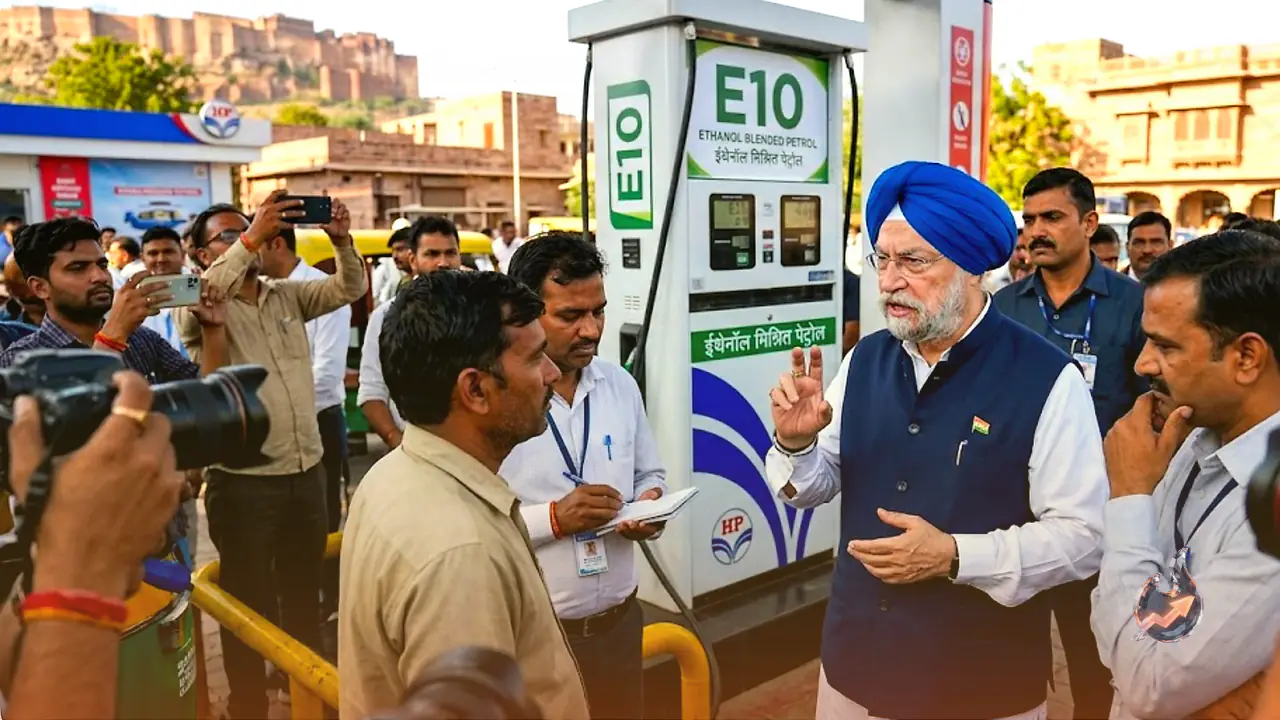

Union Petroleum and Natural Gas Minister Hardeep Singh Puri used a public event in Jodhpur, Rajasthan, to make an open case for the government's ethanol blending programme. He told the audience that anyone who spots a genuine flaw in the policy should say so without hesitation, promising that valid shortcomings would be fixed and good suggestions folded into the programme. Puri also used the platform to knock down rumours claiming that ethanol-blended petrol causes insects to breed inside vehicles and eventually makes engines fail. He stated plainly that no such incident has been reported in any vehicle so far. He added that ethanol blending itself is not a new idea, noting that several countries have been working on it for close to a century.
Welcoming the criticism
The minister said social media has been flooded with posts and videos questioning biofuel blending over the past few days. He said he welcomes this kind of scrutiny rather than viewing it negatively. According to him, if anyone believes there is a genuine gap in what the government is doing, they should raise it, and the government will listen carefully. Puri assured that reasonable suggestions from the public would be incorporated into future policy, with changes made wherever necessary. He framed the government's approach as one of transparency rather than avoidance of criticism.
Debunking the insect and engine-failure rumours
Puri went into detail on two specific rumours doing the rounds. The first claimed that using ethanol-blended petrol would cause insects to infest vehicles. The second claimed it would damage engines, stall vehicles, or stop fuel pumps from working. The minister said neither has actually happened so far, and stated firmly that no such problem is expected in the future either, calling the fear entirely unfounded.
A century-old idea, not a new experiment
Puri said that while ethanol blending might feel new to India, several parts of the world have been working on it for a long time. Scientists have researched it for years, he said, and the policy was only adopted after extensive large-scale trials. He stressed that the concept was not invented by his government, nor is it an Indian discovery, pointing out that work on it has been going on globally for roughly a century. He cited Ford Motor Company founder Henry Ford, noting that Ford ran cars in his time using biofuel, kerosene and fossil fuel. On India's own history, Puri said the first plan in this direction was drawn up during the Congress government. He recalled his time as India's ambassador to Brazil, particularly between 2006 and 2008, when Sharad Pawar was the country's Agriculture Minister. During that period, a target was set to achieve 5% biofuel blending combined across ten states and union territories, but the goal was not met and the figure stalled at just 1.4%.
Ethanol in racing cars, and the mileage question answered
At a press conference in Delhi on Friday, Puri also addressed concerns about a drop in fuel mileage. He said some people claim ethanol blending reduces mileage, but pointed out that it is now well established that ethanol-blended fuel is used in racing cars, where it improves acceleration and reduces knocking. He acknowledged that mileage can dip slightly but said this happens for multiple reasons, not ethanol alone. Puri said the decision was not taken by the government in isolation, but only after consulting all stakeholders, including SIAM and ARAI. He also addressed a rumour that insurance would no longer cover vehicles running on ethanol-blended petrol, saying insurance companies have already clarified that no such rule exists. He questioned who benefits from spreading such false claims, while making clear he was not levelling any direct accusation at anyone. Puri said India's fast-growing consumer market is large enough to accommodate multiple technologies side by side, including electric vehicles and biofuel-blended vehicles. He noted that the country currently stands at 20 percent ethanol blending, and any move from 20 percent to 25 percent would happen only after all the necessary tests are fully completed.